

Establishment of North Korean Defectors’ Day
Nam Bada
Secretary General of People for Successful Corean Reunification (PSCORE)
On July 14, 2024, South Korea designated the day as "North Korean Defectors' Day." This special day was established following a directive from President Yoon Suk-yeol during a Cabinet meeting on January 16, aiming to protect and warmly welcome North Korean defectors as fellow citizens. To implement this, the Ministry of the Interior and Safety issued a presidential decree on May 21, officially recognizing North Korean Defectors' Day as a national commemorative day.
July 14 was chosen to commemorate the enactment of the Act on the Protection and Settlement Support of North Korean Defectors, providing the legal basis for their status and support. The Ministry of Unification stated, "By establishing North Korean Defectors' Day as a national holiday, we aim to annually honor this day by embracing defectors, promoting their rights, and fostering cultural integration between South and North Korean residents to enhance unification awareness."
To celebrate the first North Korean Defectors' Day, various events were held both within South Korea and internationally. Here are some of the highlights.
The 1st North Korean Defectors’ Day Festival (July 14)
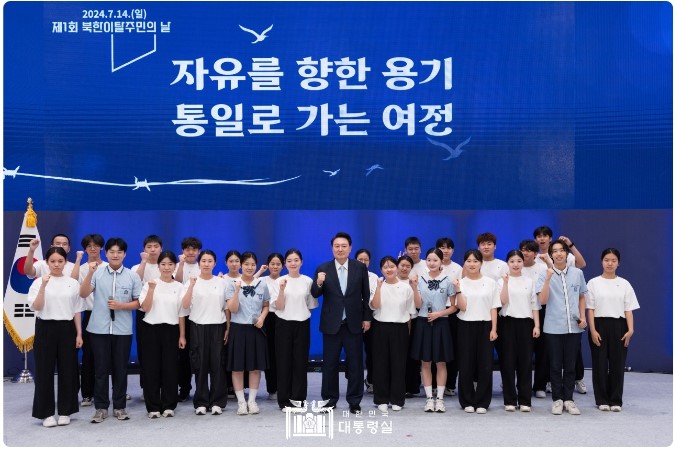
The first North Korean Defectors’ Day commemoration, now a national holiday, was held at the State Reception House Yeongbin-gwan. Over 200 attendees included defectors, support workers, government officials, and representatives from various organizations. Under the theme 'Courage Towards Freedom, Journey to Unification,' the event featured global congratulatory messages, awards, commemorative speeches, success stories from defectors, unification pledges, and performances.
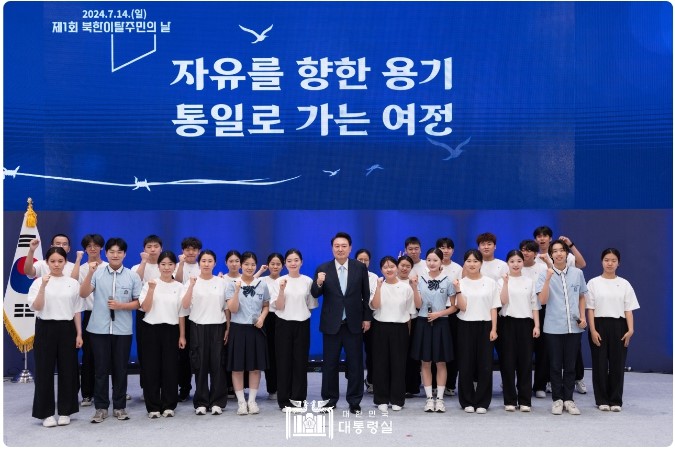
President Yoon Suk-yeol at the first 'North Korean Defectors Day' on July 14, posing with the defector youth choir.
/ Presidential Office
Video messages from around the world offered congratulations. Fred and Cindy Warmbier, parents of Otto Frederick Warmbier, said, "North Korean defectors are the strongest and bravest people in the world." Joachim Gauck, the first German president from East Germany, stressed, "Dictatorship cannot defeat freedom," and wished for the successful resettlement of North Korean defectors. Elizabeth Salmón, the UN Special Rapporteur on North Korean human rights, emphasized that establishing North Korean Defectors' Day as a national holiday is a significant step toward justice.
Awards and commendations were given to four individuals who have devoted their lives to supporting North Korean defectors. Additionally, a video essay titled 'Dreaming,' which narrated the journey of North Korean defectors striving to achieve their dreams in South Korea, was presented by Yoo Ji-tae, the Unification Ministry's ambassador for North Korean human rights promotion.
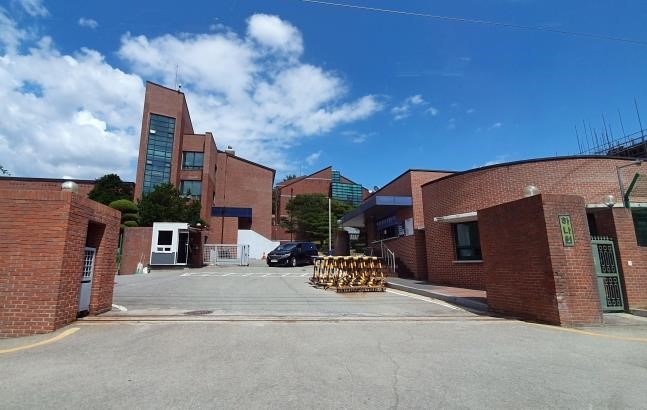
A view of Hanawon, a facility for education and settlement support for North Korean defectors located in Anseong, Gyeonggi-do
/Ministry of Unification
President Yoon Suk-yeol, in his speech, assured, "Our government will ensure that your pursuit of freedom is not in vain," and pledged, “We will never send back any North Korean compatriot who seeks refuge in South Korea.” His words were met with applause and cheers from many defectors. He also committed to "making every diplomatic effort to prevent forced repatriation of North Korean defectors abroad," which was followed by another round of applause. He concluded, "Under South Korea's Constitution, North Korean defectors are now citizens of the Republic of Korea. Protecting our citizens is the nation's most fundamental duty," bringing many defectors to tears.
North Korean Defectors’ Day Events (July 8 - 14)
The Korea Hana Foundation hosted a citizen participation event themed 'Together for a Unified Future' at the Dongdaemun Design Plaza on July 14. The event included calligraphy performances, magic shows, street dances, quiz shows, a fashion show, an exhibition of artworks by North Korean defectors, and performances by a North Korean defectors' art troupe. Additionally, over 30 booths offered activities to better understand North Korea and its defectors, such as North Korean food tasting and professional skill demonstrations by defectors.
Before this, from July 8 to July 14, the Seoul Metropolitan Government organized North Korean Defectors' Day week events at Seoul City Hall, Seoul Plaza, and various districts. Themed ‘Beyond Freedom, Towards Hope: Together as One’,' activities included the 'Seoul Forum on North Korean Human Rights 2024,' a North Korean human rights exhibition, and film screenings about North Korean human rights.
From July 8 to July 13, the Citizens' Hall in the basement of Seoul City Hall hosted a photo and video exhibition on North Korean human rights, screenings of the documentary 'Beyond Utopia' with cast meet-and-greets, and a talk concert titled 'Life in Seoul for Young North Korean Defectors.' At Seoul Plaza, films on North Korean human rights were shown on July 12 and 13, including 'Crossing,' depicting families separated during escapes, and ‘Ayla: The Daughter of War’, set during the Korean War highlighting the bond and separation between father and daughter. Before the screenings, there were cultural activities and tastings of North Korean food like Sikhye (sweet rice drink) and Corn Cake.
Seoul hosted the first 'Seoul Forum on North Korean Human Rights 2024' among local governments at 2 p.m. on July 11 in the multi-purpose hall of Seoul City Hall. The forum's themes were 'The Reality of North Korean Human Rights and International Cooperation Measures' and 'Journey to Freedom, Accompanying North Korean Defectors,' focusing on the future direction of human rights and support strategies for defectors. This forum commemorated the 10th anniversary of the UN Commission of Inquiry on Human Rights in North Korea (COI) report and the establishment of North Korean Defectors' Day.
The forum was attended by domestic and international experts, including Lee Shin-wha, South Korea's Ambassador for International Cooperation on North Korean Human Rights; Julie Turner, the U.S. Special Envoy for North Korean Human Rights Issues; Elizabeth Salmon, UN Special Rapporteur on North Korean Human Rights; James Heenan, Representative of the UN Human Rights Office in Seoul; and Brian Reynolds Myers, a professor at Dongseo University, adding significance to the event.
The Peaceful Unification Advisory Council’s Events
To honor the first North Korean Defectors' Day, the Peaceful Unification Advisory Council organized events nationwide through its regional councils and associations. Key activities included meetings with defectors, concerts, and unification-themed music events. Additionally, regional councils hosted events like Jeonnam's 'Unification Camp with North Korean Defectors,' Ulsan Namgu's 'Sailing to the Sea of Freedom: Cultural Tours on North Korean Defectors' Day' and Ansan City Council's '1st North Korean Defectors' Day Commemorative Festival.'
North Korea Freedom Week in the U.S. (July 7 - 12)
The annual North Korea Freedom Week, focused on advocating for the human rights and dignity of North Korean people, was held from July 7 to 12 in Washington, D.C. Now in its 21st year, the event was led by Suzanne Scholte, the chairman for the North Korea Freedom Coalition. A 15-member delegation, including leaders of North Korean human rights organizations and witnesses to abuses, had a packed schedule. Scholte emphasized issues like China's forced repatriation of defectors and the North Korean people’s right to know. The delegation visited the U.S. Department of State's Bureau of Democracy, Human Rights, and Labor, as well as the U.S. Congress. They also held rallies at the Korean War Veterans Memorial in Arlington National Cemetery and in front of the U.S. Capitol.
U.S. Department of State Press Release
The U.S. Department of State expressed support for North Korea Freedom Week, highlighting the key role North Korean defectors play in promoting human rights. In a press release, the Department acknowledged the resilience and bravery of escapees and human rights advocates, as well as the ongoing suffering under the North Korean regime. This year’s North Korea Freedom Week concludes with South Korea’s North Korean Defectors' Day on July 14. Recognizing the critical role defectors play in advancing human rights, the United States reaffirms its commitment to a survivor-centered approach and amplifying defectors’ voices.
In Commemoration of North Korean Defectors’ Day
North Korean defectors are often regarded as the 'first wave of unification' or 'testbeds for unification,' but their feelings and challenges in adapting to life in South Korea have not received much attention. These defectors arrive after risking their lives on perilous journeys and, without time to heal from their numerous traumas, continue to struggle to adapt and compete in South Korean society. It is hard to grasp their pain without truly listening to their stories, and it is not easy for South Koreans to fully understand their experiences.
During the North Korean Defectors’ Day ceremony, defectors were moved to tears by affirmations that they are protected citizens of South Korea. It is essential to understand the hardships they faced due to a lack of protection from their homeland and the immense effort required to adapt to a new country.
I'm delighted to celebrate North Korean Defectors’ Day, honoring their new lives and hoping that all North Korean residents can fully enjoy universal human rights. Furthermore, I hope that future discussions on unification will prioritize improving human rights for North Korean residents and supporting the settlement of North Korean defectors as essential values.