

The Untold Story Behind Operation Chromite

Shin Jongtae
Former Professor of Military Science at Chosun University
Operation Chromite marked a turning point in the Korean War, halting the North Korean advance and reversing the war's momentum in favor of the UN forces. On September 15, 1950, under General Douglas MacArthur, South Korean and UN troops launched a surprise amphibious assault on Incheon, then under North Korean control. This operation is as significant as World War II’s Battle of Midway and the Normandy landings. In North Korea, however, it is rarely acknowledged and instead misrepresented as the "Battle of Wolmido," distorting the broader conflict in the Incheon area.
▶Who Conceived Operation Chromite?
On June 29, 1950, General Douglas MacArthur, Commander of the Far East Command, visited the Han River defense line to assess the situation. The sight across the river was one of devastation, with Seoul engulfed in black smoke. South Korean troops were exhausted, and panicked civilians were fleeing southward. The South Korean army lacked the supplies and military structure necessary to mount a defense. With the destruction of the Han River bridge, heavy equipment losses made it impossible for South Korean forces to fend off the North Korean onslaught. After departing from Suwon Airfield, MacArthur’s plane flew along the Han River and turned toward Incheon.
MacArthur then ordered his Chief of Staff, Edward Almond, to explore the possibility of an amphibious landing that would strike at the core of North Korean supply lines. His plan also involved deploying divisions stationed in Japan, including the 1st Cavalry Division and the 7th, 24th, and 25th Divisions. Initially, the 24th Division would be sent to the Korean Peninsula via Busan, while the 1st Cavalry would be used as the main landing force. On July 22, MacArthur devised a plan called Operation Blue Hearts, aimed at halting the North Korean advance at Incheon. However, the rapid progression of North Korean forces forced him to adjust, sending the 1st Cavalry and 25th Divisions to defend the Nakdong River instead. Although the original landing plan was scrapped on July 20, the defense of Nakdong River allowed MacArthur to revive and refine the plan, which eventually became Operation Chromite.
▶ Overcoming Resistance to the Operation through a Powerful Speech
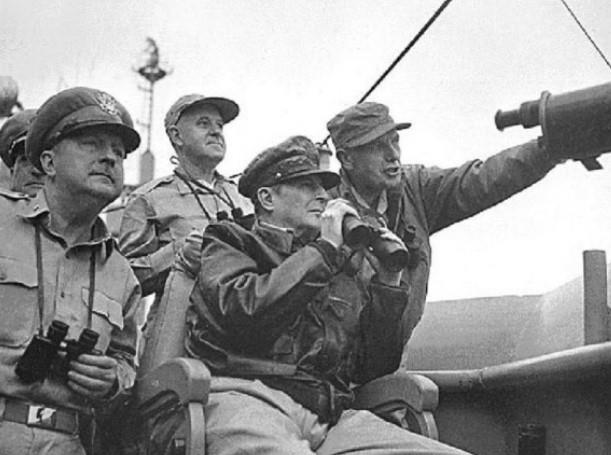
General Douglas MacArthur Commanding Operation Chromite on September 15, 1950 / Doosan Encyclopedia
When MacArthur's amphibious landing plan was presented to the U.S. Joint Chiefs of Staff, it faced significant opposition. The military leaders raised several concerns: “First, the tidal difference at Incheon is extreme, reaching up to 9 meters, leaving ships vulnerable at low tide. Second, the distance between Incheon and the Nakdong River defense line could expose our forces to piecemeal defeat. Third, there is a shortage of landing craft. Fourth, diverting troops for this operation would weaken the defense of the Nakdong River.”
Lastly, they warned that deploying the 7th Division could leave Japan vulnerable to Soviet invasion. Despite the opposition, MacArthur stood firm. He countered these arguments by saying: “The main North Korean forces are tied up at Nakdong River, and they are not prepared for a defense in Incheon. Their commanders would never expect us to launch such a daring amphibious operation. Surprise is the key to victory. While I acknowledge the challenges posed by the tides and terrain, they are not impossible to overcome. If the operation fails, I will immediately withdraw the landing forces, and the only damage will be to my personal reputation. But Operation Chromite will not fail—it will succeed.” His speech convinced the skeptics, and despite its low odds of success, Operation Chromite dramatically altered the course of the war, saving South Korea from the brink of destruction.
▶ How Did the UN Forces Deceive the North Koreans?
To further confuse the North Korean army, a series of diversionary tactics were employed. Bombings and small landings were carried out in various locations, including Samcheok, Gunsan, and parts of North Korea like Malyang-do and Nampo. On September 13, major coastal bombardments targeted Incheon, Gunsan, Samcheok, and Malyang-do. The U.S. Navy and Air Force had already begun heavy bombardments in Incheon, including Wolmido, starting from September 10. A joint U.S.-British force made a surprise landing at Gunsan on September 12 but withdrew after intentionally exposing their presence to the North Koreans. In addition, a public statement from U.S. 8th Army Commander General Walker on September 13 indicated that a major counteroffensive would occur in mid-October, causing Kim Il-sung to commit his reserves to the Nakdong River front. The North Koreans, unable to match the strategic expertise of the U.S. military, were completely outmaneuvered.
▶ The Hidden Intelligence Operations
For Operation Chromite, vital intelligence had to be gathered, including enemy troop locations, mines, and tidal heights. On September 1, 1950, U.S. Navy intelligence officer Captain Mark Clark and three others landed on Yeongheungdo, an island 25 kilometers from Incheon, where a 17-member South Korean intelligence team led by Lieutenant Ham Myeong-su was already operating. The crucial information they risked their lives to collect was quickly relayed to Douglas MacArthur.
South Korean operatives in Incheon, disguised as road workers, even inspected enemy supply trucks. However, on September 14, hundreds of North Korean troops launched a surprise attack on Yeongheungdo. Despite being heavily outnumbered, eight South Korean sailors and six members of the Agency of the Korean Youth fought to the death.
Clark and five others, who had already left the island, were tasked with securing the Palmi-do Lighthouse in Incheon Harbor. Built in 1903, it was the first lighthouse on the Korean Peninsula and essential for guiding the UN ships. On the night of September 14, Clark's team covertly landed on Palmi-do, defeating the North Korean forces there. However, the lighthouse couldn't be lit due to a missing metal pipe connecting the fuel tank to the lamp. After hours of searching, they miraculously found the part. By 2:40 AM on September 15, the lighthouse was finally lit, allowing 261 UN ships off Incheon Harbor to advance toward the landing site using its beam as a guide.
▶ How Should We Remember This War History?
The site of the 1944 Landings of Normandy has been carefully preserved, with films, books, and commemorations ensuring its place in history. Each year, heads of state and citizens from participating countries gather to mark the anniversary of the operation, using the event to promote patriotism and national pride. South Korea has recently begun expanding commemorations of Operation Chromite, but the rapid urbanization of Incheon has erased many of the war's physical remnants. Still, efforts should be made to preserve the memory of this operation through the construction of memorials, securing UN military records, and inviting dignitaries from the nations that took part in the operation.