

Ishiba Shigeru, Japan’s New Prime Minister:
Moderate on Historical Issues, Tough on Security

Yoo Min-young
Ph.D. in Political Science,
Survey Research Center, Academy of East Asian Studies, Sungkyunkwan University
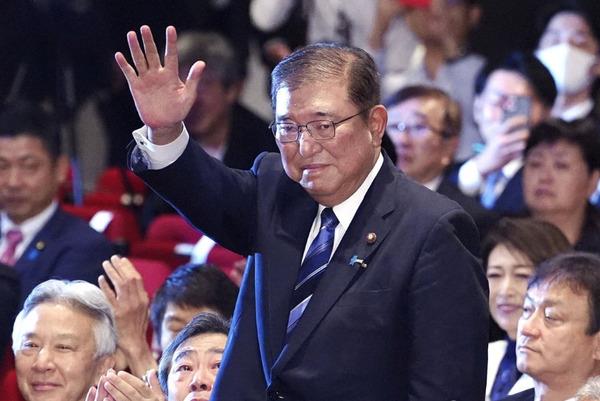
On September 27, Ishiba Shigeru, the former Secretary-General of the Liberal Democratic Party (LDP), was elected as its new leader. He is set to take office as Japan’s Prime Minister in a special parliamentary session on October 1. Known for being a reformist outsider in the LDP, Ishiba finally secured the party’s top position and the premiership on his fifth attempt. Other strong candidates in this race included Economic Security Minister Takaichi Sanae and former Environment Minister Koizumi Shinjiro. Ishiba is generally viewed as holding a moderate stance on Japan-South Korea relations but maintains a more hardline approach when it comes to national security.
The LDP leadership election involves both party lawmakers and members voting. If no candidate wins a majority in the first round, a runoff is held between the top two contenders. In this case, the runoff was between Takaichi Sanae and Ishiba Shigeru. Although Takaichi led in the first round, Ishiba managed to turn the tables in the runoff. In the first round, Takaichi secured 72 votes compared to Ishiba’s 46 among lawmakers, but in the final tally, Ishiba won 189 votes to Takaichi’s 173. This shift is interpreted as a response to concerns among LDP lawmakers about Takaichi’s strong conservative stance, prompting them to support the more moderate Ishiba in the runoff.
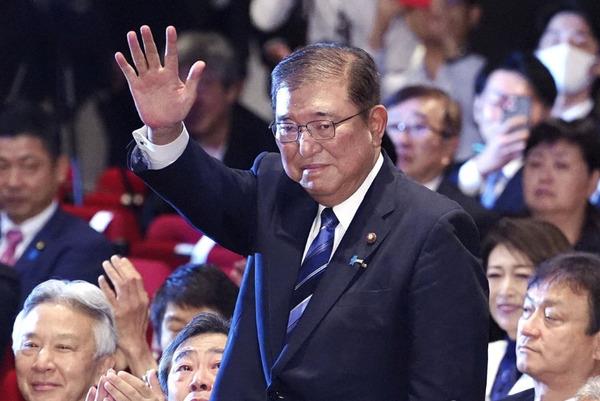
Ishiba Shigeru, former Secretary-General of the Liberal Democratic Party, waves to supporters after winning
the LDP leadership election on September 27. / Yonhap News
Ishiba Shigeru is often described as moderate, particularly with his views on historical issues. In 2019, during the rising tensions between Japan and South Korea over the termination of the General Security of Military Information Agreement (GSOMIA), Ishiba wrote on his blog that Japan’s failure to fully address its wartime responsibilities was the root of many problems. He expressed hope for a return to the cooperative relations seen during the Obuchi Keizo-Kim Dae-jung era. He has also criticized Japanese politicians’ visits to the Yasukuni Shrine and advocated for removing Class-A war criminals from the shrine, reflecting his progressive views on historical issues.
Considering Ishiba Shigeru’s views on Japan-South Korea relations, it is expected that he will maintain a relatively moderate stance on the issue. Given that President Yoon Suk-yeol and Prime Minister Kishida Fumio have held 12 summits, with Kishida’s administration taking a conciliatory approach, there seems to be little reason for a drastic shift in policy.
The power dynamics within the LDP also point in this direction. While Ishiba’s main competitor in the leadership race, Takaichi Sanae, received support from the factions of former Prime Ministers Aso Taro and Abe Shinzo, Ishiba had the backing of Kishida Fumio’s faction. Kishida's efforts to improve Japan-South Korea relations are seen as one of his major accomplishments, making it unlikely that Ishiba, who benefited from Kishida’s support, will pursue policies that could disrupt this progress. In his speech after the LDP leadership vote, Ishiba praised Kishida, saying, “I deeply respect the significant achievements made in both domestic and foreign affairs over the past three years.”
Despite his moderate reputation, Ishiba holds conservative views on security. With experience as Director General of the Japan Defense Agency and Minister of Defense, he supports constitutional revisions to officially recognize Japan’s Self-Defense Forces and has advocated for transforming them into a national defense force. He has also proposed "nuclear sharing" with the U.S. and, in a recent article for the Hudson Institute, emphasized the need for greater equality between the Japan-U.S. alliance, similar to the U.S.-U.K. relationship.
On North Korea, Ishiba has pledged to establish liaison offices in Tokyo and Pyongyang to address the issue of Japanese citizens abducted by North Korea. This proactive stance demonstrates his willingness to engage in dialogue, despite uncertainties surrounding the feasibility of this proposal.
Though Ishiba is generally viewed as moderate, he remains aligned with the LDP’s basic conservative policies. For instance, he has criticized South Korea’s Supreme Court ruling on compensation for forced labor, calling it a violation of international law, and has maintained Japan’s claim over the Dokdo (Takeshima) islands. Thus, while he may bring a softer tone to bilateral relations, the potential for conflict between Japan and South Korea under his leadership remains.
Ishiba is expected to dissolve the House of Representatives and call for a general election later this year, which will be his first major test as Prime Minister. He will need to navigate party factions and secure victory over the opposition. Following last year’s political funding scandal, many of the long-standing LDP factions have disbanded, and public trust in the party has declined. Ishiba faces the challenge of leading the party through this period of crisis. With the election of former Prime Minister Yoshihiko Noda as the new leader of the Constitutional Democratic Party, Ishiba’s moderate stance is seen as a strategic move to prevent the opposition from gaining centrist support. In this domestic political climate, there is anticipation that Ishiba and the LDP will continue on a moderate path to win over the public.
-
PREV [Column]
-
NEXT [Defectors' Podium]