

Kim Jong-un's Focus on 'People-First Politics' Stems from
Rising Public Discontent
Kang Dongwan
Professor at Dong-A University
Creator of the YouTube Channel 'Kangdongwan TV
The central theme of the recent expanded Plenary Meeting was unmistakably “People-First Politics.” Reviewing 2024’s initiatives, Kim Jong-un proudly declared, “Our Party’s People-First Politics has achieved another unprecedented milestone,” highlighting significant progress across politics, the economy, culture, defense, and diplomacy as transformative achievements.
A key highlight was the flood recovery efforts, which Kim prioritized over self-reliant defense advancements. He emphasized relocating flood victims to Pyongyang with stable living conditions and ensuring students’ education continued uninterrupted, framing these actions as proof of the regime’s commitment to education as a top state priority.
The emphasis on flood recovery highlights its broader significance beyond economic concerns, touching on socio-cultural efforts to address public sentiment. However, the Plenary Meeting’s review of the socio-cultural sector in 2024 primarily focused on science and sports. In science, Kim emphasized progress in tackling technical challenges to boost productivity in key industries and improve livelihoods.
In sports, North Korea celebrated its women’s football victories at the Asian Cup and World Cup, as well as its dominance in international competitions across weightlifting, table tennis, boxing, and taekwondo, securing “Asian and global supremacy.”
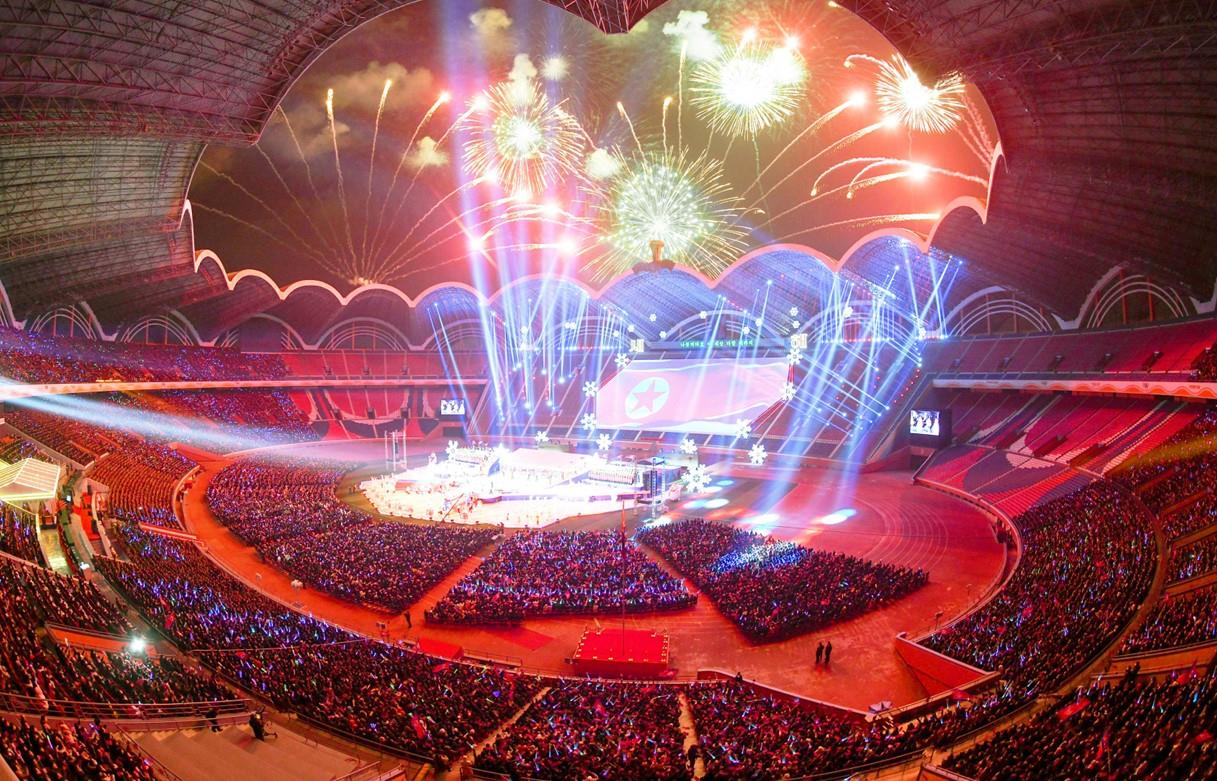
North Korea's New Year's celebration on the 1st/North Korea Central News Agency
Looking ahead to socio-cultural objectives for 2025, the meeting highlighted the need to strengthen the role of the scientific and cultural sectors. It instructed the scientific community to support the final push toward achieving the goals set by the 8th Party Congress.
In 2025, the healthcare sector will prioritize improving medical services, preventive care, and epidemic response systems. Meanwhile, the literature, arts, and media sectors aim to create impactful works, boost propaganda, and secure more sports victories.
North Korea has also designated 2025 as a pivotal year, marking the 80th anniversary of WPK and the conclusion of the 8th Central Committee’s activities. Large-scale cultural events, including a grand performance to celebrate the anniversary, are expected to bolster regime solidarity.
While the government may highlight improving livelihoods through People-First Politics, the main focus is likely to be public mobilization for commemorative events. The focus on sports achievements aligns with the regime’s strategy to build loyalty through patriotism.
Another key point in the socio-cultural agenda is the focus on “labor organizations as dynamic forces for next year’s efforts.” Kim specifically called for the Socialist Patriotic Youth League to prepare its members as the revolution’s true successors.
The regime’s persistent emphasis on People-First Politics reflects concerns about rising public dissatisfaction, especially among the “jangmadang (market) generation.” This growing ideological disengagement has led to intensified efforts to control external information and strengthen the role of labor organizations.
Despite the 20x10 Regional Development Policy's efforts to address food and necessity shortages through local factories, results have fallen short. For example, during the 2024 inauguration, the facilities were in poor condition. Factories in Songchon County, which Kim personally attended, required manual processes for sealing soy paste and chili paste containers, while bread production involved small-scale hand-kneading. Such underwhelming outcomes highlight the limitations of these initiatives, despite heavy promotion.
As 2025 unfolds, dissatisfaction and resistance are likely to grow, exacerbated by the public’s exhaustion from mass mobilization efforts and the failures of regional development policies.