

The 'Mercenaries':
Comparing South Korea's Troop Dispatch to Vietnam and North Korea's Deployment to Russia

Shin Jongtae
Former Professor of Military Science at Chosun University
In October 2024, North Korea deployed more than 10,000 troops to aid Russia in its war in Ukraine.
Analysts estimate that the Kim Jong-un regime could earn between $320 million and $1.34 billion annually from this deployment. Some have compared it to South Korea's troop dispatch to Vietnam in the 1960s, calling both acts of "mercenaries." But is this comparison valid?
Forces Defending Freedom vs. Forces Supporting Aggression
South Korea’s participation in the Vietnam War reflected its commitment to supporting allied nations. In 1950, during the Korean War, the nation’s survival depended on the intervention of 16 UN member states, including the United States. Likewise, the Vietnam War in the 1960s was closely tied to South Korea’s security, making the deployment a carefully considered decision for national preservation.

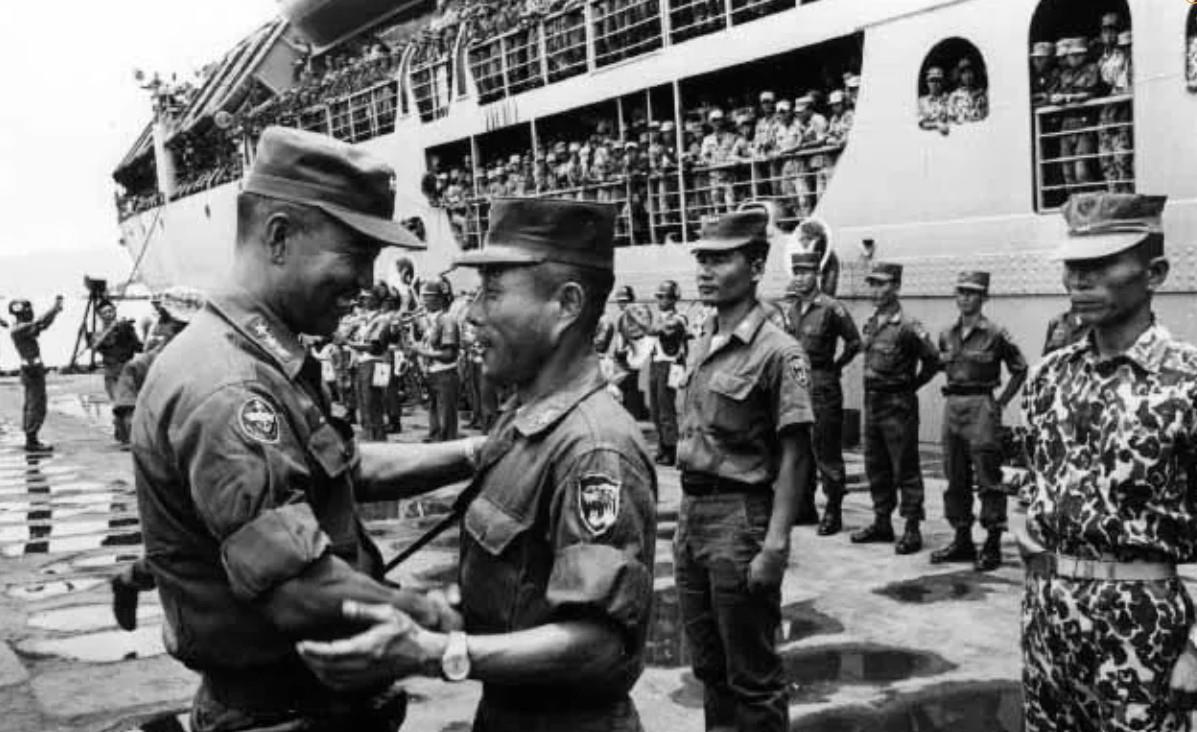
South Korean forces leaving for Vietnam in 1965/Wikipedia
The key difference is this: South Korean forces in Vietnam operated with a clear mission—to assist allied nations in safeguarding freedom—while maintaining independent command over their operations, distinguishing them from mercenaries. In contrast, North Korea’s involvement in Ukraine lacks valid justification. Although North Korea might cite historical ties with the Soviet Union, modern Russia, reestablished in 1991, is a completely different political entity.
Drawing comparisons between North Korea’s troop deployment to Russia and South Korea’s mission in Vietnam is misguided. Russia’s invasion of Ukraine breaches the UN Charter, rendering the war illegal. North Korea’s support for Russia similarly violates international law, irrespective of any agreements between the two nations.

North Korean soldiers sent to Russia in October last year receive Russian uniforms to disguise their identity/SPRAVDI
Openly Honorable Deployment vs. Secretive Dispatch
In September 1964, South Korea began its involvement in Vietnam by dispatching medical personnel and taekwondo instructors. Over the course of the war, more than 324,864 South Korean troops served. The deployment was broadly supported at home, with many seeing it as a noble effort in the defense of freedom.
In stark contrast, North Korea has kept its troop deployment to Russia a closely guarded secret. Families of the dispatched soldiers were forced to sign confidentiality agreements, and the government has not officially acknowledged the deployment. North Korea’s Ministry of State Security actively suppresses news of the dispatch, going as far as punishing citizens who share related information. If North Korea’s deployment to Russia is legitimate, why does the regime conceal it from its citizens?
Reports indicate that, to suppress potential criticism of Kim Jong-un, the families of deployed soldiers have been relocated to isolated areas resembling political prison camps.
Independent Command vs. Subordinate Obedience
During the Vietnam War, South Korean troops maintained independent command, with General Chae Myung-shin securing autonomy through negotiations with U.S. General William Westmoreland. This allowed South Korean forces to minimize casualties while enhancing tactical effectiveness.
International law mandates that deployed forces declare their mission, wear national uniforms, and operate under their own flag. However, North Korean troops in Ukraine are under Russian command, wearing Russian uniforms without North Korean insignias, and some have reportedly been issued fake Russian IDs.
Even more concerning, North Korea denies the existence of these soldiers, abandoning them both in practice and principle. As Kim Sung-hoon, counselor at South Korea’s UN mission, stated, “These soldiers have been disowned by the very government that sent them to die. They are already forgotten and discarded.”
Exploitation and Economic Gains
South Korea undeniably benefited economically from its involvement in the Vietnam War. From 1966 to 1970, remittances from soldiers and civilian workers generated $625 million, contributing to the nation’s rapid economic growth of 12% annually.
In contrast, the majority of wages earned by North Korean soldiers from their deployment will likely be confiscated by the regime.
In the Kaesong Industrial Complex, 90% of wages earned by North Korean workers historically went to WPK, leaving only 10% for the workers in North Korean currency.
The estimated monthly wage for a North Korean soldier abroad is $2,000 (2.9 million KRW), a stark contrast to North Korea's 2024 per capita GNI of 132,400 KRW (about $100) per month.
These wages are unlikely to reach the soldiers, as North Korean workers abroad typically retain only 10% of their earnings, with the rest sent to WPK as loyalty funds. Experts believe the wages of North Korean soldiers in Russia will primarily strengthen Kim Jong-un’s regime.
Merely a Means to Generate Foreign Currency
North Korean troops in Russia operate under Russian command, with Ukraine recognizing them as combatants serving Russia. Captured North Korean soldiers are treated humanely by Ukraine. However, the over 10,000 troops sent to the Ukraine war serve merely as a means for Kim Jong-un to generate foreign currency.
The circumstances of South Korea’s deployment to Vietnam and North Korea’s dispatch to Russia differ fundamentally in every way. The plight of young North Korean soldiers, sent to a distant battlefield as pawns in Kim Jong-un’s schemes for hard currency, is deeply tragic.
-
PREV [Opinion]
-
NEXT [Analysis of issues]