

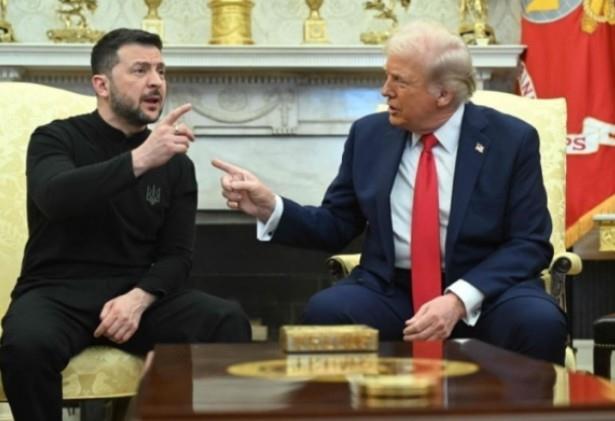
Donald Trump and Volodymyr Zelenskyy:
Implications of Their Negotiations for the Korean Peninsula

Oh Gyeong-seob
Senior Research Fellow, Korea Institute for National Unification (KINU)
U.S. Efforts to End the Ukraine War
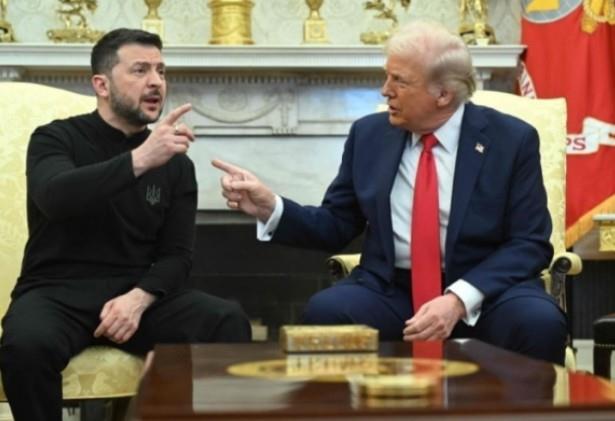
As promised during the election, the Trump administration has begun efforts to end the Ukraine war. On March 11, the U.S. and Ukraine announced a 30-day ceasefire at a high-level summit in Jeddah, Saudi Arabia—just 12 days after Trump and Zelenskyy's February 28 meeting collapsed over mineral agreements and security commitments.
In the statement, both countries committed to a 30-day ceasefire and a comprehensive mineral development agreement. The U.S. also announced the immediate resumption of intelligence sharing and security aid to Ukraine. Both sides appointed negotiation teams and agreed to start talks on long-term security. The U.S. also planned to discuss these proposals with Russian representatives.
President Trump urged Russia to respond, saying, “Now the ball is in Russia’s court.” Secretary of State Marco Rubio echoed this, stating, “If they say no, we will see who is blocking peace.” However, Russia remained hesitant about the 30-day ceasefire.
Kremlin spokesperson Dmitry Peskov stated on March 12, “We need to hear the U.S.'s detailed explanation of the ceasefire proposal.” President Putin took a harder stance. That afternoon, while visiting a Russian military command post in Kursk, he ordered his forces to "eliminate the enemy as quickly as possible and fully liberate the Kursk region." He effectively rejected the ceasefire, demanding that Ukraine cede the region to Russia as a precondition. Despite this, the U.S. remains committed to further negotiations.
U.S.-Russia Ceasefire Negotiations, Excluding Ukraine
Ending the Ukraine war will be difficult due to the stark differences in strategic interests between Russia and Ukraine. Russia wants Ukraine within its sphere of influence and demands recognition of occupied territories like Donetsk, Luhansk, Kherson, and Zaporizhzhia as Russian land. It also insists on Ukraine’s demilitarization and withdrawal from NATO. In contrast, Ukraine seeks to reclaim all lost territories, including Crimea, and demands Russian troop withdrawals and security guarantees. These opposing goals make negotiations challenging.
The Trump administration takes a different approach to ending the war compared to Biden’s. The Biden administration, citing NATO’s collective defense and the Budapest Memorandum, deemed Russia’s invasion illegal and provided military aid to Ukraine. In a UN speech on September 24, 2024, President Biden stressed, “Will we keep supporting Ukraine so it can win and defend its freedom, or will we turn away from aggression? We must not tire or look away—we will support Ukraine until peace is secured.”
The Trump administration views the war differently. Trump claims Ukraine’s NATO ambitions sparked the conflict, aligning with Russia’s justification. His administration faces criticism for sidelining Ukraine and its European allies, raising concerns of pro-Russia bias. Ukraine and the EU strongly oppose his Russia-focused diplomacy.
U.S. security expert Peter Baker reported in The New York Times International on February 20 that U.S. and Russian diplomats drafted three key principles to end the war: recognizing Russian control over occupied Ukrainian territories, ensuring Ukraine’s security through U.S.-EU cooperation, and lifting U.S. sanctions on Russia. He criticized the deal as violating the Budapest Memorandum, favoring Russia while ignoring Ukraine’s stance.
After the summit with Zelenskyy fell apart, the Trump administration intensified pressure on Ukraine. Trump ordered a complete halt to intelligence sharing and military aid. U.S. diplomatic and security officials even suggested that Zelenskyy should step down and consider territorial concessions.
National Security Advisor Michael Waltz hinted in a March 2 CNN interview that Zelenskyy’s resignation could facilitate U.S.-Ukraine negotiations. Treasury Secretary Scott Bessent also stated that without a peace agreement, an economic deal would be impossible. He emphasized that Ukraine’s leadership must actively seek an economic agreement.
Zelenskyy expressed regret over the failed summit but ultimately accepted U.S. demands. However, Ukraine was unable to fully reflect its concerns in the joint U.S.-Ukraine statement. It failed to secure European participation in the peace process and remained dissatisfied with the lack of U.S. security commitments, even as a mineral agreement was signed.
The joint statement lacked specific U.S. security assurances for Ukraine. As Russia hesitated to accept the 30-day ceasefire, concerns grew over a potential U.S.-Russia deal forcing Ukraine into unilateral concessions. Trump remains opposed to Ukraine joining NATO and sees little chance of it reclaiming pre-2014 territories.
Implications for the Korean Peninsula
The Trump administration’s approach to the Ukraine war offers key implications for the Korean Peninsula, particularly regarding North Korea’s nuclear issue. On March 13, Trump met with NATO Secretary-General Mark Rutte and was asked whether he planned to rebuild relations with Kim Jong-un as he did in his first term. He replied, “I would.” He also referred to North Korea as a “nuclear power,” mentioning it alongside India and Pakistan. Some experts worry that Trump may focus more on a "small deal" rather than full denuclearization.
Victor Cha, Korea Chair at the Center for Strategic and International Studies (CSIS), argued that Trump’s remarks signaled a shift toward negotiations focused on threat reduction rather than denuclearization. By likening North Korea to India and Pakistan, Trump may have implicitly acknowledged it as a de facto nuclear state, suggesting he no longer sees complete denuclearization as a realistic goal.
A potential U.S.-North Korea deal could have North Korea dismantle its Yongbyon nuclear facility, halt ICBM tests, and suspend nuclear experiments, while the U.S. scales back joint drills, reduces strategic deployments, suspends the NCG, and considers downsizing its forces in Korea.
However, recent statements from Trump administration officials suggest that abandoning North Korean denuclearization is unlikely. The White House reaffirmed that, just like in his first term, President Trump remains committed to achieving North Korea’s complete denuclearization.
The Trump administration has reaffirmed its commitment to North Korea’s denuclearization. On February 15, at the Munich Security Conference, U.S. and South Korean foreign ministers pledged to coordinate closely on North Korea policy, emphasizing complete denuclearization. They also expressed concern over Russia-North Korea military ties and vowed to monitor the situation.
The foreign ministers of South Korea, the U.S., and Japan also reaffirmed their strong commitment to North Korea’s denuclearization and pledged to strengthen sanctions further. They agreed to firmly respond to North Korea’s sanctions violations and evasions while maintaining strong pressure. They also made it clear that any threats or provocations from North Korea would not be tolerated.
The possibility of the Trump administration bypassing South Korea in North Korea negotiations is low. However, a situation similar to Ukraine’s exclusion from talks cannot be entirely ruled out. To prevent this, the South Korean government must strengthen its alliance with the U.S. and enhance trilateral security cooperation with the U.S. and Japan.
The South Korea-U.S. alliance must collaborate closely on global security threats. Diverging priorities would make it harder to uphold alliance commitments. South Korea, the U.S., and Japan share the goal of countering China’s threats and denuclearizing North Korea. To achieve this, South Korea should strengthen trilateral cooperation and frame North Korea’s nuclear program as a shared security concern.
-
PREV [Analysis and suggestion]
-
NEXT [Opinion]