

Parents' Day: I Dream of Freedom
— My Confession from a Life of Bondage in North Korea
Kim Hyo-joo,
North Korean Defector
When May arrives, I find myself staring blankly at the sky, lost in thought.
In South Korea, Parents' Day is a heartfelt time to honor parents with carnations and kind words. But to me, the tradition feels distant.
My memories of "Parents' Day" are filled not with love, but with hunger, hardship, and an unrelenting struggle to survive.
I was raised in North Korea, a country that doesn’t celebrate Parents' Day, but rather enforces “Mother’s Day”, a day used to demand sacrifice from women.
There, Mother’s Day has nothing to do with gratitude or celebration.
Instead, it's a time when the state reminds women of their duty to bear children, labor without rest, and dedicate themselves to their households — not out of love, but obligation.

A mother in North Korea is not seen as someone to cherish, but as a tool, expected to serve the system without question.
I’ll never forget the fall of 2020 in the remote mountain village of Sinbok, Pochon County, the place where I spent my mother’s final moments.
One day, while working in the fields, I heard she'd collapsed. I rushed to the farm shelter and found her unconscious, her forehead split open after hitting a rock.
Without time to cry, I carried her on my back down a steep mountain path. After walking for three dusty hours, we finally arrived at the hospital. She regained consciousness but was too weak to stand.
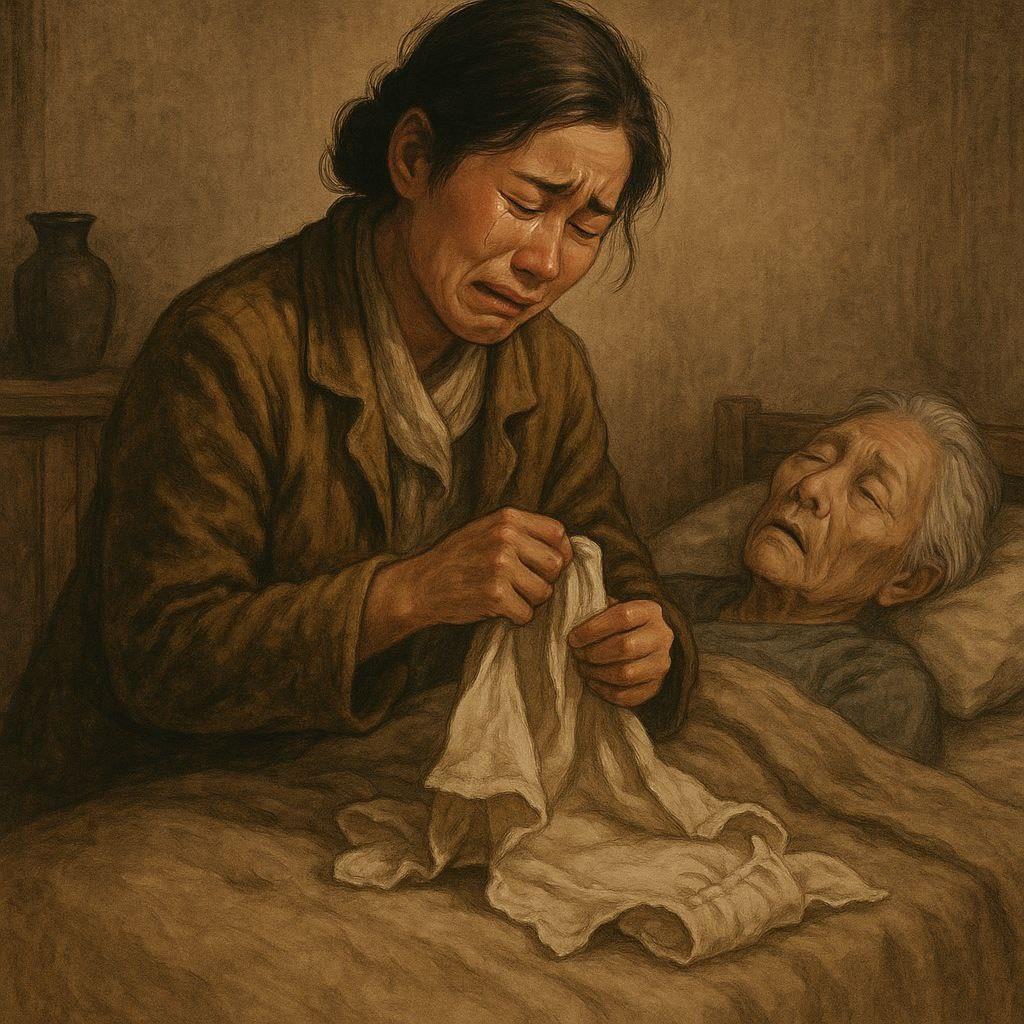
After a brief treatment, we returned home. I cooked her meals, bathed her, and helped her with everything, even the most private needs, since she couldn’t move at all.
I tore old clothes to make diapers and snuck out at night to wash them by the frozen Amnok River. My hands were numb from the cold, and tears streamed down my face without end.
To support us and try to save her, I became a traveling medicine seller. I traveled as far as Pyongsong to buy costly foreign medicine, but most people couldn't afford it.
I once heard someone say, “If you only sell real medicine, you’ll starve.” Those words stuck with me. In the end, I gave in — mixing real pills with fakes and selling yellow-dyed sugar as vitamins. It brought in some money.
I sold fever reducers too. One real pill mixed with two fake ones.
Customers thanked me, unaware of the truth. But inside, I was drowning in guilt.
In my desperation to save my mother, I had harmed others, perhaps fatally.
Every time I handed someone a pill, it felt like a piece of my heart was breaking.
Despite all I did, my mother passed away that winter.
In her final moments, she dragged over a bottle labeled "Hyminal" and swallowed a handful of pills — without water, not even knowing what they were.
No amount of crying could bring her back.
Her funeral was unspeakably painful. We burned rice husks all day to thaw the frozen ground and dug her grave by firelight, our hands stiff with cold.
I bore every ounce of the financial and emotional weight alone. And that’s when it hit me: In North Korea, especially for poor women, we are not people. We are property — slaves to the state.
We are not born to be loved, but to silently carry the burden of endless labor and sacrifice.
In South Korea, Parents' Day is a celebration of love between parent and child. A single carnation, a short letter, a gentle smile — that’s enough.
There is no command, no obligation — just love, freely given.
But in North Korea, even Mother’s Day is another reminder that a woman must surrender herself for the regime.
There, women live not as cherished daughters or respected mothers, but as faceless workers with no home and no freedom.
Even now, countless women must sell fake medicine just to care for their loved ones as I once did.
On this Parents' Day, I pray from the depths of my heart.
I hope North Korean women will one day be able to show love to their parents, live with dignity as daughters, and smile without fear.
Until that day comes, I will carry this pain and these memories with me, always.