

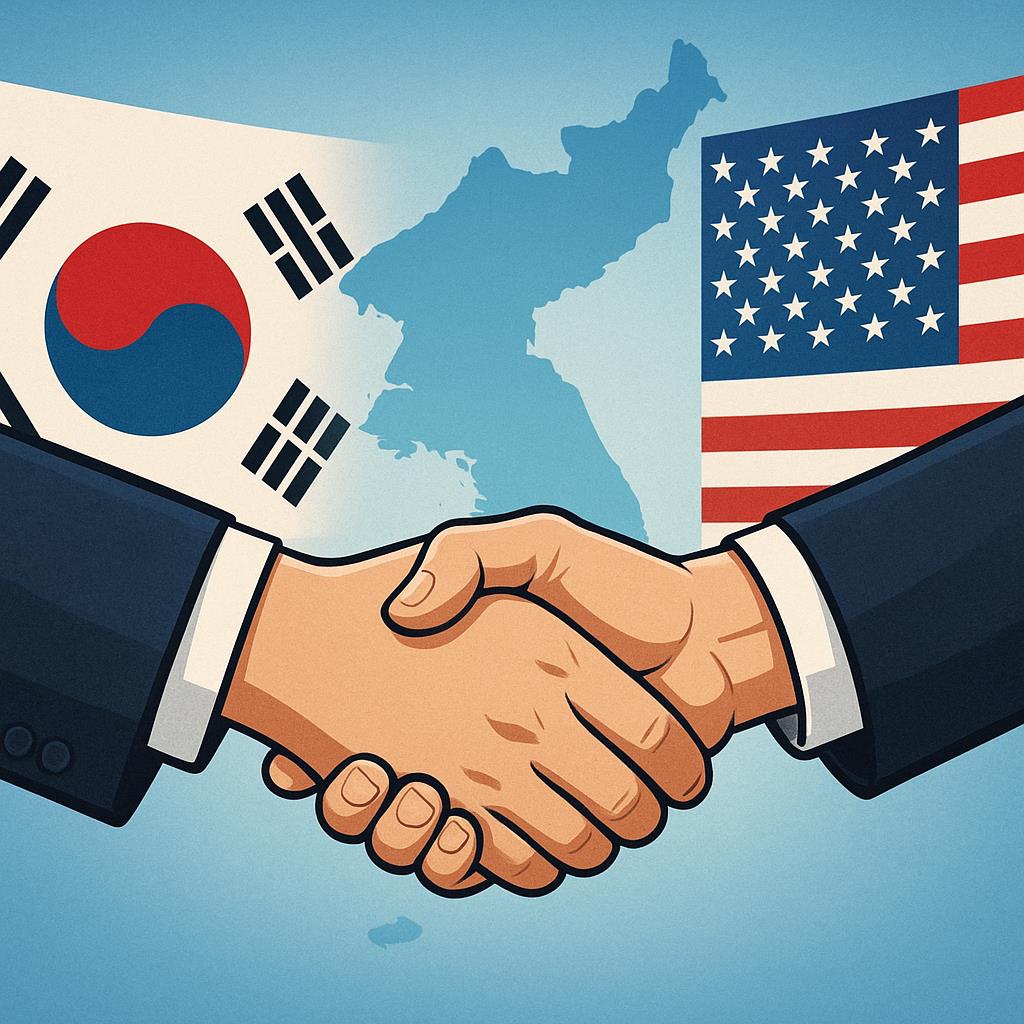
"South Korea–U.S. Summit: Approaches to North Korea for Peace on the Korean Peninsula and the Strengthening of the Alliance"

Choi Kyong-hui
Director of SAND Research Institute
Next week, President Lee Jae-myung of South Korea and President Donald Trump will hold their first summit in Washington, D.C. Beyond the symbolism of this inaugural meeting, global attention is focused on the trajectory of the U.S.–ROK alliance and the economic agenda both leaders will address.
Equally important is how the summit will approach the North Korea question. Inter-Korean dialogue has been stalled for more than six years, during which tensions on the peninsula have only deepened. Against this backdrop, the new South Korean administration has consistently signaled its intent to reopen channels of communication with Pyongyang.
President Trump, who played a pivotal role in the unprecedented U.S.–North Korea summits of 2018–2019, will inevitably draw scrutiny for his posture toward the North Korea issue at this summit. Within Washington, however, there is some unease about Seoul’s approach.
Critics argue that, despite Pyongyang’s continued intransigence, the Lee government risks prioritizing short-term appeasement at the expense of addressing North Koreans’ fundamental rights and freedoms.
The Lee administration, for its part, stresses that its policy is not an exercise in appeasement but a strategic effort to reduce the risk of conflict and to lay the groundwork for sustainable peace on the Korean Peninsula.
1. A Long-Term Strategy for Peace and Change
Seoul’s outreach to Pyongyang is conceived as a phased, long-term process aimed at both stability and eventual transformation. The current priority is to break the deadlock in inter-Korean relations and to rebuild a minimal level of trust. Far from unilateral concession, this approach is a form of crisis management designed to prevent escalation and create conditions conducive to negotiation.

Through gradual confidence-building and cooperative exchanges, South Korea seeks to foster a stable environment that could, over time, yield both peace and change in North Korea. In this sense, peace itself is not an alternative to human rights but a prerequisite for advancing the freedom and dignity of the North Korean people.
If inter-Korean reconciliation and improved U.S.–DPRK relations open the door to reform in North Korea, that outcome would represent the most moral and enduring achievement for the people of the North.
2. Reinforcing the U.S.–ROK Alliance and U.S. Interests
This approach is not at odds with U.S. strategic interests; on the contrary, it can reinforce them. Restored inter-Korean dialogue reduces the risk of accidental clashes, thereby lowering the security burden on the United States. Moreover, Seoul is positioned to serve as an intermediary that can draw Pyongyang back to serious denuclearization talks.
The Lee government has made clear that it will pursue dialogue not in isolation, but in tandem with credible deterrence and within the framework of a robust U.S.–ROK alliance.
3. An Opportunity for U.S. Leadership
For President Trump, the current moment also presents an opportunity to demonstrate statesmanship as a peacebuilder. Since returning to office, President Trump has emphasized his diplomatic engagement in conflicts from Ukraine to the Middle East. Progress on the Korean Peninsula would further underscore this legacy.
As in the 2018 Singapore summit, an improved atmosphere fostered by inter-Korean dialogue would allow President Trump to claim the mantle of “peace architect” at little cost. Should he succeed in generating momentum for peace in Korea—long regarded as the world’s most intractable flashpoint—he could rightly be remembered for shaping outcomes in multiple defining conflicts of the 21st century.
4. A Shared Commitment to Dialogue
Winston Churchill, reflecting on the devastation of World War II, once observed, “To jaw-jaw is always better than to war-war.” The South Korean government embraces a similar conviction: that the highest form of security lies not in victory through war, or even in victory without war, but in creating conditions where war itself becomes unnecessary.
By working patiently to restore trust and reestablish dialogue, Seoul seeks to advance this principle. The upcoming summit is an opportunity for both governments to reaffirm their shared commitment to peace and to consolidate the alliance as a foundation for stability on the peninsula.
-
PREV [Interpretation]
-
NEXT [Current Affairs Analysis]