

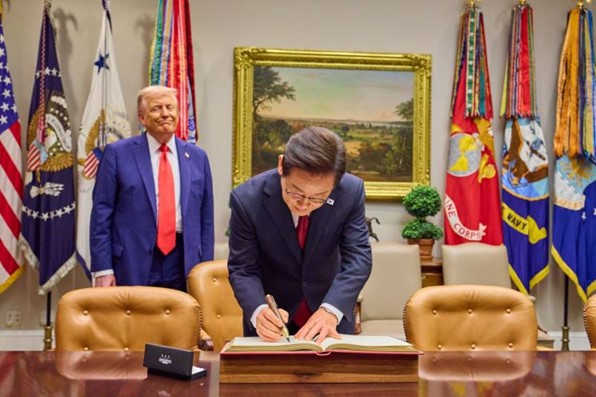
The Lee–Trump Summit:
Strategic Realignment, Alliance Modernization, and Regional Implications

Jung Kim
University of North Korean Studies
Introduction
The bilateral summit between President Lee Jae-myung of South Korea and President Donald Trump of the United States in August 2025 marked a pivotal moment in the recalibration of the Republic of Korea–United States (ROK–U.S.) alliance. Taking place after a turbulent period in Korean politics—most notably the impeachment of President Yoon Suk-yeol—the meeting was closely watched for its implications on trade, defense cooperation, and regional security.
This essay examines the summit’s outcomes through three primary lenses: (1) economic and industrial cooperation, (2) security and alliance modernization, and (3) regional diplomacy with North Korea, China, and Japan. It also situates the summit in the broader context of international order and strategic competition.
Economic and Industrial Dimensions
A central theme of the summit was Trump’s emphasis on revitalizing U.S. shipbuilding capacity through partnerships with South Korea, a global leader in ship construction. Trump articulated his ambition to “go back into the shipbuilding business again” by contracting South Korean firms both to build ships in Korea and to establish shipyards in the United States. For Trump, this initiative serves dual purposes: stimulating domestic industry in line with his broader “America First” economic doctrine, and reducing dependence on foreign manufacturing.
Lee responded by framing South Korea as a partner in America’s industrial renaissance, linking Korea’s export-driven industrial base with Trump’s vision of restoring U.S. manufacturing. The discussion extended beyond shipbuilding into energy cooperation, with Trump highlighting prospective joint ventures in Alaskan oil and gas involving both South Korea and Japan.
These economic projects, though framed in transactional terms by Trump, suggest a reconfiguration of the alliance into a more comprehensive economic-security partnership, where energy, manufacturing, and technology cooperation reinforce defense ties.
Security and Alliance Modernization
The summit reaffirmed the centrality of military cooperation in the ROK–U.S. relationship. Trump praised South Korea as a major purchaser of U.S. military equipment, while Lee emphasized the importance of transforming the alliance into a “future-oriented” partnership that integrates security with economic and technological collaboration.

The question of U.S. troop presence in Korea was particularly significant. Trump acknowledged the “40,000” U.S. troops stationed on the peninsula but revived his longstanding demand for Seoul to pay more for hosting American forces. He floated the idea of renegotiating the land arrangements for U.S. bases, suggesting South Korea transfer ownership of land currently leased to the U.S. military. While not an immediate policy change, these remarks signal Trump’s intention to leverage alliance costs as bargaining tools.
For Lee, managing this transactional approach poses both risks and opportunities. On the one hand, South Korea gains reassurance that Trump is committed to deterrence on the peninsula. On the other, the uncertainty over troop levels and cost-sharing injects instability into the alliance. Lee’s framing of the alliance as encompassing “economy and science and technology” seeks to insulate it from Trump’s transactionalism by embedding military ties within a broader, future-oriented framework.
North Korea and Peace Diplomacy
The most notable diplomatic exchange concerned North Korea. Lee explicitly appealed for Trump’s unique role as a potential “peacemaker,” urging him to reengage Kim Jong Un in dialogue and even half-jokingly offering to act as Trump’s “pacemaker”. Trump reciprocated by recalling his prior summits with Kim and suggesting that renewed talks could yield progress, positioning himself as the only leader capable of delivering peace on the peninsula.
This convergence reflects Lee’s strategic calculation: Trump’s personal rapport with Kim could unlock stalled diplomacy that faltered under Biden. Lee’s appeal also highlights South Korea’s structural dependence on U.S. mediation in inter-Korean affairs, given North Korea’s unwillingness to engage Seoul directly without Washington’s involvement.
Yet significant risks accompany this strategy. Trump’s responses to building “Trump Tower in North Korea” and playing golf with Kim Jong Un expose the unpredictability of his approach, raising questions about whether peace efforts might be subordinated to personal branding. Nevertheless, both leaders framed North Korea not simply as a security threat but as an opportunity for transformative peace, underscoring the summit’s symbolic weight.
Regional Dynamics: China and Japan
The summit also touched on the triangular relationship among South Korea, the U.S., and Japan. Trump raised historical tensions over “comfort women” as an obstacle to trilateralism, framing Japan as more eager for cooperation than South Korea. Lee countered by emphasizing his recent efforts to improve Korea–Japan relations and the importance of trilateral security cooperation in addressing North Korea and countering China.
This exchange illustrates how Trump views Japan as a strategic anchor and expects Seoul to prioritize trilateralism, while Lee seeks to leverage his outreach to Tokyo as evidence of his commitment to U.S. priorities. The implication is clear: Seoul’s ability to maintain positive ties with both Washington and Tokyo will be a critical test of Lee’s diplomatic capacity.
On China, both leaders struck a pragmatic tone. Trump suggested he and Lee might even travel to China together, signaling openness to engagement. At the same time, Trump emphasized U.S. leverage over China through tariffs.
For South Korea, deeply economically integrated with China yet dependent on the U.S. for security, this presents a delicate balancing act. Lee’s willingness to humor Trump’s joking suggestion of a joint trip to Beijing illustrates Seoul’s strategy of aligning closely with Washington while avoiding outright antagonism toward China.
Broader International Implications
The summit also reflected Trump’s broader claim to global peacemaking. He invoked his record of halting wars in places such as India–Pakistan and the Congo, and asserted that only under his leadership could conflicts like the Russia–Ukraine war and Middle East crises be resolved. Lee, in turn, echoed this framing by portraying Trump as uniquely capable of achieving peace, not only in Korea but globally.
This rhetorical convergence suggests an emerging narrative: Trump as global “maker of peace” and Lee as regional facilitator. Such framing benefits Lee domestically, reinforcing his legitimacy after political turmoil by aligning with a leader portrayed as a peacemaker. Internationally, it signals Seoul’s willingness to position itself as a proactive diplomatic actor, albeit under U.S. leadership.
Alliance Narratives and Domestic Framing
During the summit, some far-right groups in both South Korea and the United States sought to frame President Lee as a “pro-China” and “anti-U.S.” leader prior to his visit. This framing even surfaced during the summit discussions. Although the issue was eventually resolved through the leaders’ talks and joint statements, lingering aftereffects remain.
In response, the Lee administration underscored the deep history and tradition of the ROK–U.S. alliance, reaffirming it as a central pillar of national policy. Moreover, by clearly articulating its determination to further strengthen and develop the alliance, the administration aimed to dispel misconceptions, reassure domestic and international audiences, and reinforce the continuity of the bilateral partnership.
Conclusion: Outcomes and Prospects
The Lee–Trump summit produced no formal agreements but carried significant strategic implications. Economically, it signaled expanded cooperation in shipbuilding, energy, and industrial revitalization. Militarily, it reaffirmed alliance commitments while reopening debates about troop costs and basing arrangements.
Diplomatically, it reintroduced the prospect of renewed Trump–Kim engagement, with Lee positioning himself as a facilitator of inter-Korean peace. Regionally, it underscored the imperative of trilateralism with Japan and cautious engagement with China.
For South Korea, the summit demonstrated both opportunity and vulnerability. Lee succeeded in establishing personal rapport with Trump and reframing the alliance as future-oriented. Yet Trump’s transactional tendencies and unpredictability mean Seoul must carefully manage expectations while hedging against sudden shifts.
Ultimately, the summit reinforced the ROK–U.S. alliance as the indispensable axis of Korean security and economic strategy, while also highlighting the delicate balance required to navigate great power competition in East Asia.
-
PREV [Current Affairs Analysis]
-
NEXT [Feature Article]