


Changes in North Korea's Foreign Policy Amid U.S.-China Competition and South Korea's Response

Professor Dr.Choi Jae duk
Seoul School of Integrated Science and Technology
The contemporary Northeast Asian security and diplomatic environment is increasingly defined by two interlinked dynamics: intensifying U.S.-China strategic competition and the protracted Russia-Ukraine conflict. The U.S.-China competition represents both a geopolitical struggle over influence within the existing international order and a technological race in strategically critical sectors, including artificial intelligence and semiconductors.
The ongoing Russia-Ukraine war has revealed the latent potential for geopolitical conflict in the post-globalization era, reshaping regional and global security architectures. Within this context, the United States and China are intensifying their strategic competition across the Indo-Pacific, while Russia, in direct confrontation with the West, strengthens ties with China, North Korea, and other allied actors. As a result, a bifurcation of the international order in Northeast Asia is becoming increasingly pronounced.
North Korea has responded by flexibly calibrating its diplomatic posture to secure regime stability and strategic autonomy. Historically pursuing equidistant diplomacy, Pyongyang has periodically aligned more closely with China and, at other times, deepened ties with Russia.
The Russia-Ukraine war has further elevated North Korea’s strategic value, and North Korea-Russia relations have advanced to a new level of military and diplomatic engagement. North Korea has supplied Russia with military materiel, including artillery shells and missiles, while potentially securing access to advanced military and space technologies from Moscow.
September 2023 visit to Russia was hosted at the Vostochny Cosmodrome, reflecting Pyongyang’s urgent need for space-launch technology. Past precedent demonstrates that technology transfers, such as those that enabled North Korea’s nuclear weapons program under the former Soviet Union’s “Agreement on the Peaceful Use of Atomic Energy,” could similarly exacerbate security challenges for South Korea.
Institutionalization of North Korea-Russia relations was further reinforced with the June 2024 “Comprehensive Partnership Agreement,” which incorporated the automatic military intervention clause originally included in the 1961 North Korea-Soviet Friendship Treaty.
Additionally, Russia has exercised its UN Security Council veto to neutralize resolutions targeting North Korea’s ICBM tests, effectively providing Pyongyang with diplomatic protection and enhancing the security threat to the Republic of Korea.
China, for its part, perceives North Korea as a strategic buffer and is seeking to project influence on the Peninsula while monitoring North Korea’s deepening ties with Russia. Although China seeks to maintain its image as a responsible major power and avoid overt military alignment with Pyongyang, it is equally invested in preventing rapid destabilization in North Korea.
Economically, China accounts for more than 90 percent of North Korea’s trade, providing critical energy and food supplies. North Korea-China trade, which contracted sharply during the COVID-19 pandemic, has resumed growth, as evidenced by reconstruction of the New Yalu River Bridge and expansion of customs facilities in Hunchun, signaling a revival of bilateral trade.
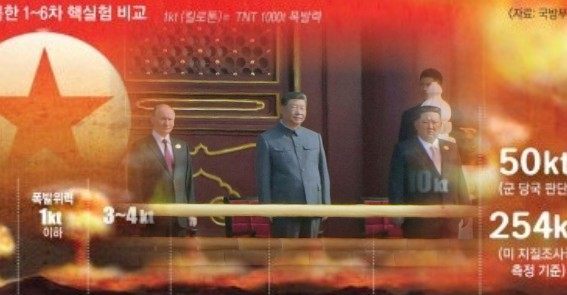
Chairman Kim Jong-un’s participation in the September 3rd military parade in Beijing, commemorating the 80th anniversary of victory in the War of Resistance Against Japanese Aggression, carries multiple strategic and symbolic significances. It marks North Korea’s first substantive engagement on the multilateral diplomatic stage since the pandemic, while signaling both the restoration of North Korea-China relations and the potential for enhanced trilateral cooperation among North Korea, China, and Russia.
This raises the possibility of a coordinated North Korea-China-Russia framework, projecting a counterweight to the U.S.-led international order and advancing North Korea’s international visibility.
North Korea has historically leveraged relations with China and Russia to increase its bargaining power vis-à-vis the United States. During the 2018-2019 North Korea-U.S. summit process, Chairman Kim underscored his strategic use of the “China card” through multiple meetings with President Xi Jinping. In this context, the recent Beijing visit appears aimed at restoring North Korea-China ties and strengthening Pyongyang’s leverage in potential future North Korea-U.S. negotiations.
For South Korea, these dynamics, compounded by strained Seoul-Beijing and Seoul-Moscow relations and persistent inter-Korean stalemates, necessitate a strategic recalibration across economic, diplomatic, and security dimensions. Key recommendations include:
Strengthening and deepening trilateral ROK-U.S.-Japan cooperation, extending beyond traditional security domains to include economic security in semiconductors, energy, and AI.
Maintaining functional engagement with China, preserving channels for cooperation in supply chains, climate, health, and education, mitigating economic risks, and incentivizing China’s constructive role in Peninsula stability.
Selective cooperation with Russia in strategic sectors, such as energy and Far East regional development, while maintaining principled positions on security and nonproliferation.
Positioning South Korea as a facilitator for inter-Korean and North Korea-U.S. dialogue, reinforcing the ROK’s strategic autonomy and mediation capacity. Requests to former U.S. leadership to serve as interlocutors reflect this strategic orientation.
Ultimately, South Korea must focus on a pragmatic assessment of the North Korea-China-Russia nexus, emphasizing the substantive effects of military and economic collaboration rather than symbolic alignments.
Effective policy requires simultaneous trilateral coordination with the United States and Japan, while managing relations with North Korea, China, and Russia to preserve avenues for diplomacy and peace. Maintaining the ROK-U.S. alliance remains paramount, while cultivating strategic autonomy through measured engagement with China and Russia ensures resilience against potential coercion.
In sum, South Korea faces a complex nexus of geopolitical and economic pressures but also opportunities to enhance its strategic leverage. A multi-pronged approach—combining alliance management, pragmatic diplomacy, and inter-Korean engagement—can reinforce the ROK’s role as a critical actor in Northeast Asian security.
Amid compound mid-21st century crises—including slow growth, pandemics, climate change, technological competition, supply chain restructuring, and democratic backsliding—Korea must adopt multidimensional strategies that integrate diplomacy, security, and economic policy.
Through such measures, South Korea can promote multilateral cooperation, strengthen regional solidarity, foster inter-Korean trust, and serve as a bridge in U.S.-North Korea relations. By situating technological, security, and economic initiatives within a broader diplomatic framework, the ROK can secure autonomy, safeguard peace, and advance prosperity on the Korean Peninsula.