

Overcoming the ‘New Cold War’ Discourse and Advancing Korea–China Cooperation
Kim Soyeon
Research Professor, Sungkyun China Institute
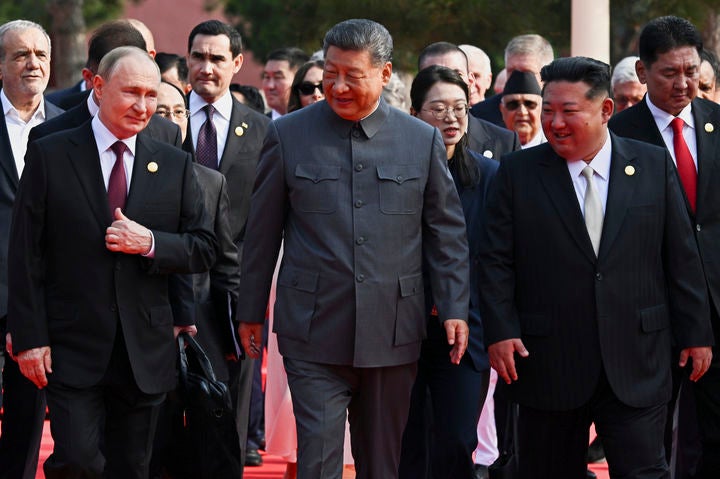
On September 3, international attention centered on the meeting of North Korean, Chinese, and Russian leaders during the 80th anniversary commemoration of China’s Victory Day.
The parade featured a range of advanced weapon systems—including the intercontinental ballistic missile Dongfeng-61, the Dongfeng-5C, unmanned submarines, and anti-ship hypersonic missiles—underscoring China’s growing military capabilities. By appearing together on the Tiananmen rostrum, Xi Jinping, Kim Jong Un, and Vladimir Putin conveyed a message of trilateral solidarity.
This alignment has revived discourse on the advent of a “new Cold War.” The North Korea–China–Russia bloc, though heterogeneous, is being shaped through cooperation between Russia—now widely regarded in Europe as a common adversary due to its ongoing war in Ukraine—and North Korea, which continues nuclear weapons development in defiance of sanctions.
China’s tacit support provides cover for both. For the United States and its allies, this trilateral coordination is emblematic of an emerging anti-Western alignment, prompting intensified countermeasures through initiatives such as the Indo-Pacific Strategy, the “One Theater” concept, and the strengthening of Asia–Europe security linkages.

While polarization in the global order is real, framing the situation solely as a new Cold War risks becoming a self-fulfilling prophecy. Cohesion within both the anti-Western bloc and the U.S.-centered coalition remains limited.
North Korea–China–Russia cooperation is situational and tactical, primarily aimed at sanction evasion and bargaining leverage. Meanwhile, the U.S. and its allies, though structurally stronger, remain divided by domestic politics and economic interests. This suggests a fluid and variable landscape, rather than a rigid bloc confrontation akin to the 20th century Cold War.
Opportunities for Engagement
Despite rising tensions, avenues for negotiation remain open. Former President Trump signaled potential for renewed U.S.–North Korea dialogue during his campaign, and the Lee Jae-myung administration has expressed its intention to create conditions for resuming inter-Korean engagement.
Kim Jong Un’s participation in China’s Victory Day events—his first multilateral diplomatic appearance since assuming power—may also reflect calculated signaling toward dialogue. Moreover, a potential Trump–Xi meeting at the upcoming APEC summit in Gyeongju could create momentum for easing U.S.–China frictions.
The Role of Korea–China Relations
South Korea–China relations can function as a stabilizing mechanism, helping to prevent Northeast Asia from sliding into a Cold War dynamic.
Yet bilateral ties have faced repeated setbacks due to U.S.–China strategic rivalry, asymmetries in national power, public distrust, and the unresolved North Korean nuclear issue. As regional polarization intensifies, it is imperative for Seoul to establish a sustainable and future-oriented framework for Korea–China cooperation.
For this, the South Korean government should:
Send clear signals to China on issues directly tied to national sovereignty and security—including illegal fishing, EEZ demarcation, and ADIZ overlaps—while affirming the ROK–U.S. alliance as a foundation of Korean diplomacy.
Manage sensitive issues carefully, such as Taiwan, by respecting the “One China” policy while consistently emphasizing the importance of peace and stability in the Taiwan Strait.
Institutionalize dialogue channels with China to strengthen strategic communication and minimize misperceptions.
Advance practical cooperation in areas such as tourism, humanitarian aid, and inter-Korean economic engagement not restricted by sanctions, thereby generating momentum for broader dialogue.
Mitigate public distrust by creating forums for people-to-people exchange and expanding cooperation on less politicized, livelihood-centered issues with tangible benefits.
Conclusion
Reinvigorating Korea–China relations is not simply about repairing bilateral ties. It is a task central to the long-term strategic sustainability of South Korea’s diplomacy.
If Seoul defines its China policy solely as a derivative of U.S.–China competition, it risks deepening its own geopolitical dilemma as a middle power. The critical question is not which side to take, but how South Korea can identify and secure its optimal interests while contributing to regional stability and cooperation.
-
PREV [Feature Article]
-
NEXT [Thematic Analysis]