

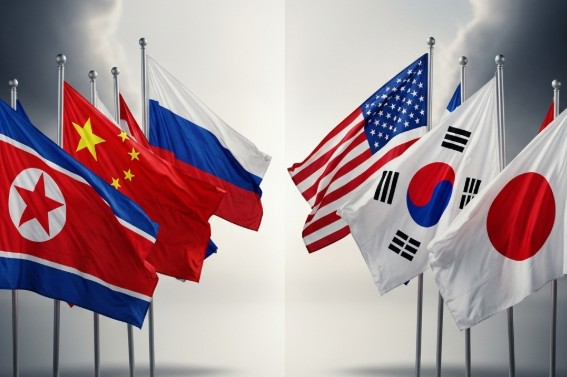
North Korea–China–Russia Convergence and Emerging Challenges: Why an Enduring ROK–U.S. Alliance Remains Indispensable

Jeong Gu-young
Former Senior Secretary for Administrative Affairs, Blue House
On September 3, North Korean leader Kim Jong-un stood alongside Chinese President Xi Jinping and Russian President Vladimir Putin at the 80th anniversary military parade commemorating China’s victory in the War of Resistance Against Japanese Aggression.
This symbolic image underscored what has become increasingly clear: the North Korea–China–Russia alignment is no longer a matter of quiet coordination but has now been openly signaled to the international community.
For Pyongyang, participation serves the dual purpose of breaking through its international isolation and reinforcing its regime legitimacy. For Beijing and Moscow, it reflects a willingness to expand strategic solidarity in ways that directly impact the security environment of the Korean Peninsula and Northeast Asia.
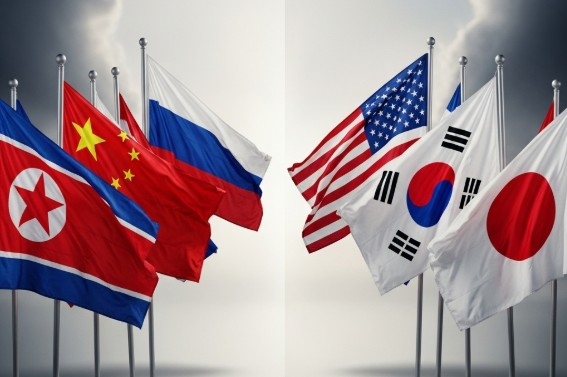
The absence of any reference to “denuclearization” in the North Korea–China summit statement was especially troubling. This omission not only complicates diplomacy on the Korean Peninsula but also directly challenges U.S. strategic objectives.
The trilateral convergence strikes at three pillars of American policy: advancing denuclearization of North Korea, sustaining a favorable balance in U.S.–China competition, and working toward a resolution of the Russia–Ukraine war.
Moscow and Beijing have consistently been reluctant to support additional UN Security Council sanctions on Pyongyang, effectively signaling tolerance for its nuclear and missile programs. More recently, indications of Russian military technology transfers to North Korea raise the prospect of accelerated nuclear capabilities, thereby eroding the effectiveness of sanctions as a tool to bring Pyongyang back to negotiations.
At the same time, weapons cooperation with North Korea enables Russia to prolong its war effort in Ukraine, complicating Washington’s strategy for conflict resolution. For Beijing, this trilateral dynamic broadens its strategic maneuvering space and advances its longer-term vision of a multipolar world order.
In this environment, the credibility and resilience of the ROK–U.S. alliance—anchored by trilateral security and economic cooperation with Japan—become indispensable to U.S. foreign strategy. South Korea plays a critical role in stabilizing supply chains in advanced industries, including semiconductors and batteries, while also sustaining joint defense readiness with U.S. Forces Korea. These contributions ease the security burden on Washington and enhance regional deterrence.
Nevertheless, narratives advanced by some U.S. commentators—most notably Gordon Chang’s claim that South Korea is drifting into China’s orbit—have distorted public understanding of the alliance.
Such arguments exaggerate Seoul’s economic dependence on China and misrepresent its North Korea policy. The reality is that South Korea has consistently demonstrated both political will and material capacity in support of alliance objectives. Allowing mischaracterizations to undermine confidence in the alliance risks weakening an essential pillar of U.S. strategy in the Indo-Pacific.
The tightening cooperation among North Korea, China, and Russia will continue to destabilize the regional security environment. The most effective counterweight remains a strong and adaptive ROK–U.S. alliance, supported by institutionalized trilateral coordination with Japan. This is not only critical for deterring North Korea and maintaining stability on the Korean Peninsula but also for advancing broader U.S. strategic objectives at a time of overlapping global challenges.
For South Korea, the imperative is clear: it must position itself not merely as a regional ally but as a global strategic partner of the United States.
For Washington, ensuring that the alliance is modernized and resilient—politically, militarily, and economically—remains essential. Together, both governments and their mainstream societies must resist the distortion of fringe narratives and instead focus on reinforcing the alliance’s enduring value.
-
PREV [Current Affairs Analysis]
-
NEXT [Feature Article]