

The North Korean Nuclear Challenge and the ‘END Initiative’

Koh Yu-hwan
Professor Emeritus, Dongguk University; Former Director, Korea Institute for National Unification
President Lee Jae-myung articulated the “END Initiative” at the 80th UN General Assembly, framing it as South Korea’s strategic approach to ending the Cold War on the Korean Peninsula and contributing to global peace and prosperity. The initiative emphasizes restoring trust between North and South Korea, shifting to a posture of mutual respect, and adhering to three principles regarding North Korea: respecting its political system, excluding absorption unification, and prohibiting hostile acts.
Central to the END Initiative is the notion that sustainable peace requires conditions under which conflict is unnecessary. The initiative outlines a phased approach to North Korea’s nuclear program—Exchange, Normalization, and Denuclearization—with normalization of inter-Korean relations positioned as the foundational step.
This represents a departure from prior “denuclearization-first” strategies, such as the CVID (Complete, Verifiable, and Irreversible Dismantlement) framework, aiming instead to leverage normalized relations to drive progress on denuclearization.
The proposed three-stage nuclear approach—suspension, reduction, dismantlement—differs substantively from previous agreements, including the 2007 February 13 Agreement and the September 19 Joint Declaration. Notably, the use of “suspension” rather than “freeze” implies that negotiations on normalization could proceed immediately upon North Korea’s declarative commitment, without initial verification.

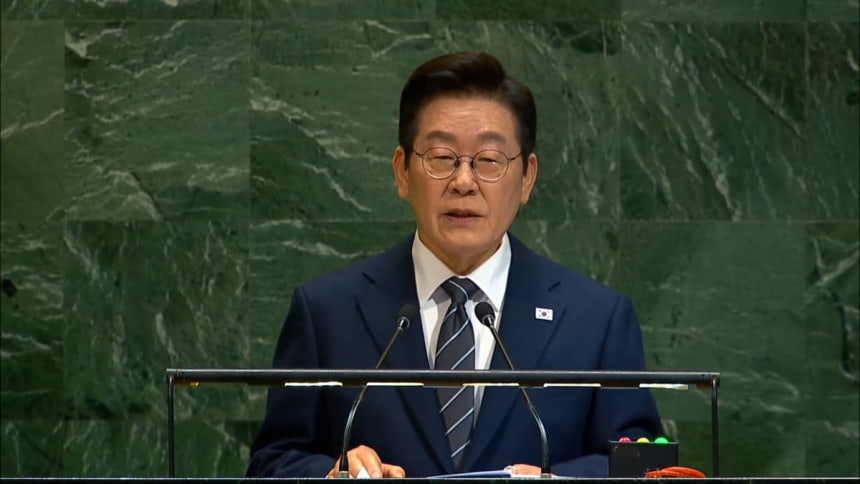
President Lee Jae-myung delivers a keynote address at the United Nations General Assembly
in New York, USA, on September 23. /2025.09.24/Presidential Office website
The second stage, reduction, may involve both a decrease in North Korea’s nuclear capabilities and the potential acknowledgment of its de facto nuclear status, opening the door to arms control or disarmament negotiations with the U.S.
Over thirty years of engagement with North Korea’s nuclear program have demonstrated the limitations of path-dependent approaches. The END Initiative emphasizes a “security-for-security exchange” framework that addresses both external concerns and North Korea’s demands. Given the rapid advancement of North Korea’s nuclear capabilities, diplomatic efforts must focus on halting further development while preventing the reemergence of military options on the Peninsula.
Prioritizing normalization of relations represents an untested strategy, which may attract criticism for implicitly recognizing North Korea’s nuclear status. Nevertheless, historical lessons, including the Soviet nuclear experience and evidence from the Russia-Ukraine conflict, suggest that nuclear weapons function primarily as deterrents rather than tools for early-stage conflict. Extended deterrence under the ROK-U.S. Nuclear Consultative Group (NCG) and modernization of South Korea’s conventional forces remain essential to maintaining strategic balance.
The END Initiative may also serve as a strategic framework for U.S.-North Korea engagement. President Trump, in his second term, has referred to North Korea as a “nuclear power” and indicated willingness to engage with Kim Jong-un.
North Korea has stated that dialogue requires recognition of its “irreversible nuclear status” and an acknowledgment of fundamentally changed geopolitical conditions. Should the U.S. deem engagement with North Korea advantageous amid U.S.-China strategic competition, negotiations could involve exchange of nuclear capability reduction and sanctions relief for normalization of relations.
In conclusion, the successful implementation of the END Initiative depends critically on close coordination and strategic cooperation between South Korea and the United States. Even as normalization with North Korea is pursued, maintaining peace and stability on the Korean Peninsula requires a unified ROK-U.S. response. Only through synchronized actions, transparent information sharing, and a shared roadmap can the END Initiative move beyond conceptual strategy to a practical pathway for sustainable peace.
-
PREV [Thematic Analysis]
-
NEXT [Thematic Analysis]