


The Evolution of the ROK–U.S. Alliance and the Rise of Strategic Complex Alliances

J.R. Kim, Ph.D.
President
Korea Council For Peace and Cooperation
Northeast Asia represents one of the world’s most intricate security environments, where the strategic calculations of the United States, South Korea, China, Japan, Russia, and North Korea are deeply interwoven. The United States has long relied on its forward-deployed forces in this region to counter China’s growing maritime presence and assertive regional ambitions.
Geopolitically, the Korean Peninsula’s position adjacent to China places South Korea on the frontline of great-power competition—making it an indispensable “forward node” within America’s Indo-Pacific strategy.
From Military Deterrence to Strategic Comprehensiveness
The 21st-century international order is being reshaped by the fusion of economic security, industrial resilience, and technological hegemony. Against this backdrop, as U.S.–China strategic rivalry deepens, South Korea’s role as a technological and industrial powerhouse in Northeast Asia has gained unprecedented significance.
Traditionally, the ROK–U.S. alliance was defined by a singular focus on deterrence and defense. Today, it is evolving into what may be termed a strategic comprehensive alliance—a multidimensional partnership that integrates cooperation across defense, high technology, and key industrial sectors such as semiconductors and shipbuilding.
Recent developments—such as enhanced trilateral security coordination among Seoul, Washington, and Tokyo; the establishment of the U.S.–ROK Nuclear Consultative Group (NCG); and Seoul’s participation in the U.S.-led semiconductor alliance (CHIP 4)—illustrate this transition. This reconfiguration of the alliance aligns economic, industrial, and military domains in a mutually reinforcing framework, thereby advancing U.S. interests in supply chain stabilization, technological sovereignty, and regional strategic balance.
Economic and Industrial Integration as Strategic Assets
Deeper economic and industrial integration between the United States and South Korea is not only an economic imperative but also a strategic one. As China seeks to reshape the regional order through economic coercion and industrial dominance, the ROK–U.S. alliance must evolve beyond traditional defense cooperation to include strategic industries. South Korea’s technological competitiveness—in semiconductors, shipbuilding, and other high-value manufacturing sectors—constitutes a non-military strategic asset for the United States.
For Washington, embracing Seoul as a strategic military-industrial partner—not merely a military ally—is essential. South Korea possesses capabilities that complement U.S. strengths and fill critical gaps in the broader contest with China over industrial capacity and technological supremacy.
Semiconductors: The Core of Technological Competition
In the competition for technological hegemony, semiconductors occupy a central role. Since the early 2020s, the United States has defined semiconductors as the “oil of the 21st century,” crafting policies to secure supply chain dominance. As of September 2025, South Korea accounts for approximately 22 percent of the global semiconductor market—second only to the United States at 54 percent—and commands more than 56 percent of the global memory chip market.
A closer partnership between U.S. firms—leaders in chip design and equipment—and Korea’s world-class memory semiconductor producers would bolster both nations’ supply chain resilience and technological autonomy. In 2024, Korea’s semiconductor exports reached $141.9 billion, up 43.9 percent from the previous year. Following Washington’s export controls on China, Beijing’s share of Korea’s semiconductor exports fell sharply—from 61.1 percent in 2022 to 51.7 percent in 2024—while exports to the United States and Taiwan rose.
This realignment illustrates a structural shift toward U.S.-centered semiconductor networks, with Korea emerging as a key enabler of Washington’s efforts to sustain technological leadership vis-à-vis Beijing.
Shipbuilding: Revitalizing Allied Maritime Power
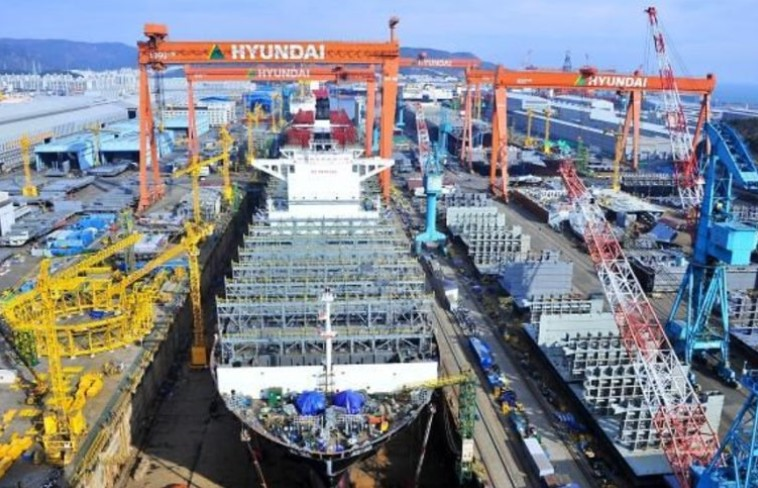
South Korea’s globally competitive shipbuilding sector presents another avenue for deepened strategic cooperation. According to Clarkson Research (August 2025), South Korea secured 23 percent of global ship orders (560,000 CGT, 8 vessels), ranking second after China’s 57 percent (1.38 million CGT, 57 vessels). However, Korea’s average tonnage per vessel—70,000 CGT—is nearly three times China’s, underscoring Korea’s dominance in high-value, technologically sophisticated shipbuilding.
By contrast, the U.S. commercial shipbuilding industry, once the world’s largest, now commands a mere 0.2 percent global market share. Private shipyard employment has fallen by more than 40 percent since the 1980s, eroding America’s capacity to build and maintain both commercial and naval vessels. These industrial deficiencies have contributed to shipbuilding delays and a shrinking margin of maritime superiority vis-à-vis China.
China, meanwhile, has aggressively expanded its shipbuilding infrastructure since 2010, constructing dozens of large-scale shipyards and integrating them into its Belt and Road Initiative. As of 2025, the Chinese Navy fields roughly 1,025 vessels—more than double the 471 ships operated by the U.S. Navy. Roughly 70 percent of China’s naval fleet has been built since 2010, demonstrating a direct link between industrial capacity and maritime power.
In this context, South Korea’s shipbuilding and maritime technologies can serve as vital strategic assets for U.S. maritime strategy. Bilateral cooperation in shipbuilding, maintenance, and logistics can help offset the U.S. Navy’s capacity shortfalls while countering China’s expanding maritime infrastructure network. The acquisition of a U.S. shipyard by South Korea’s Hanwha Ocean and its participation in U.S. Navy repair and maintenance programs represent promising models of ROK–U.S. military-industrial cooperation.
Korea’s Role in the Next Frontier of Technological Competition
Beyond semiconductors and shipbuilding, South Korea leads in multiple high-tech fields critical to future security and economic competition, including energy storage systems (ESS), all-solid-state batteries, AI semiconductors, high-bandwidth memory (HBM), small modular reactors (SMR), and defense technologies. These capabilities align directly with U.S. strategic priorities in areas such as smart defense innovation, energy security, 6G network development, and advanced supply chain stabilization.
Given this broad technological base, South Korea should be recognized as one of the United States’ most strategically valuable allies—a partner capable of reinforcing U.S. leadership in both military and non-military domains of competition with China.
Conclusion: Toward a 21st-Century Comprehensive Alliance
The true evolution of the ROK–U.S. alliance lies in transcending its traditional military character to become an alliance of industrial and technological competitiveness. South Korea’s advanced industrial capabilities offer the United States enduring leverage in the strategic rivalry with China.
Strengthening institutional frameworks that integrate economic, industrial, and security cooperation will be essential to completing this transformation. The future of the ROK–U.S. partnership thus depends not merely on shared defense commitments, but on building a comprehensive strategic alliance—one that fuses military strength with industrial and technological innovation to shape the balance of power in the 21st century.
-
PREV [Feature Article]
-
NEXT [Thematic Analysis]