

The South Korea–Indonesia Summit (April 1, 2026) and the KF-21:
Exploring the Potential of a Strategic Partnership Model for Defense Exports

Seok-jeong Yoon
Korea National Diplomatic Academy
1. The South Korea–Indonesia “Special Comprehensive Strategic Partnership” and the KF-21
On April 1, 2026, South Korean President Lee Jae-myung met with Indonesian President Prabowo Subianto during the latter’s state visit to South Korea. The two leaders agreed to elevate bilateral relations to a “Special Comprehensive Strategic Partnership,” signaling a significant deepening of cooperation across political, economic, and security domains.
In his opening remarks, President Lee highlighted the strategic significance of the bilateral relationship amid heightened global uncertainty, emphasizing Indonesia’s role as a stable supplier of key energy resources—including liquefied natural gas (LNG) and coal—which provides important reassurance to South Korea. The two sides subsequently signed memorandums of understanding on a Special Comprehensive Strategic Dialogue and “Economic Cooperation 2.0,” and agreed to expand collaboration in critical sectors such as strategic minerals, infrastructure, and artificial intelligence.
President Prabowo, for his part, stressed that rising global instability has amplified the importance of Indonesia’s partnership with South Korea. As a leading regional actor—hosting the ASEAN Secretariat, possessing the world’s fourth-largest population, and abundant natural resources—Indonesia occupies a pivotal position in the Indo-Pacific. The summit thus formalized Indonesia’s status as a key strategic partner for South Korea in promoting regional peace and prosperity.
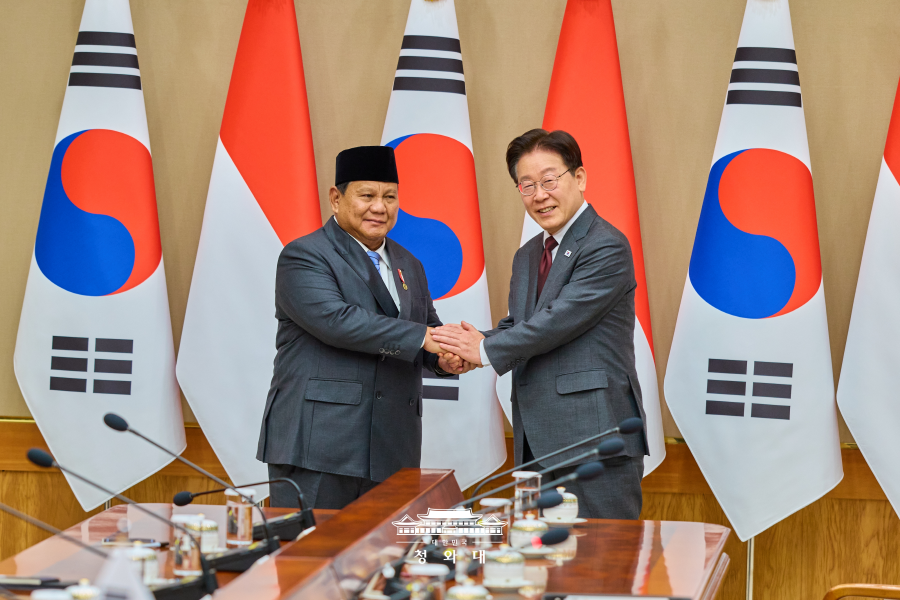
A particularly notable outcome was the conclusion of an export agreement for the KF-21 fighter aircraft, jointly developed by South Korea and Indonesia. Defense cooperation has emerged as a central pillar of the upgraded partnership. President Lee described the KF-21 program as a “global model” of defense collaboration grounded in mutual trust. Significantly, Indonesia’s dual role as both co-developer and launch customer reflects the parallel evolution of bilateral relations, highlighting a potential model for sustaining the global competitiveness of South Korea’s defense industry.
2. South Korea’s Defense Exports to Indonesia: From the T-50 to the KF-21
South Korea’s defense export relationship with Indonesia began in 2011 with the sale of the T-50 advanced trainer aircraft, developed by Korea Aerospace Industries (KAI). Known as the “Golden Eagle,” the T-50 was the product of a decade-long development effort that began in 1997. Its export marked a milestone, making South Korea the sixth country in the world to export supersonic aircraft.
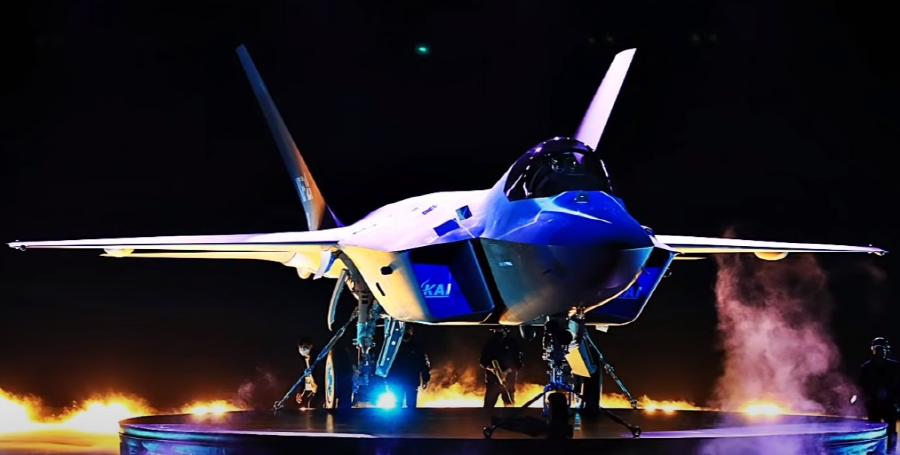
The Indonesian deal served as a critical entry point for South Korea into the global defense market. Building on this foundation, Indonesia became a key partner in the K-Defense ecosystem when it joined the KF-21 joint development program in 2010. Although the project faced challenges—particularly due to Indonesia’s fiscal constraints—it ultimately moved forward following renegotiations that included reduced financial contributions and in-kind support.
Through the KF-21 program, South Korea has become the eighth country to develop a 4.5-generation or more advanced supersonic fighter. The KF-21 is designed to strike a balance between cost-efficiency and advanced combat capabilities, positioning it as an attractive option for emerging air forces seeking modernization without the high costs associated with fifth-generation stealth platforms.
Indonesia’s role as both co-developer and first operator is strategically significant. As with the T-50, the KF-21 is expected to leverage its initial export to Indonesia as a springboard into broader global markets, potentially extending beyond Southeast Asia.
3. Strategic Implications for South Korea’s Defense Export Model
The joint development and export of the KF-21 to Indonesia exemplify an emerging strategic model for South Korea’s defense industry amid a rapidly evolving global market. Intensifying geopolitical competition has fueled sustained growth in global defense spending. According to the Stockholm International Peace Research Institute (SIPRI), global military expenditures reached $2.718 trillion in 2024—an increase of 9.7 percent year-on-year and 37 percent compared to 2015.
This surge reflects a broad spectrum of geopolitical risks, including the war in Ukraine, China’s military expansion and tensions over Taiwan, and ongoing conflicts in the Middle East. As a result, the defense sector is increasingly characterized by structural excess demand, creating expanded opportunities for exporters such as South Korea across multiple regions.
At the same time, protectionist dynamics are intensifying. The United States has prioritized strengthening defense supply chain resilience, while the European Union has advanced initiatives to increase intra-regional procurement and joint acquisition. Under the EU’s European Defence Industrial Strategy, announced in March 2024, member states aim to significantly expand collaborative procurement by 2030.
These trends pose structural challenges for the K-Defense sector. South Korea’s competitive advantage has historically rested on its ability to deliver high-performance systems quickly and at relatively low cost. However, a shift toward regionally closed defense markets could constrain these advantages.
In this context, South Korea’s defense export strategy must evolve. Future success will likely depend not only on cost and speed, but also on deeper forms of industrial cooperation, including local production, technology sharing, and financial arrangements. More fundamentally, defense exports need to be embedded within broader strategic partnerships—integrating political, economic, and societal dimensions—rather than remaining purely transactional.
The elevation of South Korea–Indonesia relations to a “Special Comprehensive Strategic Partnership,” together with the KF-21 program, provides a compelling case study of this evolving model. It underscores the importance of aligning defense cooperation with a comprehensive, long-term strategic framework—an approach likely to define the next phase of South Korea’s defense export strategy.
-
PREV [Feature Article]
-
NEXT [Current Affairs Analysis]