

An Assessment of the South Korea–Indonesia Summit:
The Strategic Imperative of Continued Defense Cooperation Through the Joint Development of the KF-21

Hyung-jun Kim
Professor
Department of Cultural Anthropology
Kangwon National University
South Korea and Indonesia established diplomatic relations at the ambassadorial level in 1973 and commemorated the 50th anniversary of their diplomatic ties in 2023. In parallel with the development of bilateral relations, the expansion of South Korean companies into Indonesia has also increased steadily.
South Korean firms that initially entered Indonesia in the 1970s were primarily focused on utilizing the country’s abundant forest resources, followed by business activities led by general trading companies and construction firms. Beginning in the late 1980s, the entry of textile, apparel, and footwear manufacturers seeking to capitalize on Indonesia’s abundant and cost-competitive labor force accelerated significantly.
From the mid-1990s onward, corporate activities in Indonesia evolved beyond simple processing and export-oriented operations to actively target the domestic market. Indonesia’s large consumer base—exceeding 200 million people—and the expansion of its middle class, driven by sustained economic growth, increasingly attracted the attention of South Korean firms.
In the 2000s, the entry of Lotte Mart served as a catalyst for expanding Korean corporate presence in the retail sector. Since the 2010s, large-scale investments have been undertaken, with companies such as POSCO, Hyundai Motor, and Lotte Chemical establishing local production bases. Investment sectors have also diversified, extending beyond locally embedded industries such as finance, food services, and entertainment to include emerging strategic sectors such as artificial intelligence, the digital economy, and clean energy.
In the trade domain, the cooperative relationship between South Korea and Indonesia has remained steady. Indonesia ranked among South Korea’s top ten trading partners until the mid-2010s and has since maintained a stable position within the top fifteen. More recently, tourism has emerged as a central pillar of both people-to-people and economic exchanges, with South Korea becoming a preferred destination for Indonesian travelers. The influence of the Korean Wave has also expanded, with Indonesia widely regarded as one of the leading markets for its diffusion.
However, despite this long history of engagement, Indonesia does not command a commensurate level of recognition within South Korean society. This contrast is particularly evident when compared with Vietnam. Since the 2010s, Vietnam—having rapidly deepened its relationship with South Korea across trade, investment, and people-to-people exchanges—has become widely recognized by the South Korean public as a key partner. By contrast, public awareness of Indonesia, despite its comparable economic potential, remains relatively limited.
Even within this context, there are notable examples of bilateral cooperation that have gained visibility in both media and public discourse. One prominent case is collaboration in the aviation sector, particularly the KF-21 fighter development project led by Korea Aerospace Industries (KAI). Indonesia’s participation as a partner in this project has consistently attracted attention, with significant public interest accompanying related developments.
The symbolic significance of this cooperation is reflected in the display of both national flags on the first KF-21 prototype, delivered in 2021, as well as on the first production model scheduled for delivery in 2026. Moreover, the attendance of the Indonesian president at the prototype rollout ceremony underscored the political and strategic importance of defense cooperation between the two countries.
There are two principal reasons why aviation cooperation with Indonesia has attracted greater attention than collaboration in other sectors. First, there is strong domestic interest in the development of an indigenous South Korean fighter aircraft. Historically, the achievements of the so-called “K-defense” sector have been most prominent in land and naval domains.
Capabilities such as submarines, surface combatants, self-propelled artillery, tanks, and guided missile systems have demonstrated global competitiveness and generated substantial export success. In contrast, achievements in the air power domain have been comparatively limited, with the FA-50 light combat aircraft representing the most notable example. In this context, the KF-21 has been viewed as a flagship project to complete the portfolio of Korean defense capabilities, thereby amplifying interest in associated cooperation with Indonesia.
Second, challenges that emerged during the course of cooperation have also drawn attention. Under the 2016 agreement for joint fighter development, Indonesia committed to contributing 20% of the total development cost. However, payments did not proceed as initially planned, with delays beginning as early as 2017.
Although partial payments were subsequently made, overall contributions remained in arrears. During later negotiations, Indonesia requested a revision of its contribution, resulting in a reduction to approximately KRW 600 billion, or about 7% of the total development cost. Even this adjusted contribution, however, was not disbursed according to schedule.
In parallel with the reduction in financial contributions, the scope of technology transfer initially agreed upon by the South Korean side was also scaled back. These developments were further compounded by a 2024 security incident, in which an Indonesian engineer assigned to KAI was caught attempting to remove development data using an external storage device, heightening concerns over trust in bilateral cooperation.
At the same time, the Indonesian government has pursued a range of defense acquisition options, raising further questions. It has explored multiple fighter platforms—including France’s Rafale, the United States’ F-15EX, China’s J-10C, and Russia’s Su-35—and has announced plans to acquire advanced trainer aircraft from Italy. Indonesia has also signaled interest in developing an indigenous fighter and participating in Turkey’s next-generation fighter program. Media coverage of these developments has contributed to increasingly skeptical perceptions of Indonesia as a reliable defense cooperation partner.
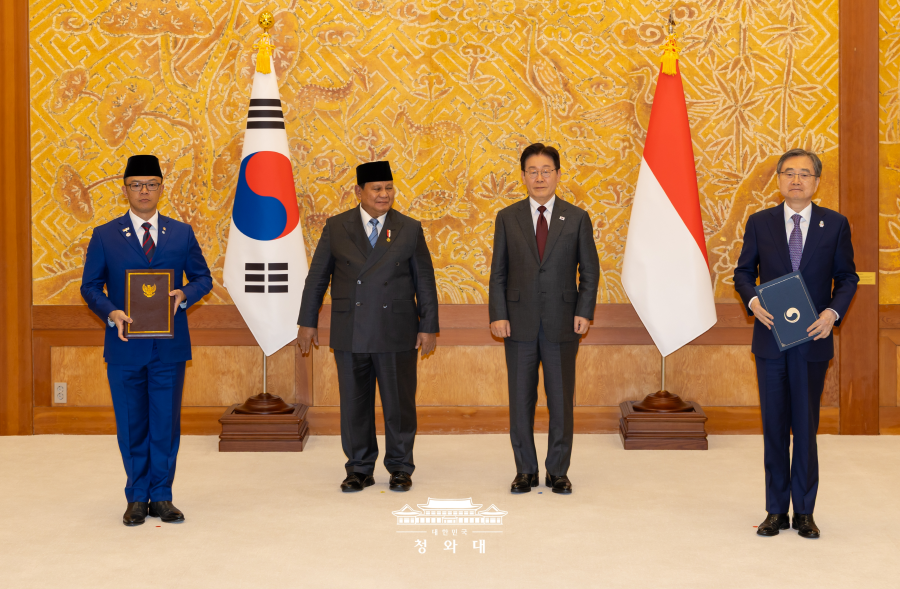
Concerns about the reliability of aviation cooperation have recently resurfaced. On March 25, the rollout ceremony for the first mass-produced KF-21 was held, followed shortly by President Prabowo Subianto’s state visit on April 1. Given the proximity of these events, expectations had been high that a KF-21 procurement agreement would be finalized during the visit.
Prior to the rollout, South Korean officials indicated that the export of the KF-21 would be a key agenda item at the summit, and some reports suggested a possible deal involving 16 aircraft. However, no such agreement was ultimately reached. While the summit elevated bilateral relations from a “Comprehensive Strategic Partnership” to a “Special Comprehensive Strategic Partnership,” it did not yield tangible results in terms of KF-21 procurement, thereby reinforcing uncertainty surrounding defense cooperation.
The controversies surrounding the KF-21 project may be seen as illustrative of the structural constraints inherent in defense cooperation with Indonesia. Repeated disputes over cost-sharing and contract adjustments have highlighted the opacity and volatility of the partnership, leading some to argue for a shift toward independent development.
In particular, growing interest in the KF-21 from Southeast Asian countries such as the Philippines and Malaysia, as well as from partners in the Middle East and Europe, has reinforced the case for a more autonomous approach. Nevertheless, despite these challenges, the strategic rationale for maintaining cooperation with Indonesia remains significant and warrants careful consideration from multiple perspectives.
First, cooperation between the two countries has been built on a solid historical foundation. Indonesia was the first export destination for the KT-1 basic trainer, which South Korea developed using indigenous technology and began mass-producing in 2000. As exports later expanded to Turkey, Peru, Senegal, and other countries, South Korea was able to consolidate its position as an aircraft exporter.
Indonesia was also the first buyer of the T-50 supersonic advanced trainer, which entered mass production in 2005, followed by exports to Iraq, the Philippines, and Thailand. These examples demonstrate that aviation cooperation between the two countries has evolved beyond a one-off engagement, building cumulatively on long-term experience.
Second, it should be noted that the various issues that emerged during the KF-21 development process are widely recognized internationally. South Korea’s continued commitment to cooperation despite Indonesia’s unpredictability offers an opportunity to showcase the credibility and reliability of its defense industry to the global market.
This could generate positive spillover effects not only for the diversification of KF-21 export markets but also for the broader “K-defense” sector. Sustained cooperation with Indonesia could, therefore, contribute to strengthening South Korea’s credibility with other prospective partner countries.
Third, Indonesia’s market potential represents another critical consideration. As of 2025, Indonesia ranks 17th globally in terms of GDP, and with a population exceeding 280 million and an average annual economic growth rate above 5%, it is projected to surpass South Korea in economic size by around 2030. In this context, cooperation with Indonesia should be evaluated from a medium- to long-term strategic perspective rather than through a narrow focus on short-term outcomes.
In particular, KF-21-centered cooperation has the potential to extend beyond the aviation sector to other defense domains, such as naval systems, and further into broader industrial sectors requiring government-to-government collaboration. South Korean President Lee Jae-myung’s reference during the summit to potential cooperation in the naval sector, in addition to aviation, can be seen as reflecting this strategic calculus.
Fourth, Indonesia’s domestic context must also be considered. Although not widely recognized in South Korea, Indonesia developed and produced its own aircraft in the mid-1990s, and Indonesian-made transport aircraft remain in operation in several countries, including South Korea. Given that the aviation industry is closely tied to national prestige, Indonesia has a strong incentive to continue its participation in the KF-21 project—valued at approximately KRW 600 billion—through adjustments to the terms rather than withdrawing entirely.
This position is also reflected in statements by Indonesia’s Minister of Economic Affairs following the visit. According to local reporting, while acknowledging that the KF-21 was a major agenda item between the two leaders, he noted that certain outstanding issues remain regarding procurement. He characterized these issues as primarily technical, including matters related to aircraft specifications, and indicated that engineering personnel would be dispatched to South Korea promptly to address them.
He also referenced the possibility of additional financial support for the project. This represents a meaningful shift in the position articulated by a senior Indonesian official and raises expectations that a KF-21 procurement agreement could be concluded in the near term.
In light of these considerations, it would be premature to conclude that bilateral cooperation has failed solely because a KF-21 export contract was not finalized during the summit. Considering the broader strategic context, the prospect of Indonesia becoming the first export market for the KF-21 remains viable.
Reflecting this potential, President Lee Jae-myung characterized Indonesia during the summit as a key partner that has contributed to the development of the K-defense industry. Furthermore, in a written interview with local media, he described the joint development of the next-generation fighter as an internationally exemplary model of defense cooperation.
To be sure, such an assessment may be considered somewhat optimistic. However, President Lee Jae-myung’s remarks should be understood as a strategic signal aimed at addressing the frictions that have accumulated over the past decade of cooperation and translating them into future achievements. Accordingly, defense cooperation with Indonesia should be evaluated in terms of the accumulation of long-term strategic assets and approached with a focus on sustaining partnerships rather than prioritizing short-term gains.
-
PREV [Current Affairs Analysis]
-
NEXT [Feature Article]