

The Practical Implications of a "Freeze-First" Approach to North Korea's Nuclear Program: A Phased Strategy and the Conditions for Resuming U.S.–North Korea Negotiations

Nam-eun Kim
Chungnam National University
The North Korean nuclear issue has entered a phase in which the normative objective of complete denuclearization increasingly conflicts with the strategic reality of Pyongyang's expanding nuclear capabilities. North Korea seeks to institutionalize its status as a nuclear-armed state as a precondition for negotiations, while the United States continues to uphold the principle of complete denuclearization without presenting a credible diplomatic pathway for achieving that objective. Meanwhile, China's increasingly passive posture and Russia's growing strategic alignment with Pyongyang have eroded the effectiveness of the international sanctions regime. Against this backdrop, the South Korean government has advanced a "freeze-first" strategy that seeks to halt the further expansion of North Korea's nuclear capabilities as an initial step toward reopening negotiations.
On June 19, 2026, President Lee Jae-myung disclosed during a press briefing following his ten-day visit to Europe and participation in the G7 Summit that North Korea's nuclear program had been the central topic of his more than 90-minute bilateral meeting with U.S. President Donald Trump during the official G7 dinner in Évian, France. This disclosure was significant not merely as an account of high-level diplomatic engagement, but because it marked the first indication that Seoul's phased denuclearization strategy had been formally presented to a U.S. president at the highest political level.
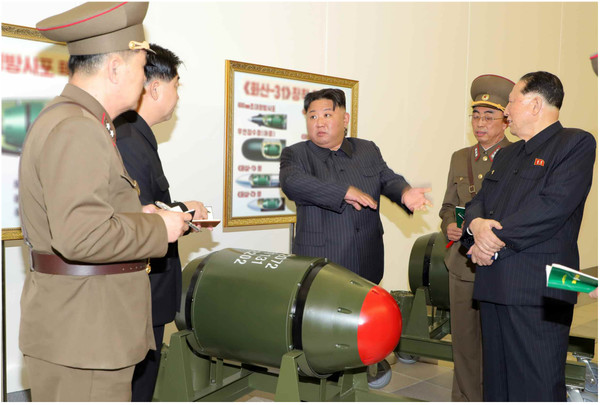
Pyongyang, however, conveyed a fundamentally different message during the same period. On June 23, Rodong Sinmun published the results of the Enlarged Second Plenary Meeting of the Ninth Central Committee of the Workers' Party of Korea, held from June 20 to 22, reporting that Kim Jong Un had identified the continued expansion of North Korea's nuclear forces and the full exercise of its status as a nuclear-weapon state as the country's sole strategic course. North Korea continues to portray its nuclear arsenal as indispensable to regime survival and national sovereignty while increasingly framing its nuclear status not as a subject for negotiation, but as a prerequisite for future dialogue.
The simultaneous articulation of Seoul's phased approach and Pyongyang's insistence on the irreversibility of its nuclear status underscores that the principal obstacle to future negotiations is not merely the resumption of dialogue. Rather, it reflects a deeper structural disagreement over the ultimate objective of the negotiating process.
1. South Korea's "Freeze-First" Strategy: A Phased Path from Nuclear Freeze to Denuclearization
The proposal presented by President Lee to President Trump centers on a phased strategy of freezing, reducing, and ultimately eliminating North Korea's nuclear capabilities.
During his press briefing, President Lee explained that negotiations have reached an impasse because North Korea insists that its status as a nuclear-weapon state must first be recognized before dialogue can begin, whereas the international community remains unwilling to abandon the objective of complete denuclearization. Under these circumstances, he argued, meaningful negotiations have become virtually impossible.
To overcome this deadlock, President Lee proposed first preventing any further expansion of North Korea's nuclear capabilities before pursuing gradual reductions and, ultimately, complete denuclearization. The immediate objectives include halting the further production of fissile materials, preventing the transfer of nuclear materials abroad, and suspending the continued development of intercontinental ballistic missile (ICBM) technologies. These initial measures would then be followed by a broader process of reducing mutual security threats and creating the conditions necessary for eventual denuclearization.
According to President Lee, President Trump responded that "this could be one possible approach" and indicated that he would give the proposal serious consideration.
This initiative reflects Seoul's continued shift toward a more pragmatic and phased approach to addressing the North Korean nuclear issue.
The Fifth Basic Plan for the Development of Inter-Korean Relations (2026–2030) identifies "achieving substantive progress on the North Korean nuclear issue through a phased and pragmatic approach" as one of the government's principal policy objectives. Similarly, Minister of Unification Jeong Dong-young has emphasized the importance of creating favorable conditions for both inter-Korean and U.S.–North Korea dialogue while pursuing gradual, practical measures toward denuclearization.
Likewise, Yeondoo Jung, South Korea's Head of the Bureau of Diplomatic Strategy and information of the Ministry of Foreign Affairs, outlined a three-stage framework—freeze, reduction, and dismantlement—at the Conference on Disarmament in Geneva. Under this approach, North Korea's nuclear and missile programs would first be frozen, followed by the gradual reduction of its nuclear capabilities and, ultimately, their complete dismantlement.
Taken together, these initiatives reflect Seoul's effort to preserve complete denuclearization as the long-term objective while recognizing the practical necessity of first halting the continued expansion of North Korea's nuclear capabilities.
2. North Korea's Hardline Position: Institutionalizing Its Status as a Nuclear-Weapon State
For Seoul's phased strategy to succeed, North Korea must have at least some incentive to return to negotiations. The outcomes of the June 2026 Party Plenary Meeting, however, indicate that Pyongyang currently places far greater priority on institutionalizing its status as a nuclear-weapon state than on resuming denuclearization talks.
During the meeting, Kim Jong-un cited discussions in South Korea regarding the acquisition of nuclear-powered submarines, combined U.S.–ROK military exercises, and allied intelligence, surveillance, and reconnaissance (ISR) activities as the principal drivers of heightened tensions on the Korean Peninsula. Against this backdrop, he reaffirmed that "the continuous expansion and strengthening of nuclear forces and the full exercise of our status as a nuclear-weapon state constitute the only correct strategic course."
Kim further characterized North Korea's nuclear forces as the foundation of the country's military sovereignty and the central pillar of both its deterrence posture and war-fighting strategy, while directing the continued expansion of its defense capabilities. The Plenary Meeting also denounced the U.S.–ROK Nuclear Consultative Group (NCG), portraying its nuclear planning exercises as evidence of the "criminal nature" of a "nuclear war apparatus." Such rhetoric reinforces Pyongyang's longstanding narrative that strengthened U.S.–ROK extended deterrence serves as the principal justification for the continued expansion of its own nuclear arsenal.
This position had already been foreshadowed several days earlier. On June 18, Kim Yo-jong, Vice Department Director of the Workers' Party of Korea, declared that "denuclearization is an issue that has already been conclusively settled." Her statement further underscored Pyongyang's determination to regard its nuclear status not as a subject for negotiation but as a fixed reality—and a prerequisite for any future dialogue.
If this position remains unchanged, North Korea is unlikely to embrace Seoul's freeze–reduction–denuclearization framework. Instead, it is more likely to seek to redefine future negotiations as discussions on nuclear arms control or strategic arms management rather than denuclearization. Whereas South Korea views a nuclear freeze as the first stage of a broader denuclearization process, Pyongyang is more likely to regard such an agreement as implicit international recognition of its status as a de facto nuclear-weapon state. This divergence in the interpretation of a "freeze" constitutes one of the most fundamental conceptual obstacles to any future negotiation process.
3. The United States: A Principled Position Without a Clear Strategy
The official U.S. position continues to center on the complete denuclearization of North Korea. In early June 2026, coinciding with Chinese President Xi Jinping's June 8–9 visit to Pyongyang, Washington reaffirmed this position through two separate diplomatic channels.
First, at the International Atomic Energy Agency (IAEA) Board of Governors meeting in Vienna on June 9, the U.S. delegation rejected assertions that North Korea's weapons of mass destruction and ballistic missile programs constitute "a closed issue." Second, in the joint statement issued following the U.S.–Japan Extended Deterrence Dialogue (EDD) held in Tokyo on June 8–9, the U.S. Departments of State and Defense, together with Japan's Ministry of Foreign Affairs and Ministry of Defense, rejected Russia's characterization of North Korea's nuclear program as a settled matter and reaffirmed their shared commitment to the complete denuclearization of North Korea.
These statements stand in marked contrast to China's decision not to publicly reference denuclearization during President Xi's visit to Pyongyang. They also underscore Washington's continuing effort to prevent the emergence of international narratives that could be interpreted as implicitly recognizing North Korea as a legitimate nuclear-weapon state.
Beyond reaffirming this long-standing principle, however, the U.S. approach continues to face significant strategic limitations. President Trump's reported remarks during his meeting with President Lee Jae-myung suggest an implicit recognition that the existing policy framework has reached its limits. According to President Lee, President Trump observed that "it is unfortunate that no practical measures were taken before North Korea actually acquired nuclear weapons," before adding that Seoul's phased proposal "could be one possible approach" worthy of further consideration.
Although the 2018 Singapore Summit reaffirmed the shared objective of complete denuclearization, the United States has yet to develop a practical negotiating framework capable of translating that objective into sustained diplomatic progress. President Lee's observation that President Trump expressed frustration over the current state of U.S.–North Korea diplomacy further illustrates this dilemma: Washington continues to uphold denuclearization as its strategic objective while lacking a clearly defined diplomatic pathway to achieve it.
Against this backdrop, Seoul's freeze-first strategy assumes particular significance. Rather than abandoning the principle of complete denuclearization, it seeks to establish realistic conditions for resuming negotiations by first halting the continued expansion of North Korea's nuclear capabilities.
4. China and Russia: Strategic Silence and Explicit Support Weaken International Pressure
The international pressure campaign surrounding North Korea's nuclear program has weakened considerably as both China and Russia have recalibrated their respective approaches toward Pyongyang.
During President Xi Jinping's June 8–9 visit to North Korea—his first in seven years—Beijing notably omitted any public reference to "the denuclearization of the Korean Peninsula" in the official readout of the summit. This marked a clear departure from Xi's 2019 visit, during which both sides explicitly reaffirmed their commitment to the denuclearization of the Korean Peninsula.
The omission suggests that Beijing increasingly views North Korea's nuclear issue through the broader prism of regional strategic competition rather than primarily as a nonproliferation challenge. China's current priorities appear to include stabilizing Sino–North Korean relations, preventing Pyongyang from drifting further toward Moscow, managing strategic competition with the United States, and responding to the expanding security cooperation among the United States, South Korea, and Japan.
This interpretation is consistent with the assessments of several leading U.S. analysts. Sydney Seiler, Senior Adviser at the Center for Strategic and International Studies (CSIS), has argued that meaningful denuclearization discussions between Beijing and Pyongyang are increasingly unlikely because China's leverage over North Korea has diminished significantly. Likewise, Patricia Kim, Senior Fellow at the Brookings Institution, has observed that public pressure from Beijing is unlikely to alter Pyongyang's firmly entrenched nuclear policy and could instead accelerate North Korea's strategic dependence on Russia.
Taken together, these assessments suggest that China is gradually shifting from serving as a principal advocate of denuclearization to acting as a strategic manager of regional stability and balance-of-power dynamics.
Russia's position has become even more explicit.
The joint statement issued following the Xi–Putin Summit on June 1 likewise omitted any reference to denuclearization. Instead, China and Russia jointly declared their opposition to "diplomatic isolation, economic sanctions, and military pressure that threaten North Korea's security." Rather than encouraging denuclearization, the statement signaled expanded political support for Pyongyang.
The subsequent U.S.–Japan Extended Deterrence Dialogue further underscored this growing divergence. Its joint statement explicitly rejected Russia's assertion that North Korea's nuclear weapons program is "a closed issue," reflecting Washington's and Tokyo's concern that Moscow's position could contribute to the gradual international normalization of North Korea's status as a nuclear-weapon state.
Compared with China's strategic silence, Russia has adopted a far more proactive posture in supporting Pyongyang. Together, these developments have weakened international coordination on North Korea policy and further eroded the credibility of the international sanctions regime.
The cumulative impact of China's restraint and Russia's overt support has become increasingly evident in multilateral institutions.
The Eleventh Review Conference of the Treaty on the Non-Proliferation of Nuclear Weapons (NPT), held at United Nations Headquarters in New York from April 27 to May 22, 2026, failed for the third consecutive review cycle to produce a final consensus document, following similar failures in 2015 and 2022. More significantly, language condemning North Korea's nuclear weapons program—which had appeared in draft texts during previous review conferences—was omitted altogether.
These developments underscore an important reality: Seoul's freeze-first strategy cannot succeed through international sanctions alone. Instead, future diplomacy will necessarily depend less on multilateral pressure and more on close U.S.–ROK policy coordination, robust verification mechanisms, and clearly defined reciprocal implementation measures.
5. The Practical Implications of a Freeze-First Strategy: Opportunities for Compromise and Effective Implementation
Against the backdrop of the current diplomatic stalemate, Seoul's freeze-first approach offers a potentially realistic entry point for renewed negotiations.
With North Korea categorically rejecting denuclearization talks and the United States remaining committed to complete denuclearization, negotiations are unlikely to resume unless both sides can identify a politically acceptable intermediate objective. In this context, a freeze on the further expansion of North Korea's nuclear program offers a practical starting point that preserves the long-term objective of denuclearization while creating space for renewed diplomacy.
The three immediate objectives proposed by Seoul—halting additional production of fissile materials, prohibiting the transfer of nuclear materials abroad, and suspending further ICBM development—represent concrete and verifiable measures designed to prevent both the qualitative and quantitative expansion of North Korea's nuclear capabilities. Their relative clarity makes them suitable candidates for an initial negotiating agenda.
More importantly, the freeze-first approach would enable South Korea to play a more active role in shaping the structure of future negotiations. Rather than remaining a passive observer of U.S.–North Korea diplomacy, Seoul could help define the scope of the freeze, establish verification mechanisms, design reciprocal incentives, and determine the conditions under which negotiations would transition from a freeze to reductions in nuclear capabilities. By doing so, South Korea would strengthen its ability to ensure that future negotiations adequately reflect its own security interests.
Nevertheless, the approach also carries significant risks.
North Korea already possesses operational ICBMs and an expanding nuclear arsenal. Consequently, an agreement focused solely on freezing future development could be interpreted as tacit acceptance of its existing nuclear capabilities. Previous diplomatic experience—including the 1994 Agreed Framework and the 2007 Initial Actions Agreement under the Six-Party Talks—demonstrates that freeze arrangements can become protracted and ultimately ineffective when they are not accompanied by robust verification mechanisms and credible pathways toward subsequent implementation.
There is also a significant risk that Pyongyang would seek to redefine future negotiations as discussions on nuclear arms control rather than denuclearization. Moreover, in an international environment where sanctions enforcement has weakened due to China's restraint and Russia's support, a freeze agreement could inadvertently reduce the bargaining leverage of both Seoul and Washington.
These risks should not be interpreted as arguments against a freeze-first strategy. Rather, they highlight the importance of careful institutional design.
The comprehensive denuclearization approach pursued since 1994 has produced limited tangible progress despite more than three decades of diplomatic efforts. At the same time, both Washington and Pyongyang appear to recognize the limitations of the current impasse without having identified a viable alternative. These circumstances underscore the need for a new negotiating framework.
A carefully designed freeze-first strategy offers one such alternative. It preserves complete denuclearization as the ultimate objective while creating politically feasible conditions under which both the United States and North Korea could return to the negotiating table. If accompanied by clearly defined limits on the scope of the freeze, rigorous verification procedures, predetermined responses to violations, and explicit benchmarks for transitioning to a reduction phase, a freeze-first framework could become more than simply a mechanism for facilitating another U.S.–North Korea summit. It could provide a realistic foundation for restarting a sustained denuclearization process on the Korean Peninsula.
-
PREV [Current Affairs Analysis]
-
NEXT [Feature Article]