

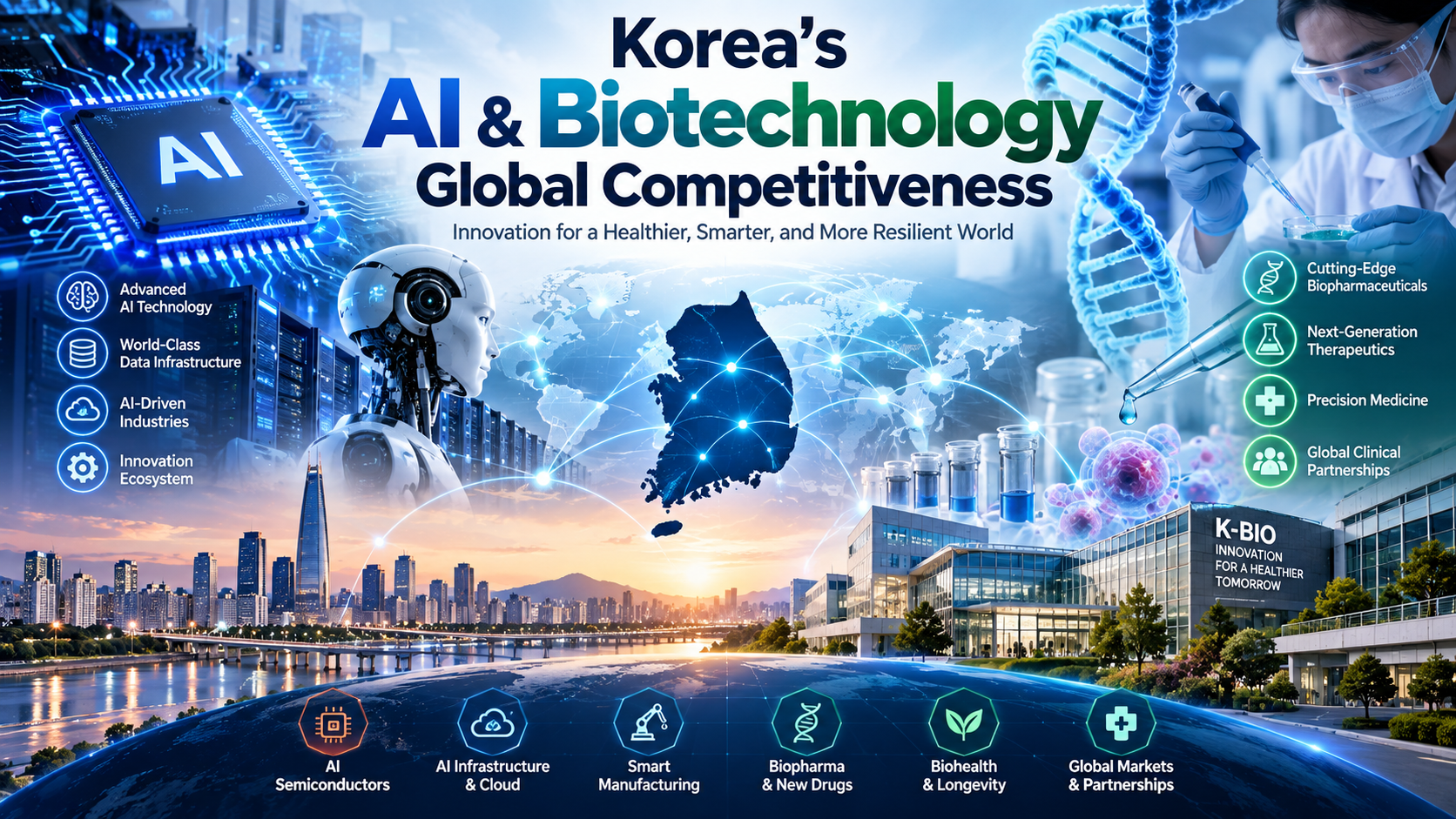
South Korea’s Competitive Edge in AI and Biotechnology Lies in Its Factories and Hospitals
Keeyoung Yoon
Adjunct Professor
Hankuk University of Foreign Studies
Introduction
When NVIDIA announced at the APEC Summit in Gyeongju on October 31, 2025, that it would supply more than 260,000 GPUs to the South Korean government and major Korean companies, including Samsung, SK, Hyundai Motor Group, and Naver, my initial reaction was that the announcement sounded somewhat like a sales pitch. Perhaps that assessment was unfair to NVIDIA. According to estimates by South Korean analysts at the time, South Korea had only about 45,000 high-end GPUs, meaning that the commitment could multiply the country’s computing capacity several times over. Nevertheless, semiconductors are only one component of a broader AI ecosystem. A functioning ecosystem requires the effective integration of talent, data, regulatory frameworks, and the institutions and organizations capable of putting computing resources to productive use. In my view, South Korea was already making progress toward building such an ecosystem. Even so, I regarded NVIDIA’s commitment as a meaningful demonstration of the government’s determination and a potential catalyst for further development.
This article examines South Korea’s AI ecosystem and biotechnology industry through the lens of the Three Horizons framework used in futures studies, focusing on their potential development trajectories. My central argument is that South Korea’s comparative advantages in these fields lie primarily in its manufacturing infrastructure and healthcare system, rather than in the race to develop ever-larger frontier AI models—a competition currently dominated by research institutions and technology companies in the United States and China. Because promotional narratives offer limited value to policymakers, I also seek to provide a balanced assessment of South Korea’s structural weaknesses and institutional constraints.
South Korea’s AI Ecosystem
The AI ecosystem encompasses a broad range of interconnected capabilities, including semiconductors, computing infrastructure, foundation models, data, distribution channels through which AI reaches end users, and the financial and regulatory frameworks that support these activities. South Korea possesses substantial competitive advantages in certain segments of this ecosystem, while in others its capabilities remain broadly comparable to those of its international peers.
Its most significant competitive advantage lies in memory semiconductors. High-bandwidth memory (HBM) consists of vertically stacked DRAM chips positioned alongside AI accelerators to ensure that data can be delivered to processors at the speed required for optimal performance. HBM is therefore indispensable to realizing the full computational potential of advanced GPUs. According to Counterpoint Research, SK Hynix accounted for 50 percent of global HBM revenue in the second quarter of 2026, while Samsung Electronics accounted for another 33 percent. In other words, these two South Korean companies captured more than four-fifths of global HBM spending. Their intense competition for major customers, including NVIDIA, benefits buyers by expanding supply options and encouraging technological innovation. However, South Korea's position changes considerably at the next level of the technology stack. The country has yet to design a leading-edge AI accelerator capable of competing at the technological frontier. Although Samsung's foundry business is expected to return to profitability, it continues to lag behind Taiwan Semiconductor Manufacturing Company (TSMC). Moreover, South Korean AI developers, like many of their counterparts elsewhere, remain heavily dependent on NVIDIA's CUDA software ecosystem.
In AI model development, South Korea is relatively well positioned compared with most countries of similar economic size. The government has shown considerable commitment to developing sovereign AI capabilities. Worldwide, 184 countries are pursuing some form of sovereign AI, a concept that encompasses a broad spectrum of capabilities, from domestically developed foundation models to nationally controlled data centers and computing infrastructure.
South Korea’s initiative places particular emphasis on developing indigenous foundation models. Following successive rounds of competition among domestic developers, LG AI Research’s EXAONE, Upstage’s Solar, and SK Telecom’s A.X remain among the active contenders at the time of writing. Nevertheless, I do not expect these models to achieve technological parity with the world’s leading frontier models in the near term.
I once recommended that a medical supplies manufacturer introduce computer vision AI into its production-line quality inspection process. The company adopted the proposal, and the system was successfully implemented. The technology itself was not particularly sophisticated. Yet I believe that South Korea’s greatest AI-related economic gains will come from the cumulative impact of thousands of comparable applications across its industrial base.
The country’s most valuable data assets may not be the vast repositories of web-based text accumulated by major platform companies in the United States and China. Rather, they may lie in the data generated continuously by physical production processes in semiconductor fabrication plants, shipyards, steel mills, and automobile factories, where operational and inspection data are recorded around the clock. The International Federation of Robotics (IFR) has consistently ranked South Korea first in the world in industrial robot density, with more than 1,000 industrial robots per 10,000 manufacturing workers. Against this backdrop, it is no coincidence that Samsung, SK, and Hyundai Motor Group have each announced plans to deploy approximately 50,000 NVIDIA GPUs in AI factories to support manufacturing operations and autonomous driving technologies.
Government investment in AI has also increased substantially. South Korea’s 2026 budget allocated KRW 10.1 trillion, approximately US$7 billion, to the AI sector, nearly three times the KRW 3.3 trillion allocated in 2025. On January 22, 2026, the country’s AI Basic Act entered into force. Although the legislation provides a one-year grace period before penalties may be imposed, its implementation places South Korea among the early adopters of comprehensive AI regulatory frameworks, alongside the European Union’s AI Act.
According to Stanford University’s AI Index 2025, South Korea ranked first globally in AI patents per 100,000 people in 2023, with 17.27 patents, and retained its leading position in the 2026 edition. Patents, however, are only one measure of technological activity. They do not necessarily indicate commercial adoption or translate directly into economic value. The 2026 AI Index also ranked South Korea third in the number of notable AI models released in 2025. Yet the country produced only a handful of such models, compared with approximately 50 in the United States and 30 in China. Given the substantial gap between South Korea and the two leading countries, its third-place ranking should not be overstated.
South Korea also faces structural challenges in translating its research capabilities into broader technological influence. South Korean companies have yet to establish global developer ecosystems comparable to those maintained by major U.S. hyperscalers. Meanwhile, many talented South Korean AI researchers continue to seek opportunities abroad, attracted in part by more competitive compensation.
Biotech Industry
Samsung Biologics was established only in 2011, yet it has since emerged as the world’s largest contract development and manufacturing organization (CDMO), providing biopharmaceutical development and manufacturing services to pharmaceutical companies that retain ownership of the underlying drug intellectual property. Its total production capacity has reached approximately 845,000 liters, including the facility in Rockville, Maryland, acquired from GSK. In 2025, Samsung Biologics reported revenue of KRW 4.56 trillion and operating profit of KRW 2.07 trillion, becoming the first South Korean biopharmaceutical company to exceed KRW 2 trillion in annual operating profit.
Meanwhile, Celltrion has expanded its business through biosimilars. In July 2026, the company announced that its infliximab biosimilar had captured a 48 percent share of the Japanese market, surpassing the originator product in sales volume for the first time. Both companies are now investing in antibody-drug conjugates (ADCs), which use antibodies to deliver cytotoxic agents selectively to cancer cells. Contract manufacturing remains the most mature segment of South Korea’s biotechnology industry, followed by healthcare data applications and clinical trials. Independent drug discovery and development, by contrast, has a comparatively limited track record.
U.S. government policy has also created an unintended opportunity for South Korean companies. As restrictions targeting designated biotechnology companies of concern were introduced through the BIOSECURE provisions incorporated into the fiscal year 2026 National Defense Authorization Act (NDAA), pharmaceutical developers began seeking manufacturing partners outside China. South Korean CDMOs, alongside established international providers such as Lonza and Fujifilm, are well positioned to benefit from this shift. At the same time, Washington is encouraging pharmaceutical production within the United States. This policy environment helps explain Samsung Biologics’ acquisition of the Rockville facility. To capitalize on these opportunities, South Korean companies will increasingly need to establish production capabilities closer to their principal customers.
My assessment of South Korea’s healthcare data sector is considerably more pessimistic, primarily because of the institutional structure of its healthcare system. On paper, the country’s data resources are extraordinary. The National Health Insurance Service (NHIS), which operates as the country’s single public insurer, provides coverage for virtually the entire population of approximately 51 million people. Its records, dating back to 2002, integrate information on insurance eligibility, medical claims, health screenings, cancer and rare disease registries, and long-term care insurance. According to the NHIS, these datasets contain more than one trillion records. This wealth of information offers an exceptional foundation for generating real-world evidence (RWE)—evidence derived from data collected through routine clinical practice to assess treatment outcomes and effectiveness—at a scale few other countries can match.
In practice, however, South Korea’s healthcare system remains highly fragmented, with hospitals and clinics sharing relatively little information. As of September 2024, approximately 91 percent of medical institutions had adopted electronic medical records (EMRs), yet only about 12 percent used government-certified systems. The seamless transfer of patient records between institutions remains exceptionally rare, while the adoption of interoperability standards such as the Observational Medical Outcomes Partnership (OMOP) Common Data Model and Health Level Seven Fast Healthcare Interoperability Resources (HL7 FHIR) has progressed slowly.
Meanwhile, the Personal Information Protection Act imposes stringent requirements on the collection, processing, and sharing of personal data, broadly reflecting public preferences regarding privacy. I see little reason to expect rapid change. The obstacles are not simply technological; they are also institutional, involving competing interests and differing assessments of the costs, benefits, and implications of greater data integration.
Clinical trials represent another competitive advantage whose durability should not be taken for granted. According to the Korea National Enterprise for Clinical Trials (KoNECT), Seoul ranked first globally among cities in the number of clinical trials conducted for several consecutive years. Approximately half of South Korea’s population lives in the Seoul metropolitan area, which is also home to major academic medical centers, including Seoul National University Hospital, Asan Medical Center, Samsung Medical Center, and Severance Hospital in Sinchon. In addition, the Ministry of Food and Drug Safety’s 30-business-day review period for Investigational New Drug (IND) applications has helped sponsors initiate clinical trials relatively quickly and recruit patients efficiently.
In 2024, however, Seoul fell to second place behind Beijing, while South Korea’s global ranking by clinical trial market share declined from fourth to sixth. Much of the industry has attributed this deterioration to the prolonged disruption caused by resident physicians’ collective action in response to the government’s proposed increase in medical school enrollment quotas. My assessment is more nuanced. Although physician shortages have weakened clinical research capacity, they may also accelerate the adoption of medical AI technologies in South Korean hospitals.
South Korea is no longer merely a manufacturing base for pharmaceutical products developed elsewhere. Lazertinib, a lung cancer treatment developed by Yuhan Corporation and licensed to Johnson & Johnson, received approval from the U.S. Food and Drug Administration (FDA) in August 2024 for use in combination with amivantamab. Similarly, Alteogen’s enzyme technology underpinned the subcutaneous formulation of Merck’s Keytruda, which received FDA approval in September 2025.
Both products reached international markets through technology-licensing arrangements, which remain a principal mechanism through which South Korean pharmaceutical research is commercialized globally. As a result, a substantial share of the economic value generated may accrue to overseas partners. With a few notable exceptions, such as cenobamate, an epilepsy treatment developed by SK Biopharmaceuticals and marketed directly in the United States, South Korean companies have had limited success in independently managing the entire drug-development process, from laboratory discovery to commercialization in global markets.
The Future as Seen Through the Three Horizons Framework
The Three Horizons framework originated in McKinsey’s 1999 model of business growth and was subsequently adapted into a futures studies methodology by Bill Sharpe, Anthony Hodgson, and Andrew Curry. Horizon 1 (H1) represents the prevailing system of economic activity, which may remain highly profitable even as it becomes increasingly misaligned with changes in its surrounding environment. Horizon 3 (H3) represents emerging patterns of future activity whose early manifestations can already be observed at the margins of the existing system. Horizon 2 (H2) is the unstable transitional space between the two, where innovations may either help bring H3 into being (H2+) or merely prolong the viability of H1 (H2−).
The framework is not designed to generate statistical forecasts. Rather, it encourages policymakers and other stakeholders to consider which emerging patterns they wish to support and cultivate. I frequently use this framework in lectures and workshops in South Korea, where participants generally find it more concrete and useful than conventional distinctions among short-, medium-, and long-term planning. They also often express concern that policies oriented toward the distant future are difficult to sustain within South Korea’s institutional environment.
Recently, however, signs of change have emerged. As AI technology advances rapidly, I have observed a growing willingness to discuss Horizon 3 and commit resources to initiatives intended to help bring that future into being.
South Korea’s first strategic horizon (H1) is defined by its manufacturing-led export model, particularly in memory semiconductors, contract development and manufacturing organization (CDMO) services, and biosimilars. These industries generate substantial profits and strengthen South Korea’s bargaining position in trade and security negotiations. Nevertheless, the model is gradually approaching significant structural limits. China’s Changxin Memory Technologies (CXMT) is expanding into DRAM and high-bandwidth memory (HBM), Chinese CDMO companies continue to compete aggressively on price, and South Korea’s working-age population is shrinking. The country’s total fertility rate fell to a record low of 0.72 in 2023 before rising modestly to 0.75 in 2024.
The profits generated by H1 provide essential financial resources for future transformation. Yet continued profitability can also diminish the perceived urgency of structural change, making it more difficult to redirect resources and attention toward emerging opportunities.
Horizon 2 contains numerous promising opportunities. These include industrial and physical AI deployed in new AI factories, sovereign AI models designed for government agencies and regulated sectors, AI-assisted drug discovery, antibody-drug conjugate (ADC) platforms, and real-world evidence (RWE) applications drawing on National Health Insurance Service (NHIS) data. Whether these initiatives contribute to genuine transformation will depend heavily on policy choices.
If GPUs are acquired primarily for symbolic purposes, domestic models are shielded from international competition, and public programs are captured by a small number of major conglomerates, these investments will become H2− initiatives that merely extend the existing economic model. By contrast, progress toward H2+ will require opening access to data under rigorous privacy safeguards, enforcing interoperability standards, providing startups with equitable access to national computing infrastructure, and evaluating publicly supported programs against measurable indicators of adoption and practical impact.
Implementing this second set of reforms will be considerably more difficult. Given the institutional and political obstacles involved, I remain skeptical that policymakers will consistently follow through.
The third strategic horizon (H3) I envision is a nationwide learning healthcare system. Such a system continuously incorporates data generated through routine clinical care into research and translates research findings back into clinical practice. South Korea already possesses many of the essential components: comprehensive population-level data generated by its single-payer health insurance system, hospitals capable of conducting clinical trials relatively quickly, extensive biopharmaceutical manufacturing capacity, and the memory semiconductors and AI computing infrastructure needed to train advanced models.
If these assets can be effectively integrated, AI could help identify promising drug candidates through population-level data analysis, South Korean hospitals could conduct clinical evaluations, and domestic manufacturing facilities could produce the resulting therapies. Nevertheless, given my concerns about the fragmentation of healthcare data, I regard this vision as a possibility worth pursuing rather than an outcome that can be confidently predicted.
Demographic change adds another dimension to this opportunity. South Korea became a super-aged society in December 2024, when the proportion of its population aged 65 and older exceeded 20 percent. As a result, the pressures that many advanced economies will face over the coming generation—from rising demand for healthcare services and long-term care to the need for innovative treatments—are already acutely visible in South Korea.
The future remains open, but it is already shaped by emerging structures and constraints. Amara’s Law reminds us that societies tend to overestimate the short-term effects of technological change while underestimating its long-term consequences. The 2026 AI budget may disappoint those expecting immediate and dramatic results. Viewed over a 20-year horizon, however, the convergence of artificial intelligence and biotechnology in South Korea could prove far more consequential than current expectations suggest.
Conclusion
The growing multipolarity and fragmentation of the international order are making trust an increasingly scarce strategic resource. South Korea has the potential to become a reliable partner on which other countries can depend, offering tangible value to foreign policymakers. South Korea supplies the overwhelming majority of the world’s high-bandwidth memory (HBM), operates the world’s largest biopharmaceutical contract development and manufacturing organization (CDMO), and possesses one of the most comprehensive population-based healthcare datasets available.
Provisions associated with the U.S. BIOSECURE Act have elevated concerns about reliance on Chinese biomanufacturing to the level of national security policy. Through bilateral agreements, South Korea and its partners could formally recognize Korean memory semiconductor and biopharmaceutical manufacturing capabilities as essential components of trusted supply chains.
Greater interoperability across South Korea’s healthcare records could also open new opportunities for international research collaboration. Foreign researchers could conduct studies using appropriately anonymized South Korean healthcare data within secure computing environments, while partner countries with extensive experience implementing the Observational Medical Outcomes Partnership (OMOP) Common Data Model and Health Level Seven Fast Healthcare Interoperability Resources (HL7 FHIR) standards could provide technical expertise and institutional support.
Finally, other governments could learn from South Korea’s experience implementing AI regulation. South Korea’s AI Basic Act is among the early comprehensive AI regulatory frameworks to enter into force. Its implementation over the coming years could offer valuable lessons for governments seeking to develop regulatory approaches that balance technological innovation, public protection, and economic competitiveness.
Foreign companies are likely to achieve greater success by complementing, rather than directly competing with, South Korean firms. Although South Korea’s major conglomerates possess considerable industrial capabilities, they have often struggled to develop internationally competitive software platforms and build global user bases. This creates meaningful opportunities for foreign partners with established distribution networks, software expertise, and access to international markets.
Pharmaceutical companies can use South Korea as a base for early-stage clinical trials and as an alternative to China for biopharmaceutical manufacturing, while recognizing the vulnerability of its clinical research capacity to systemic disruptions, as demonstrated by the 2024 crisis involving resident physicians. AI companies, meanwhile, may find opportunities among factories and hospitals seeking solutions tailored to Korean-language requirements, industry-specific workflows, and domestic regulatory conditions.
Smaller foreign partners, in particular, should recognize that economic value in South Korea is often concentrated among a relatively small number of large conglomerates. They should therefore establish clear contractual protections for data access and use, intellectual property ownership, and the allocation of commercial rights from the outset.
Investors, meanwhile, face two distinct investment horizons in the South Korean economy. The first, H1 Korea, is represented by memory semiconductors, contract development and manufacturing organizations (CDMOs), and biosimilars. These industries generate substantial cash flows and carry considerable strategic importance, but they are also cyclical and exposed to competition from China and shifts in U.S. industrial policy.
The second, H2 Korea, encompasses physical AI, antibody-drug conjugates (ADCs), AI-driven drug discovery, and healthcare data services. These sectors offer greater potential for long-term growth, but their commercial prospects remain considerably more uncertain.
For H2 Korea, I recommend monitoring several indicators over the coming years: the actual utilization of national GPU resources by startups and hospitals; the adoption of certified electronic medical record (EMR) systems and common healthcare data standards; the number of innovative drugs developed in South Korea and commercialized globally by their developers, rather than primarily through licensing arrangements; and whether South Korea recovers its previous position in the global clinical trials market.
Investors should also be cautious about corporate valuations that rise or fall sharply in response to government budget announcements rather than demonstrable progress in technology adoption, revenue generation, and commercial performance.
South Korea has achieved remarkable economic success by manufacturing high-quality products efficiently and at scale. Whether it can now build an integrated system that continuously learns from its factories and healthcare institutions remains an open question. International partners that engage early will have an opportunity not only to contribute to this transformation but also to help shape its direction. I hope many will choose to be part of this endeavor.
- References (Sources) -
Counterpoint Research. (2026). Global DRAM and HBM market share: Quarterly. https://counterpointresearch.com/insights/global-dram-and-hbm-market-share
Samsung Biologics. (January 21, 2026). Samsung Biologics reports fourth-quarter and fiscal year 2025 financial results. https://samsungbiologics.com/media/company-news/samsung-biologics-reports-fourth-quarter-and-fiscal-year-2025-financial-results
Korea Times. (August 29, 2025). Korea to more than triple AI budget to $7.27 billion in 2026. https://www.koreatimes.co.kr/economy/20250829/korea-to-more-than-triple-ai-budget-to-727-bil-in-2026
Korea Times. (January 15, 2026). Naver Cloud and NC AI excluded from national AI foundation model competition. https://www.koreatimes.co.kr/business/tech-science/20260115/naver-cloud-nc-ai-cut-from-national-ai-foundation-model-race
NVIDIA. (October 31, 2025). NVIDIA, the South Korean government, and industrial giants build AI infrastructure and ecosystem. https://investor.nvidia.com/news/press-release-details/2025/NVIDIA-South-Korea-Government-and-Industrial-Giants-Build-AI-Infrastructure-and-Ecosystem-to-Fuel-Korea-Innovation-Industries-and-Jobs/
Stanford HAI. (2025). AI Index Report 2025. https://hai-production.s3.amazonaws.com/files/hai_ai_index_report_2025.pdf
Cooley. (January 27, 2026). South Korea's AI Basic Act: Overview and Key Takeaways. https://www.cooley.com/news/insight/2026/2026-01-27-south-koreas-ai-basic-act-overview-and-key-takeaways
Korea National Enterprise for Clinical Trials (KoNECT). Why Korea. https://khub.konect.or.kr/whykorea/whykorea
Sharpe, B. (2013). Three Horizons: The Patterning of Hope. Triarchy Press.
BioPharma Dive. (November 22, 2019). FDA approves SK Life Science's epilepsy drug Xcopri. https://www.biopharmadive.com/news/fda-approval-xcopri-epilepsy-sk-life-science/567898/
-
PREV [Feature Article] K-Satellite Industry
-
NEXT 다음 글이 없습니다.