

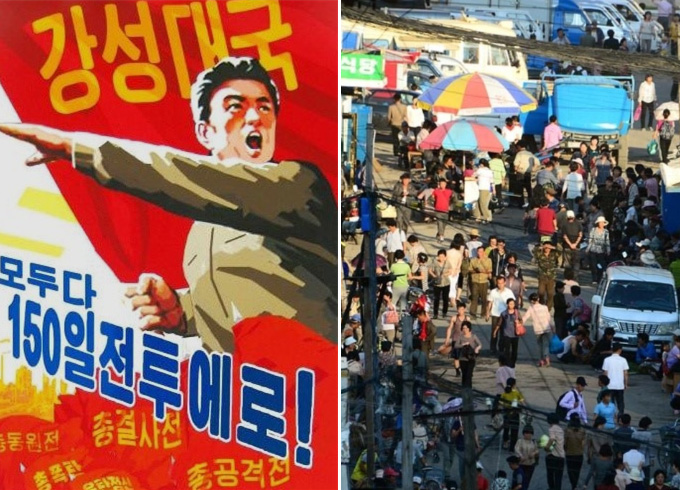
The 'Antisocial Group' was formed in North Korea as a result of increased deviant behavior due to external intervention following the collapse of the Soviet Union and socialist countries in Eastern Europe in the late 1980s.Established in October 1992, by order of Kim Jong-il, it was created as the non-permanent inspection organization to remove and monitor "antisocial" phenomena within North Korea. It controls and regulates all regions of North Korea by managing "antisocial" behavior.The 'Antisocial Group' is made up of personnel from five North Korean organizations: the Organization and Guidance Department of WPK, Central Prosecutor's Office, Central Court, State Security Department, and Ministry of Social Security. Its main role is to censor and crack down on antisocial elements that arise in the daily lives of North Korean citizens.
In the early 1990s, North Korea experienced significant shockwaves as it witnessed the transition of socialist regimes in the Soviet Union and Eastern Europe. To prevent "socialist betrayers" from leaving North Korea or "revisionism" from entering North Korea, North Korea expanded its police force in the Social Security Agency. Together with this expansion, North Korea established various organizations such as "6.4 Antisocial Group," "Workers' Surveillance Corps," and "Antisocial Elimination Group" for ideological education and surveillance of residents.
Since July 10, 2004, the "Antisocial Group" has resumed its activities under the name "6.4 Antisocial Group" in the border area. This group is said to have originated from the "Antisocial Group" organized on June 4th, but there is also an assessment that it is a surveillance and control organization that is conscious of the June 4th Tiananmen Square protests and massacre in China in 1989.
Initially, when the "Antisocial Group" was first organized in the 1990s, it focused on exposing political phenomena such as dissident propaganda and spreading obituaries of political leaders. However, since the 2000s, the scope of censorship has expanded to include unemployment, gangsters, domestic tutors, doctors who make house calls, nurses, and pharmacists. In particular, they have strengthened the censorship of the border area, with a focus on trade and other economic activities. The "Antisocial Group" was established with the aim of preventing the influx of capitalist cultural and lifestyle trends that come with the introduction and expansion of markets. They monitor and control not only ordinary residents but also party cadres in order to strengthen their control.
-
PREV [Opinion]
-
NEXT [North Korea Glossary]