

2024 Outlook on Advancements in North Korea's Nuclear and Missile Capabilities and South Korea's Strategy for Nuclear Latency

Cheong Seong-chang,Ph.D.
THE SEJONG INSTITUTE
Director, Center for Korean Peninsula Strategy
In December 2022, Kim Jong-un declared at a Workers' Party of Korea meeting his intention to ‘significantly expand’ North Korea's nuclear warhead collection. This led to South Korean and U.S. research institutions reassessing and increasing their estimates of North Korea's nuclear capabilities.
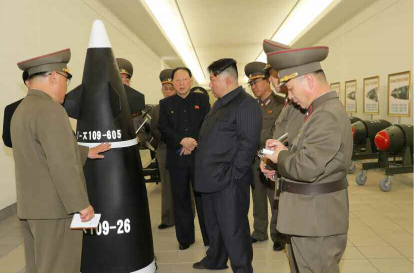
On March 27, 2023, Kim Jong-un was seen receiving a briefing on the nuclear weapons research institute's progress, with the 'Hwasan-31' tactical nuclear missile debuting in the background. (Photo by Rodong Sinmun)
A January 2023 study by Dr. Pa Yong-han and Dr. Lee Sang-kyu from the Korea Institute for Defense Analyses (KIDA) proposed that North Korea had around 80-90 nuclear warheads made of uranium and plutonium at that time. They predicted this number could rise to 166 by 2030, with North Korea aiming for approximately 300 nuclear warheads.
In the August 2023 report "Options for Strengthening ROK Nuclear Assurance" by RAND Corporation and Asan Institute for Policy Studies, it was estimated that North Korea could have at least 180 nuclear weapons, potentially rising to 300 by 2030. The report also noted that if Kim Jong-un doubles nuclear production from 2025, North Korea might reach 300 nuclear weapons by 2028.
In December 2023, at the Workers' Party of Korea meeting, Kim Jong-un discussed the "2024 nuclear weapons production plan" and revealed plans to launch three reconnaissance satellites. He also stressed improving the navy's capabilities, both underwater and on the surface, and focusing on five key areas of defense development that had been ‘previously overlooked’. This year, North Korea is anticipated to carry out its 7th nuclear test for tactical weapon development, advance its nuclear submarine program, and transform existing medium-sized submarines into "tactical nuclear attack submarines."
At the meeting in December 2023, Kim Jong-un emphasized the need to continue preparations for a "grand revolution to conquer South Korea's entire territory," which implies a full-scale military invasion to occupy South Korea. If North Korea's nuclear weapons development is for "survival" or "negotiation," having 50-60 nuclear weapons would be sufficient. However, North Korea is estimated to aim for 300-500 nuclear weapons and is prepared for a full-scale invasion of South Korea. As a result, North Korea's nuclear weapons pose a realistic threat to South Korea's security.
However, if a Republican Party candidate wins the 2024 U.S. presidential election, the United States' commitment to South Korea's defense may weaken. On October 4, 2023, a survey by the Chicago Council on Global Affairs (CCGA), a U.S. foreign policy think tank, showed that out of 3,242 American adults surveyed from September 7-18, only 50% believed that the U.S. military should defend South Korea in the event of a North Korean invasion. This percentage decreased from 63% in 2021 and 55% in 2022. While 57% of those who support the ruling Democratic Party were in favor of U.S. military defense of South Korea, only 46% of Republican Party supporters shared this view.
This sentiment reflects a growing trend in the U.S. towards isolationism and 'America First' policies, particularly with the resurgence of former President Donald Trump, weakening the national mood to defend allies like South Korea.
According to a survey by the Chicago Council on Global Affairs (CCGA) on October 4, 2023, following the Ukraine conflict and Hamas attacks on Israel, 48% of Americans believed that President Biden was spending too much on the Ukraine war. If a military conflict escalates on the Korean Peninsula, American war fatigue could increase, making it difficult to expect strong U.S. support for South Korea. The recent reduction in military support for Ukraine by the United States and Western allies following their setbacks in the Ukraine conflict highlights the limitations of assistance to allies.
If North Korea ramps up its production of solid-fueled intercontinental ballistic missiles (ICBMs) capable of reaching the U.S., achieves its goal of acquiring nuclear submarines as stated by Kim Jong-un at the 8th WPK meeting, and expands its nuclear arsenal to about 300 warheads, the U.S. would face greater challenges in countering North Korean nuclear threats. With U.S. presidential elections every four years, the election of an isolationist leader could lead to a reduction in America's defense commitments to South Korea.
Therefore, it is not wise for South Korea to heavily rely on the United States, which changes its leadership every 4 or 8 years, to secure its destiny. Consequently, South Korea's independent nuclear capability is essential in the medium to long term to prevent North Korea from misusing nuclear weapons and engaging in nuclear warfare. In the short term, South Korea needs to acquire nuclear latency similar to Japan's, which involves securing the ability to reprocess nuclear fuel and enrich uranium. This would ensure that if Japan, spurred by events like China's Taiwan invasion, pursues nuclear armament, South Korea does not remain the only non-nuclear state in Northeast Asia. With the potential to quickly arm itself with nuclear weapons like Japan, South Korea could effectively discourage North Korean threats and provocations.
To achieve nuclear latency, South Korea should form a trilateral consortium with the U.S. and Japan, focusing on uranium enrichment for civilian nuclear power plants, enhancing economic security. Also, to address North Korean submarine threats, a collaborative effort to create a trilateral consortium for jointly building and operating nuclear-powered submarines is necessary. While South Korea does not have nuclear weapons, collaborating with Japan in possessing nuclear-powered submarines would significantly enhance their surveillance and response capabilities against North Korean nuclear attack submarines. Given the extensive time required to develop these submarines, it's vital for South Korea, the U.S., and Japan to begin discussions on this initiative promptly.