

Re-examining North Korea-Japan Relations:
Analysis of Factors and Prospects

Cho Jin-goo
The Institute for Far Eastern Studies, Kyungnam University
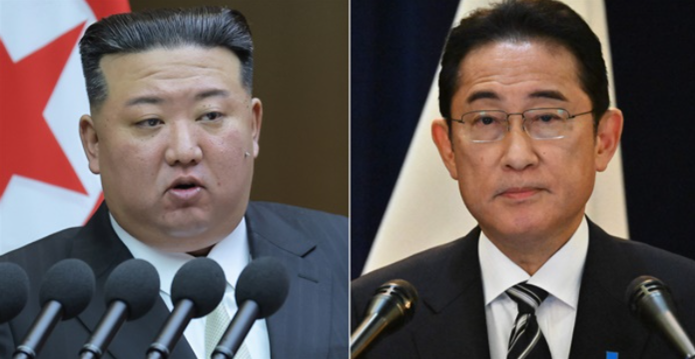
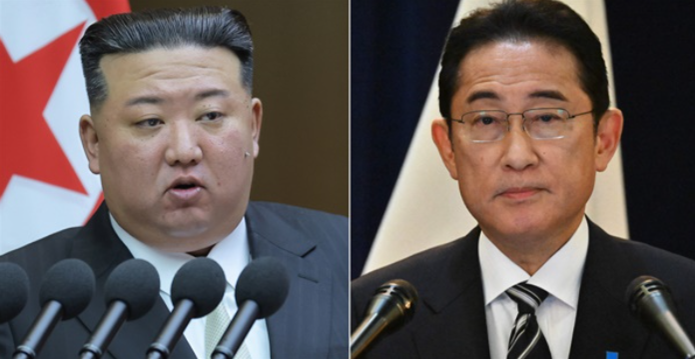
From left, North Korean leader Kim Jong-un and Prime Minister Kishida Fumio of Japan. (Photo by Rodong Sinmun, Yonhap News Agency)
North Korea-Japan Relations and the Pyongyang Declaration
“Japan–North Korea Pyongyang Declaration, crucial in our efforts to better North Korea-Japan relations, has been consistently undermined by Japan’s self-interested interpretations. Despite our genuine and ongoing dialogue, Japan has misconstrued the agreement to suit its own needs, using it primarily to address 'abductions, nuclear, and missile issues' for political gain.”
This statement was made by Song Il-ho, Ambassador of the North Korean Ministry of Foreign Affairs, on September 15, 2022.
On September 17, 2002, Prime Minister Junichiro Koizumi of Japan, despite the absence of formal diplomatic relations with North Korea, embarked on a historic visit and held a summit with Kim Jong-il. The Pyongyang Declaration, jointly signed by both leaders, underscored the mutual national interest in addressing contemporary issues and reconciling historical grievances as prerequisites for normalizing diplomatic ties. Notably, Kim Jong-il officially acknowledged for the abduction of Japanese citizens by North Korea, pledging to take necessary steps for investigation and prevention.
About a month after the DPRK-Japan Summit, on October 15, 2002, five Japanese abductees returned home. However, North Korea's negative portrayal in Japan, particularly over the abduction issue, hindered bilateral relations improvement. Japan labeled the abductions a 'national crime by North Korean authorities.' In October 2006, Japan adopted a comprehensive strategy to tackle abductions, nuclear issues, and missile programs, seeking to resolve past conflicts and normalize ties. Japan insisted on resolving the abduction issue as a key condition for progress, but unfortunately, no more abductees have been repatriated beyond the initial five.
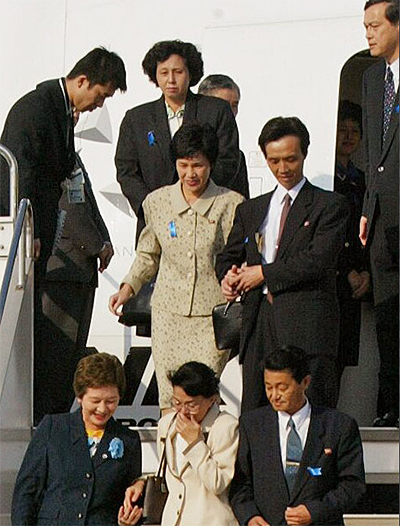
In 2002, five Japanese people kidnapped by North Korea are returning home. (Photo by Sisa)
North Korea's ultimate goal in normalizing diplomatic relations with Japan centers on reconciling their historical grievances and securing economic cooperation. However, even if diplomatic normalization materializes, it is crucial to recognize that Japan's economic cooperation hinges on the lifting of sanctions against North Korea. During his tenure, the former Prime Minister Shinzo Abe (21 September 1954 – 8 July 2022), who held the record for the longest-serving Prime Minister, advocated for solving the abduction issue as a national priority and expressed a willingness to engage in a DPRK-Japan Summit without preconditions. Unfortunately, the abduction issue remained unresolved, and the summit never came to fruition.
On May 27, 2023, Prime Minister Fumio Kishida made a significant announcement, expressing his intention to conduct high-level discussions directly with Kim, without any preconditions, in a bid to expedite the summit. In a statement two days later, on May 29, North Korean Ministry of Foreign Affairs Deputy Minister Pak Sang-gil responded positively, asserting that there was no reason for the two nations not to engage in talks.
If The Asahi Shimbun's reports published on September 29, 2023, suggesting secret contacts between North Korea and Japan in Southeast Asia from March and May 2023, hold true, then Pak’s statement was not just a mere exchange of words; it represented a call for tangible actions and a signal of potential shifts in Japan's policy towards North Korea following the passing of Shinzo Abe, a noted hardliner on North Korea.
Japan's Major Shift in Security Policy and the Statement from North Korea's Ministry of Foreign Affairs
On December 16, 2022, the Japanese government released three critical security documents, including the 'National Security Strategy (NSS).' This framework outlines Japan's diplomatic and security strategies. Prime Minister Kishida Fumio highlighted the urgency of reassessing Japan's security policy at a 'historic turning point,' characterized by threats to the free and open international order, notably Russia's invasion of Ukraine. This policy shift was prompted by a host of factors, including North Korea's launch of approximately 59 ballistic missiles in 2022, seven of which were ICBM-class, China's expanding military capabilities and maritime presence, frequent territorial violations around the Senkaku Islands, and the deepening military collaboration between North Korea, China, and Russia.
Japan has been enhancing its defense readiness due to the escalating military threats from North Korea, China, and Russia. This strengthening began in December 2012 with the second Abe administration, marking a reversal from declining defense budgets to a consistent increase in spending. The 2022 Defense of Japan report, presented in July 2022, represented a notable shift by redefining 'enemy base attack capability' as 'retaliation capability.' This change acknowledges the inadequacy of solely relying on interception in the face of rapidly advancing missile technologies.
Japan's national security strategy is now anchored by three key policy documents: the National Security Strategy, National Defense Strategy, and Defense Buildup Plan. There is also a goal to increase defense spending to 2% of GDP by 2027. A major element of Japan's shift in security policy is its plan to develop retaliation capability. This move could significantly alter the traditional roles of the Japan Self-Defense Forces and the U.S. military, which have operated under an exclusively defensive principle, with the former as 'shield' and the latter as 'spear.' The Japanese government intends to use this capability as a 'minimum necessary self-defense measure' in response to armed attacks, following specific criteria for force use. However, accurately deciding the timing of retaliation, whether at the onset of an attack or post-attack, poses challenges. While there is uncertainty about whether this capability will effectively deter invasions, concerns remain that it could be viewed as a pre-emptive attack, potentially clashing with international law.
In the previously mentioned statement, North Korean Ambassador Song Il-ho criticized Japan for overstating the 'North Korean threat' and aggressively expanding its military capabilities. He believes the actions could destabilize regional peace and stability. On December 20, a follow-up statement escalated this criticism. The statement voiced concern about Japan's latest security strategy, which includes pre-emptive strike capabilities, suggesting this turns Japan into an offensive military force and exacerbates tensions in East Asia. It criticized Japan's remilitarization as a breach of the United Nations Charter and a threat to international peace, warning that North Korea would take 'actual actions' in response to Japan's military buildup.
On April 18, 2023, the G7 Foreign Ministers condemned North Korea's ballistic missile tests and called for the dismantlement of its nuclear and missile programs. Responding on April 21, North Korean Foreign Minister Choe Son-hui stated that North Korea would keep bolstering its defense capabilities, citing legitimate rights, until the perceived military threats from the U.S. and other hostile forces are resolved and the hostile environment ceases. Choe further justified North Korea's defense enhancements as a legitimate exercise of sovereignty in response to provocative actions by the U.S. and its allies, reiterating that only the comprehensive and complete withdrawal of the U.S.'s hostile policies could guarantee North Korea's security. Consequently, deep-seated mistrust between North Korea and Japan persists, with their respective stances on international affairs in direct opposition.
2024 Forecast for North Korea-Japan Relations
From December 26 to 30, 2023, the 9th Plenary Meeting of the 8th Central Committee of the Workers' Party of Korea took place. At the meeting, Kim Jong-un evaluated the policies implemented in 2023 and unveiled strategic goals for 2024. He emphasized the September 2023 constitutional amendment aimed at enhancing the national nuclear force. This move, he stated, represents a direct challenge to the U.S. and its key allies, especially the South Korea-U.S.-Japan alliance, and serves as a means to safeguard the security of the state and its citizens.
During President Yoon Suk-yeol's tenure, South Korea-Japan relations, once strained, have seen improvement. Prime Minister Kishida has called for stronger U.S.-Japan and South Korea-U.S. security cooperation. He advocates not only for a united front against North Korea's nuclear and missile threats and strict enforcement of sanctions but also for expanded collaboration in critical areas like supply chain management, marking a new chapter in the trilateral partnership for a free and open Indo-Pacific.
However, this heightened trilateral cooperation could strengthen the alliance between North Korea, China, and Russia. The increase in Japan's defense capabilities may spark a regional arms race, illustrating the security dilemma in international politics. In such a scenario, countries increase their military power due to security concerns, which can lead to mutual distrust and heightened threat perceptions, potentially escalating into an arms race and prompting pre-emptive strike impulses.
Amidst the 'new Cold War', North Korea has been deepening ties with China and Russia, adopting an aggressive stance towards South Korea, the U.S., and Japan. Firmly supporting the 'One China' principle, North Korea criticizes U.S. involvement in Taiwan, accusing it of escalating regional tensions. Following Russia's invasion of Ukraine, North Korea has consistently supported Russia, notably by recognizing the independence of the Donetsk and Lugansk People's Republics. This move has further strengthened its strategic alliance with Russia.
At the December 2023 Central Committee Plenary Meeting of the WPK, Kim Jong-un announced a policy to actively foster ties with anti-imperialist nations opposing U.S. and Western dominance. He pledged to engage in strong international anti-imperialist actions, emphasizing confrontation and direct opposition to the U.S. and its allies with a robust, hardline approach. Specifically, he denounced the increased security collaboration between South Korea, the U.S., and Japan as a 'conspiracy against the republic,' cautioning that their plan to regularize tripartite exercises and hold various diplomatic and defense ministerial meetings from 2024 could create a more unstable and uncertain situation in the Korean Peninsula.
The multi-year exercises involving South Korea, the U.S., and Japan, while not exclusively targeting North Korea, may also cover joint operations to secure maritime routes from the Middle East through Southeast Asia, and to maintain peace in the Taiwan Strait, crucial for global security and prosperity. Additionally, the real-time exchange of missile warning data about North Korea between these nations is seen by North Korea as a direct challenge to its security and that of China and Russia, potentially leading to the formalization of the South Korea-U.S.-Japan military alliance.
In 2024, developments in the Russia-Ukraine war and the Israel-Hamas conflict, along with key political events like the Taiwanese presidential election, Russian presidential election, South Korean legislative election, and U.S. presidential election, will significantly affect the Korean Peninsula. North Korea’s Supreme People's Assembly legalized its nuclear force policy in September 2022, with Kim Jong-un firmly ruling out denuclearization or disarmament negotiations. Kim asserted that any change in North Korea's nuclear policy hinges on a global shift and changes in the Korean Peninsula's political and military environment. Given North Korea's capability to target Japan with nuclear weapons and missiles, Japan must pursue diplomatic engagement with North Korea alongside strengthening its defense, to address this pressing threat.
In his 2024 New Year’s reflection, Prime Minister Kishida described 2024 to be a 'year of tension' due to diplomatic challenges and committed to engaging in proactive summit diplomacy. He emphasized the need for North Korea and Japan to resolve their mutual distrust and historical grievances for peace in the Korean Peninsula and East Asia. While a DPRK-Japan Summit would be a significant move, the current geopolitical climate makes meaningful changes in North Korea-Japan relations, including a summit, unlikely in 2024.
-
PREV [Feature Article]
-
NEXT [Defectors' Podium]