

Changes in North Korea-China Relations Following the Conclusion
of China's Two Sessions

Lee Jae-young
Research Fellow at the Korea Institute for National Unification (KINU)
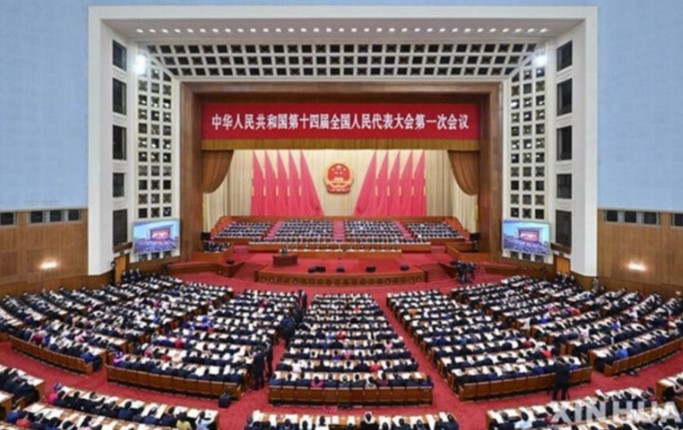
From March 5th to 11th, 2024, the Two Sessions convened at Beijing's Great Hall of the People, marking a pivotal moment for China. A standout feature of this year's sessions was the further cementing of Xi Jinping's solo rule and the Communist Party's tightening grip over the State Council. Li Qiang, China's second-in-command, steadfastly highlighted adherence to the Central Committee of the Communist Party of China's directives throughout his governmental work report. A notable reduction in the Premier's influence within the collective leadership structure was signaled by his constrained authority over key appointments in the State Council and the discontinuation of the Premier's annual press conference, a tradition since 1993.
The Two Sessions also brought revisions to the State Council Organization Law, clarifying its function in executing Central Committee decisions, and subjugated the People's Bank of China, traditionally responsible for autonomous monetary policy, under State Council supervision, reflecting a direct commitment from Xi Jinping and the Central Committee to tackle pressing economic issues like local government debt, property market slump, and Western sanctions through fortified financial security.
Despite setting a modest economic growth target of around 5% for the year, the Two Sessions fell short of presenting a concrete strategy or blueprint for China's broader economic ambitions, beyond announcing a significant $27 billion fund to boost the semiconductor industry and initiatives like the artificial intelligence movement to counteract U.S. sanctions. The postponement of the 20th Central Committee of the Communist Party of China's 3rd Plenum, expected last fall, indicates ongoing challenges in formulating solutions to structural economic dilemmas among China's leadership.
This year, China's defense budget has exceeded 300 trillion won (309 trillion won, equivalent to 1 trillion 670 billion yuan), marking a 7.2% increase from the previous year.
Shortly after China's Two Sessions concluded, North Korea fired more than three ballistic missiles into the East Sea on March 18th, seemingly targeting Antony John Blinken, the U.S. Secretary of State, who visited South Korea for the Freedom Shield joint military exercises from March 4th to 14th and the Democracy Summit in Seoul.
North Korea's heightened military activities this year serve not only to initiate nuclear disarmament negotiations with the U.S. after the November presidential election but also to secure acknowledgment as a nuclear-armed state within its alliance, particularly from Russia and China. Vladimir Putin's statement in a local media interview on March 13th, mentioning North Korea's possession of its own nuclear umbrella, has been interpreted as Russia practically recognizing North Korea as a nuclear-armed state.
While China still advocates for Korean Peninsula denuclearization, it now prioritizes North Korea's security concerns over denuclearization efforts, shifting blame for North Korea's provocations onto the U.S. and joint U.S.-South Korea military exercises. This implies that China does not outright deny North Korea's nuclear-armed status.
2024 marks the 75th anniversary of diplomatic relations between North Korea and China. Wang Yajun, the Chinese ambassador to North Korea, visited Dandong on January 11th, while on January 5th, a delegation from Dandong City government visited Shinuiju, North Korea. The recent opening of the New Yalu River Bridge has led to signs of resumed logistics between the two countries.
During a January 26th meeting, Sun Weidong, Deputy Director of China's Ministry of Foreign Affairs, and Choe Son-hui, North Korea's Foreign Minister, expressed their intent to commemorate the 75th anniversary of diplomatic ties in 2024 with a focus on friendly cooperation, emphasizing "tactical cooperation and joint support for common core interests."
Discussions about a potential summit between North Korea and China have emerged. However, the summit's success hinges on tangible achievements and legitimacy. Recent deterioration in their relations, compounded by ineffective outcomes from past summits due to sanctions, raises doubts. China, aiming to mend ties with the US despite technology sanctions, sees limited benefits in closer ties with North Korea. Consequently, the likelihood of a summit on their 75th diplomatic anniversary remains low this year.