

Different Family Affection for Parents:
Observing the Differences in Filial Piety Culture between North and
South Korea

Choi Kyong-hui
President of SAND and doctor of Political Science at the University of Tokyo
In South Korea, May is celebrated as Family Month, featuring several significant days: May 5th is 'Children's Day', May 8th is 'Parents' Day', May 21st is 'Couple's Day', and May 15th is both 'Buddha's Day' and 'Teachers' Day'. Among these traditional Confucian holidays symbolizing 'filial piety', the most significant is 'Parents' Day'. This day is dedicated to expressing gratitude to parents for giving birth and raising their children and practicing the traditional virtue of respecting elders. Children give carnations and various gifts to their parents and grandparents, often arranging trips. For Koreans, May serves as a reminder of the importance of family amidst the hustle and bustle of modern life.
In contrast, North Koreans have two perspectives on parents: biological parents who gave them life and the 'great parent' who provides socio-political life. In the traditional family, the mother’s role is paramount as she cares for the family and raises the children. Nationally, the entire country is seen as 'one great family', with the ruler as the 'great parent' and the citizens as children, reflecting a master-servant dynamic.
North Korea observes 'Mother's Day' on November 16, but there is no equivalent day for fathers. Instead, Kim Jong-un is referred to as the 'Parent'. In 2024, the notion of 'One Great Family' has resurged. Kim Jong-un has emphasized the roles of women as daughters-in-law, wives, and mothers, highlighting their significance within the family. This creates a framework where individual families have their mothers, while the state is represented by a single paternal figure.
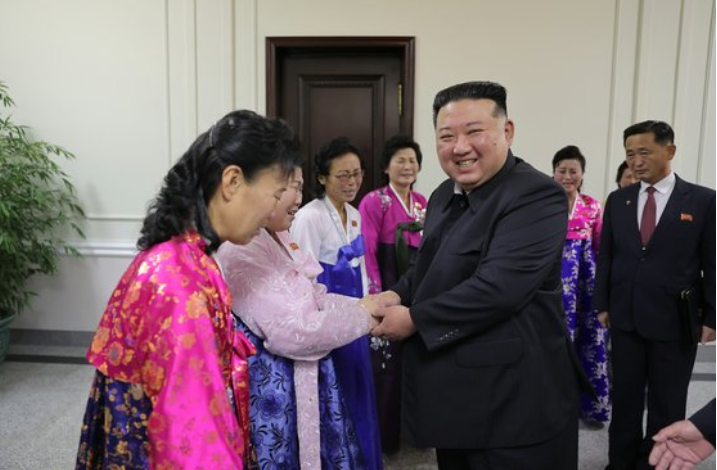
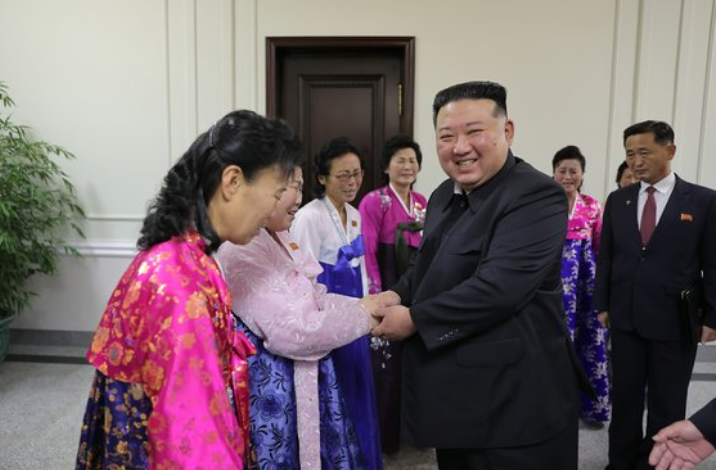
Meeting participants of the 5th National Mothers' Convention in December 2023. / Rodong Sinmun
Kim Jong-un, now 40 years old, is shifting his title from ‘Great Leader' to 'Great Parent'. To maintain a lifelong dictatorship, it is crucial to enhance the ruler's charismatic authority. In this context, the culture of filial piety proves highly effective. According to traditional Confucian values, no matter how tough the circumstances, children do not blame their parents and cannot replace or surpass them. Parents provide love, and children are obligated to show filial piety.
The concept of ‘One Great Family’ first emerged in North Korea in January 1992, after the Cold War ended and the Soviet Union collapsed. As the communist bloc disintegrated, North Korea promoted ‘One Great Family,’ with Kim Il-sung as the parent and Kim Jong-il as a model of both loyalty and filial piety. This culture spread nationwide through the 'Jong Chun-sil Movement,' popularized by the film 'Filial Daughter,' featuring Jong Chun-sil, a rural girl who calls Kim Il-sung her “father“. This effort aimed to propagate a culture of filial piety that venerates Kim Il-sung as the parent.
During the later years of Kim Il-sung's rule, when the economy struggled, social order was unstable, and international isolation increased, emphasizing ‘One Great Family’ helped stabilize society and clarify dictatorial power. Kim Jong-un appears to be following a similar path.
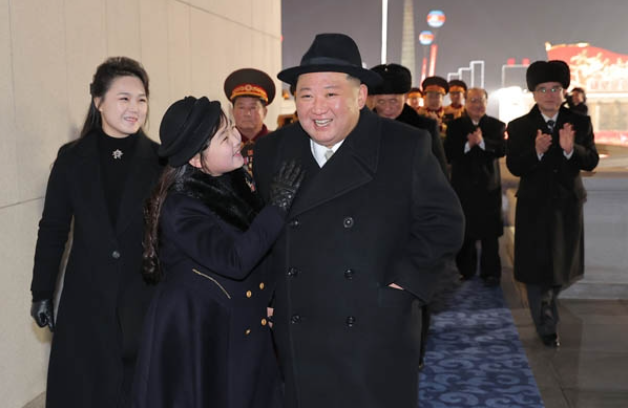
Kim Jong-un attended the 75th-anniversary military parade of Korean People's Army Foundation Day on February 8 last year with his daughter Kim Ju-ae (front row, left) and his wife Ri Sol-ju (back row, left). / Korean Central News Agency
In November 2022, marking 10 years of his rule, Kim Jong-un took his 10-year-old daughter Kim Ju-ae to a high-profile nuclear missile launch, presenting himself as a caring father and showcasing her as a symbol of filial piety. Their frequent public appearances, even at everyday sites, effectively promote this model to North Korean residents.
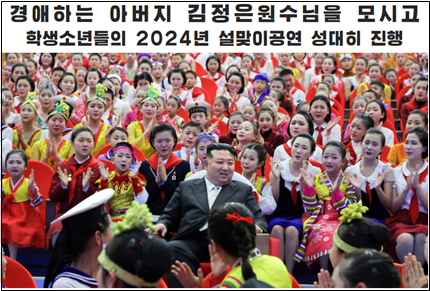
At the New Year's performance on January 1, 2024, the students referred to Kim Jong-un as their father. / Minju Choson
Since Kim Jong-un came to power in 2012, North Korean youth have been calling him 'Great Father'. Now that he holds the highest positions in both the party and the state, he seems focused on establishing himself as the ‘Great Parent of all the people,’ encompassing all generations.
Although North and South Korea share a long tradition of Confucian culture, the realities of filial piety in each country are starkly different. In South Korea, filial piety is celebrated through love and respect for parents during Family Month in May. In contrast, in North Korea, filial piety is used as a tool of national governance.
South Korea's Family Month, which seeks genuine family happiness, contrasts sharply with Kim Jong-un's 'One Great Family' and his self-proclaimed title as the Great Parent, which restricts individual freedom and happiness. It's essential to create an environment and raise awareness so North Korean residents, forced to serve Kim Jong-un and practice loyalty and filial piety, can reclaim their dignity and rights.
-
PREV [Defectors’ Podium]
-
NEXT [Opinion]