

The implications of the G7 Summit for the security environment
on the Korean Peninsula.

Yongmin Kim (Konkuk University)
Overview
The G7 Summit was convened once again this year in Italy from 13 to 15 June. In contrast to the G7 held in Japan last year, this year's meeting did not extend an invitation to South Korea and instead focused on European affairs. This further illustrates the prominence of the Russo-Ukrainian conflict on the European political agenda and the significance that Europe attaches to the situation in Ukraine. In particular, the results of the European Parliament elections, which were held shortly before, demonstrated an unexpected advance of the far-right, intensifying the sense of crisis in Europe and influencing domestic politics in G7 member states.
It is reasonable to conclude that all G7 members were compelled to present a unified stance on the Russia-Ukraine conflict at a time when all European countries were experiencing the fatigue of a prolonged war. Additionally, there was a sense of urgency to institutionalize the decisions taken, as some members were facing elections. This has resulted in a number of significant decisions, spearheaded by the United States, that will have far-reaching implications for the geographically distant Korean Peninsula. Let us now examine the pivotal agreements.
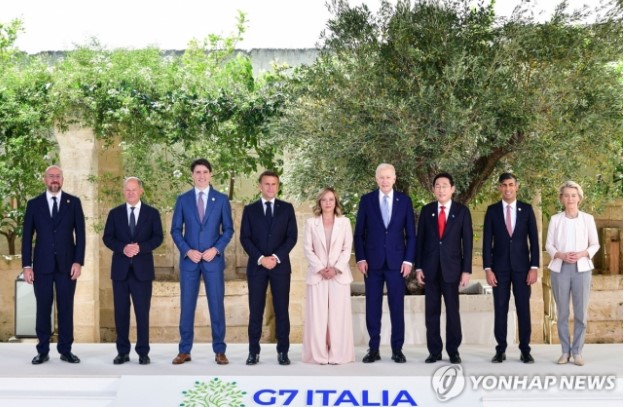
G7 leaders pose for a group photo at the G7 Summit held at the Borgo Egnazia Resort in Brindisi, Puglia, Italy, on June 13, 2024. From left to right: Charles Michel, President of the European Council; Olaf Scholz, German Chancellor; Justin Trudeau, Canadian Prime Minister; Emmanuel Macron, French President; Giorgia Meloni, Italian Prime Minister; Joe Biden, US President; Fumio Kishida, Japanese Prime Minister; Rishi Sunak, UK Prime Minister; and Ursula von der Leyen, President of the European Commission. / Yonhap News Agency
Agreements on Security
In accordance with the established theme and the limitation of the consensus to security issues, the following agreements are presented.
① Supporting Ukraine’s Fight for Freedom
Joined by Ukrainian President Zelenskyy, G7 leaders reaffirmed their unwavering support for Ukraine for as long as it takes.
1) Unlocking $50 billion for Ukraine: G7 leaders announced a plan to provide Ukraine with $50 billion in new financing by bringing forward the interest earned on immobilized Russian sovereign assets held in the European Union and other jurisdictions. Leaders reaffirmed their commitment that Russia’s sovereign assets within G7 jurisdictions will remain immobilized until Russia ends its aggression and pays for the damage it has caused to Ukraine.
2) Driving Up Costs for the Russian War Machine: The Biden Administration this week issued a sweeping set of new sanctions and export control measures, guided by G7 commitments to intensify the pressure on Russia for its war against Ukraine. Foreign banks now face increased sanctions risk when they deal with Russia’s war economy
3) Supporting Ukraine Now and in the Future: In Puglia, President Biden and President Zelensky signed the U.S.-Ukraine Bilateral Security Agreement as a demonstration of enduring U.S. support for Ukraine, including through binding commitments to deepen our security and defense cooperation and to consult in the event of a future armed attack.
-
PREV [Defectors' Podium]
-
NEXT [Column]