

The Establishment of North Korean Defectors' Day:
Declaring North Korean Residents as South Korean Citizens

Young-Hyun Lee
Corporate law firm IRE attorney
the first North Korean defector lawyer
July 14 marks the enactment of the "North Korean Defectors Protection and Settlement Support Act," which is fundamental to the legal status and support policies for North Korean defectors. It is now officially recognized as "North Korean Defectors' Day," a national commemorative day. The designation of "North Korean Defectors' Day" as a national holiday has been warmly received by the North Korean defector community. Reports indicate admiration from North Korean residents and positive reactions from North Korean workers abroad. This day holds significant implications domestically, internationally, and for North Korea.
Within South Korea, the creation of "North Korean Defectors' Day" is aimed at enhancing support for defectors' integration and fostering unity with the general populace.
Despite the considerable efforts by both the government and private sector to help North Korean defectors settle successfully, adapting to South Korea's competitive environment remains challenging for many defectors who have lived under a different regime for a long time. Additionally, the cold stares, discrimination, and prejudice from some South Koreans add to their difficulties. Some defectors have candidly expressed that "it's harder to settle in South Korea than to defect," or "the South Korean government accepted us, but the people did not.“
The government should use "North Korean Defectors' Day" to identify and address the challenges defectors face and improve any legal, institutional, or policy gaps in settlement support. Additionally, initiatives are needed to change and improve the public's negative perceptions of defectors. As the "first wave of unification," enhancing support systems and public perception is crucial to bridging gaps and enabling true integration. Successful settlement of defectors in South Korea will inspire North Korean residents to dream of and hope for national unification.
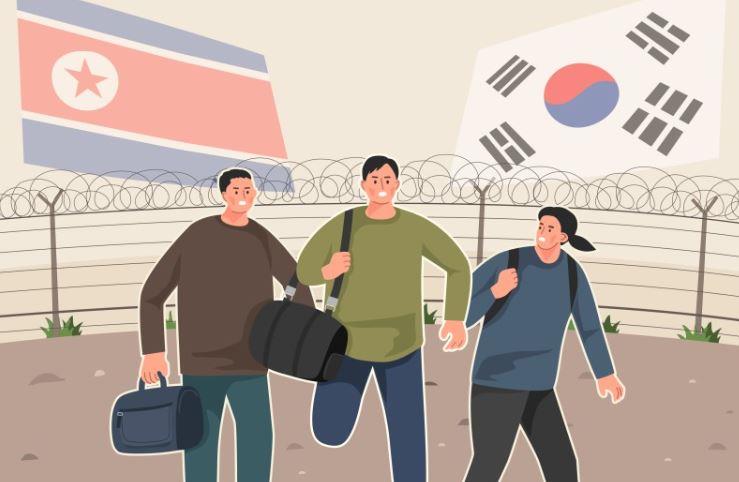
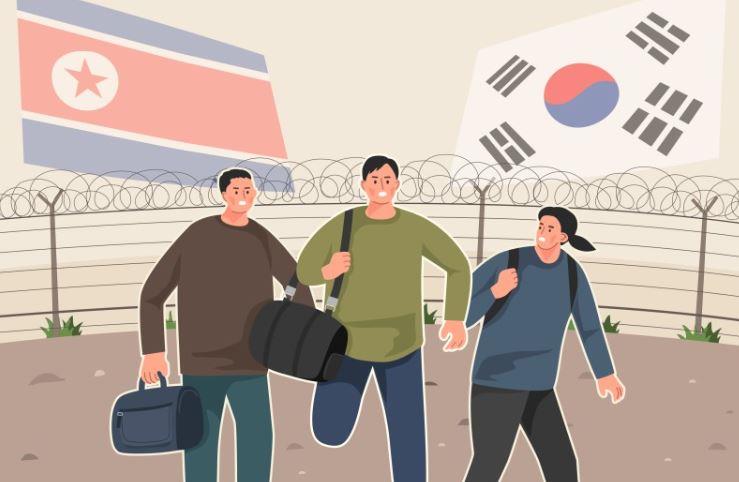
North Korean defectors fleeing North Korea/Clip Art Korea
Internationally, this day serves to meet our constitutional and legal obligations under the North Korean Defectors Protection and Settlement Support Act to protect defectors abroad, showcasing the special relationship between South and North Korea to the world.
Many North Korean defectors escape to China by crossing the Amnok or Tuman Rivers. Support organizations estimate that around 100,000 defectors live in China. Despite international concerns, China continues to forcibly repatriate defectors. Recently, alarming news surfaced that China repatriated 60 defectors, following the repatriation of 200 defectors in April.
The government should use "North Korean Defectors' Day" to highlight the human rights issues defectors face abroad and urge the international community to address forced repatriation. Defectors abroad will view this day as a commitment from South Korea to their protection. Efforts should also be increased to press China to adhere to non-refoulement principles under the Refugee and Torture Conventions and improve the human rights situation for defectors in China.
Defectors abroad are constitutionally South Korean citizens and deserve protection. Unlike North Korea, which has declared the South and North as separate states and abandoned unification, we must emphasize that South and North Korea share a special relationship and aim for peaceful unification, continuously spreading this message to the international community.
From the standpoint of engaging with North Korea, this day represents a dedication to enhancing human rights and striving for peaceful unification rooted in the idea of a single ethnic community.
Despite recent actions by the Kim Jong-un regime to reject the idea of a single ethnic community and declare a two-state Korea, North Korean residents' perception of the South and North as one ethnicity cannot change overnight. The establishment of North Korean Defectors' Day affirms that North Korean residents, like defectors, are part of the same nation, entitled to the same freedoms, human rights, peace, and prosperity. It sends a message of commitment to separating the North Korean regime from its people and continuing efforts to remember and improve their dire human rights situation.
In the future, North Korean residents may increasingly trust and admire South Korea's policies towards defectors, fostering a growing desire among them to flee their repressive and anti-humanitarian regime, governed by laws like the Reactionary Ideology and Culture Rejection Law and the Pyongyang Cultural Language Protection Law, and seek refuge in South Korea. The potential for a unified Korean Peninsula through democratic means has also grown. During "North Korean Defectors' Day," the government should underscore that peaceful unification based on democratic principles is crucial to addressing the human rights challenges faced by North Korean residents.
The Ministry of Unification announced that the inaugural "North Korean Defectors' Day" will feature a memorial ceremony and related activities honoring defectors who lost their lives during escape attempts, while also conveying a message of hope for freedom and prosperity to North Korean residents. This event aims to underscore the historical significance of defectors and the establishment of their dedicated day. Moreover, it presents an opportunity for the 34,121 defectors to reflect on their pivotal role in advancing Korean Peninsula unification.