

From the Sorrows of the First Generation to Vision and Hope:
The Journey of North Korean Defectors

Kim Byung-wook
Director of the North Korea Development Institute (NKDI)
According to the Ministry of Unification, as of December 2023, there are 27,086 elderly individuals over 80 among the surviving first generation of displaced persons. Of these, 12,463 are over 90 years old, and 14,623 are between 80 and 90 years old, comprising 66.7% of the total survivors. With South Korea's average life expectancy at 83.6 years, most of these individuals are expected to pass away by 2038, leaving only about a decade. Their primary wish is to reunite with their separated families. However, given North Korea's historical stance and the current tense relationship between the North and South, family reunions seem unlikely.
As the possibility of family reunions fades and the end of life approaches, they wish to see how their hometowns have changed and to pass on the location of their ancestral homes to their descendants. However, despite the assistance of their children or grandchildren using Google Maps, they are unable to locate their old homes, leading to frustration.
North Korea's land reclamation policies, implemented as part of its unification preparations, and the use of Japan's Tokyo coordinates in cadastral maps that replaced old land documents, make it impossible to find these locations on Google Maps. Solving this issue should be led by the North Korean defector community.
To address this, defectors at the North Korea Development Institute (NKDI) have developed technology to identify the locations of ancestral homes. They hold two related patents. With the motto, "While family reunions require North Korea's cooperation, we can find hometown locations with South Korea's resources." the NKDI has been assisting the first generation of displaced persons in locating their hometowns for nearly a decade.
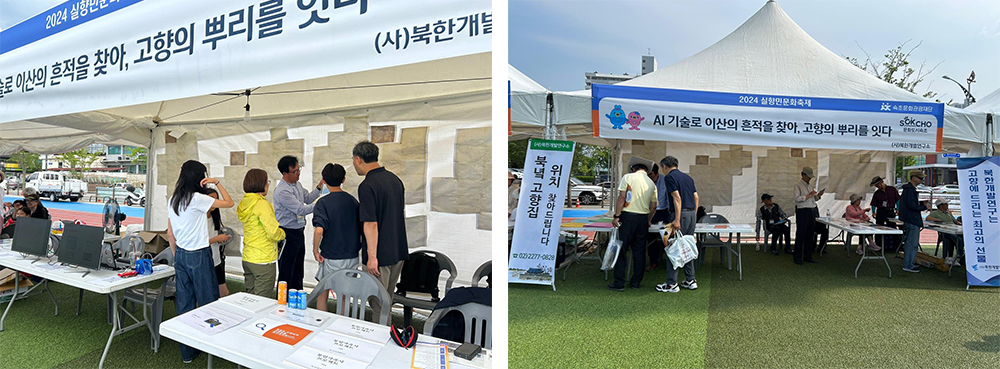
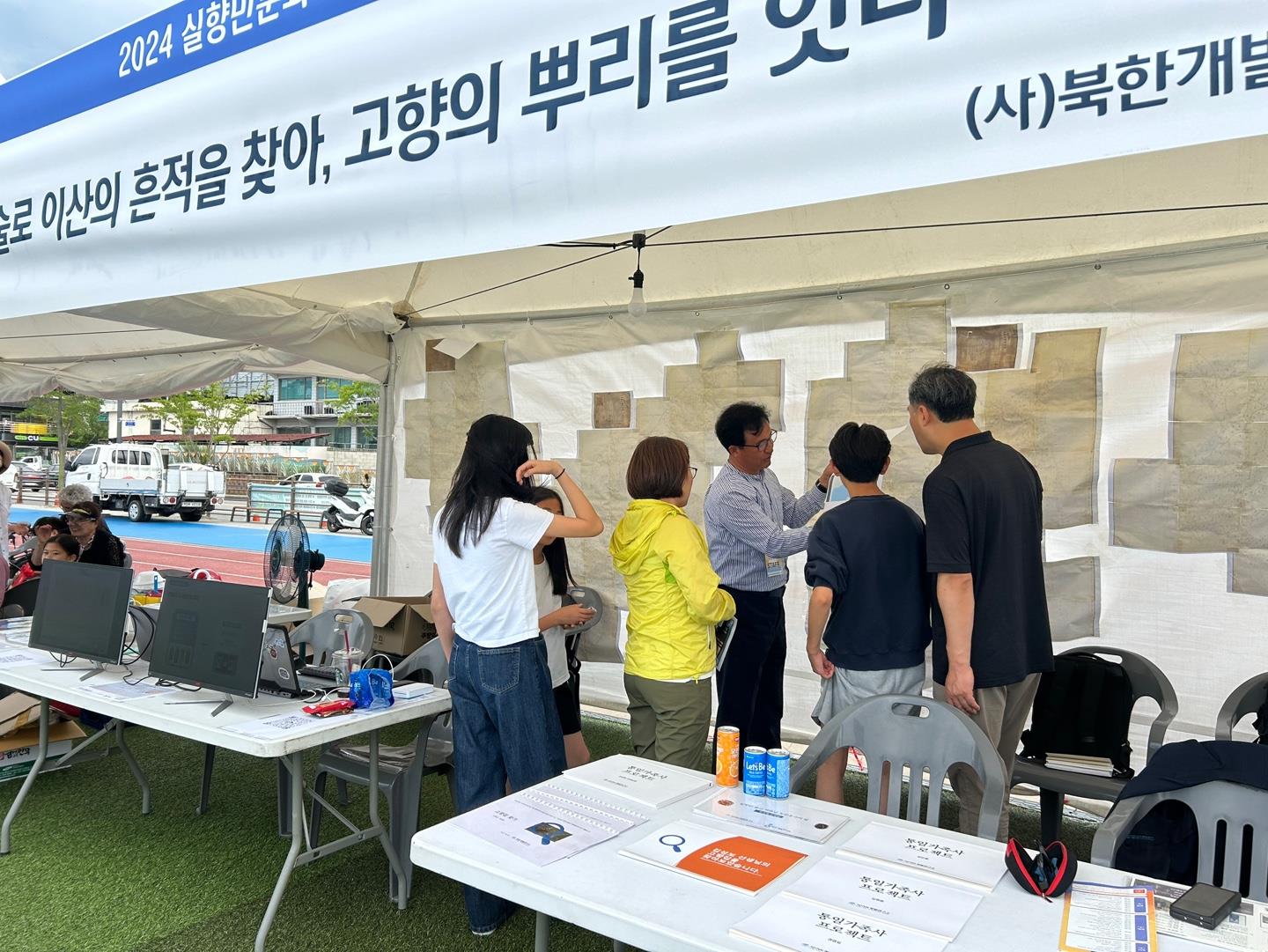
During the 2024 Sokcho Cultural Festival for Displaced Persons on June 14, NKDI presented a booth with the theme "Using AI Technology to Reconnect Separated Families and Rediscover Roots."
The NKDI booth has been a regular feature at the Sokcho Cultural Festival for Displaced Persons, held annually since 2016, and is known for helping to alleviate the sorrows of the first generation of displaced persons. Initially, the booth's activities included locating ancestral homes for those living in special triangular and overseas areas, in collaboration with the Busan Historical Records Center of the National Archives. These activities involved presenting framed photos of hometown locations found on Google Maps, videos on family reunification, and 3D printed models.
Currently, various AI technology-based activities led by Millennials and Gen Z defectors are being showcased. For instance, they offer services that restore old photos of hometowns or family members to resemble current images and recreate the voices of the first generation to provide answers applicants wish to hear. Additionally, they are developing an app called "Digital Legacy and Life Archive (DL-LA Archive)" to help the first generation manage their life records and assets for inheritance by family members still in North Korea.
These efforts are transforming the festival venues into places of hope, where one can see messages from the young generation, aiming to continue the spirits and roots of the first generation, rather than just sites filled with sorrow and separation.
Instead of just acknowledging the sorrows of the first generation, our focus today is on providing vision and hope to future generations. We should remember their initial defection and continue this journey together.
-
PREV [Current Affairs Review]
-
NEXT [Opinion]