

The Legitimacy Competition on the Korean Peninsula:
The Founding of South Korea and the North Korean Regime

Cho Young-ki
Secretary-General of the Hansun Foundation,
former professor at Korea University
1. Legitimacy as an Essential Element of Modern State-Building
Legitimacy is commonly understood as the general acceptance of a society or state's political system, authority, and traditions as rightful. In a state context, legitimacy involves the justification and legality of power that earns widespread trust and support from its people. Establishing legitimacy is crucial because it encourages the voluntary compliance of citizens with the state's order, which, in turn, fosters stable governance. Legitimacy provides a government with a foundational rationale for its rule, reinforcing both its authority and its appropriateness in the eyes of its citizens. Ultimately, a legitimate state secures voluntary adherence from its people and solidifies the authority of its governing powers.
2. Securing Legitimacy through the Establishment of a Constitution
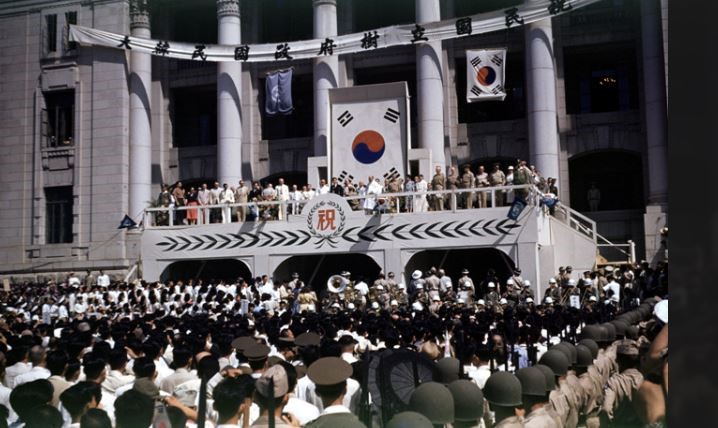
A constitution serves as the cornerstone of a state's governance and is the primary mechanism for establishing national legitimacy. Recognizing its importance, both South and North Korea rushed to draft their constitutions immediately after liberation to assert their versions of a modern state. However, the processes they followed differed significantly. South Korea's constitution was crafted according to the "principle of parliamentary representation," which, while limited to regional representation, upheld democratic principles by ensuring multiple political parties were represented. On May 10, 1948, South Korea held a general election to form the Constitutional Assembly, which drafted and promulgated the constitution on July 17, thereby affirming popular sovereignty and leading to the Republic of Korea's founding on August 15, 1948.
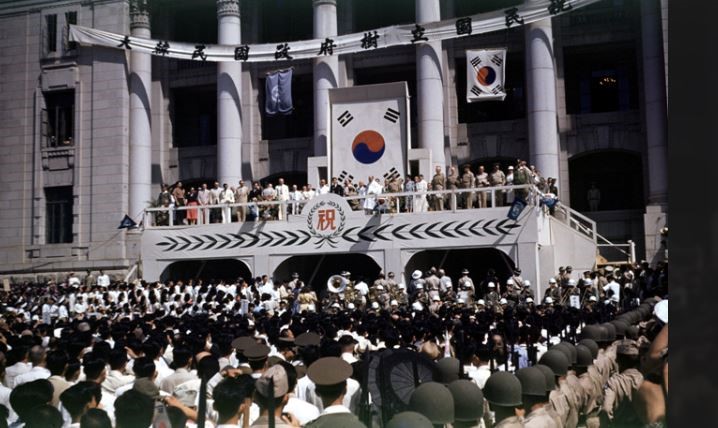
A celebration of the establishment of the South Korean government is being held on August 15, 1948 /the National Archives
Conversely, North Korea's constitutional drafting process followed the "Soviet principle," which aimed to fully express the people's will. However, this approach had a major flaw: while it claimed to represent all citizens by including various power structures, political parties, organizations, and regional representatives, the process was heavily dominated by members of the Workers' Party. This ensured that the constitution was shaped entirely by a single party, reinforcing the party's control over the state.
Both constitutions espoused democratic ideals, but their interpretations diverged significantly. South Korea emphasized popular sovereignty within a liberal democracy framework, whereas North Korea focused on people's sovereignty under a people's democracy model. In North Korea's context, the "people" excluded certain classes like the bourgeoisie and landlords, and individual agency was overshadowed by collective participation in state-run assemblies. Thus, in South Korea, sovereignty rested with the citizens, while in North Korea, the concept of sovereignty was effectively absent from the individual perspective.
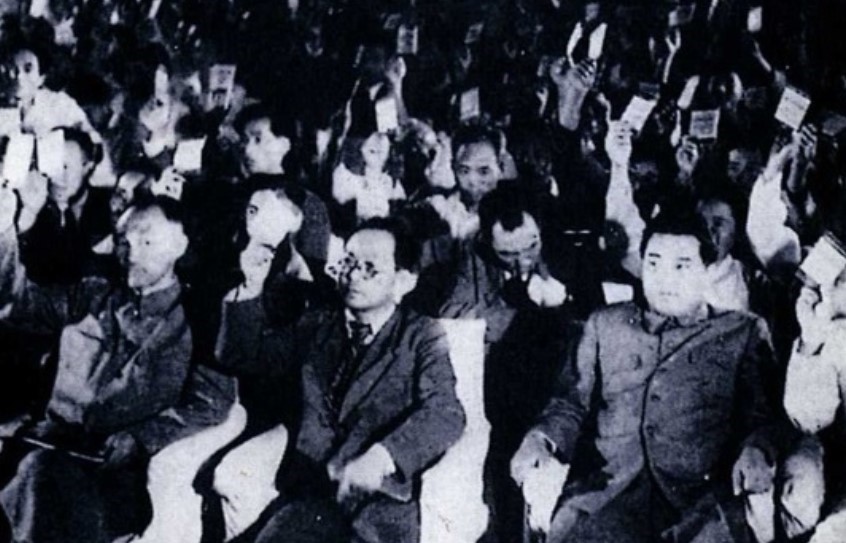
On September 2, 1948, Kim Il-sung was elected Prime Minister at the first meeting of the North Korean
Supreme People's Assembly /National Archives
3. The Competition to Secure Historical Legitimacy
After liberation from Japanese colonial rule, South and North Korea developed different political systems, each seeking to claim historical legitimacy. While history should be based on objective facts, North Korea often distorted its historical narrative to strengthen its regime's legitimacy. A key example is the exaggerated portrayal of Kim Il-sung’s anti-Japanese resistance, manipulated through propaganda to justify the regime's authority. These distortions are frequently accepted as truth, contributing to misunderstandings, such as the belief that North Korea effectively purged pro-Japanese collaborators while South Korea failed to do so. Such claims distort the historical record and are fundamentally inaccurate.
South Korea enacted laws specifically to punish those who collaborated with the Japanese, focusing on anti-national activities. The Rhee Syng-man government, formed on August 15, 1948, consisted mainly of independence activists, with no pro-Japanese figures among its 19 members. However, controversy arose when some former pro-Japanese police officers were appointed to investigate communists, which led to scrutiny of even former independence activists, creating tensions over the perceived leniency.
In contrast, when the Democratic People's Republic of Korea was established, Kim Il-sung’s cabinet included numerous pro-Japanese collaborators, indicating that their purge was not as complete as claimed. Of the 20 original cabinet members, 10 were later purged through execution or exile to political prison camps, suggesting that these purges were more about solidifying power than justice. The absence of detailed records in North Korean history books further implies that these purges were largely propaganda tools rather than genuine efforts to eliminate collaborators.
4. The Results and Challenges of the Legitimacy Competition between South and North Korea
South Korea was founded as a liberal democracy on August 15, 1948, while North Korea was established as a communist state on September 9, 1948. Since their respective founding, both Koreas have been locked in a contest to prove the legitimacy of their systems. However, more than 70 years later, the vast differences in their achievements render such comparisons pointless. South Korea’s democratic system allows its citizens the freedom to shape their own lives, creating an environment where individuals can take active roles in their futures. This system has paved the way for values like prosperity, rule of law, human rights, equality, and peace to flourish.
On the other hand, North Korea's communist regime has heavily restricted personal freedoms, compelling individuals to rely on the state for every decision, effectively reducing them to subjects under authoritarian rule. These contrasting political frameworks have resulted in significantly different economic outcomes. For example, in 2022, South Korea's Gross National Income (GNI) was 59.8 times that of North Korea's, and its per capita GNI was about 29.7 times higher. This enormous economic gap highlights the effectiveness of South Korea's system compared to North Korea's, clearly showing that South Korea's establishment was more successful and legitimate.
North Korea continues to use propaganda, agitation, and distortion to uphold its claim to historical legitimacy. The regime seeks to justify its dictatorship through Juche ideology, using anti-American and anti-Japanese narratives. It labels the period before August 15, 1945, as "Korea under Japanese rule" and the period after liberation as "Korea under United States rule," falsely claiming that Korea has been under American occupation since liberation by American imperialists. North Korea's Juche-based interpretation of history undermines South Korea's legitimacy and is further supported by some left-leaning historians in South Korea, who unintentionally bolster North Korea's claims. This distorted view of history must be corrected to firmly establish South Korea's historical legitimacy, strengthen its national identity, and support its continued development.