

Post-2025: Scenarios for Quad 3.0

Huh Won-young
Research Professor, Institute of Asian Culture Studies, Mokpo National University
On September 22, the Quadrilateral Security Dialogue (Quad), comprising the U.S., Japan, India, and Australia, held its fifth summit. As both U.S. President Joe Biden and Japanese Prime Minister Kishida Fumio have announced they won't seek another term, the Quad is expected to shift direction after the upcoming elections. This presents a timely opportunity to assess its achievements, challenges, and implications for South Korea.
To understand the Quad's trajectory, it’s important to revisit past analyses and timelines. Many mark 2007—when former Japanese Prime Minister Abe Shinzo proposed the ‘Arc of Freedom and Prosperity’—as the start of Quad 1.0, and its 2017 revival under the Trump administration as Quad 2.0. However, its evolution, including periods of stagnation and resurgence, spans a broader historical context.
Quad 1.0 was driven by Japan's proactive geopolitical vision when China’s perceived threat was minimal. It originated from the 2004 ‘Tsunami Core Group’ formed for disaster relief after the Indian Ocean tsunami. Early developments included the 2008 election of Australian Prime Minister Kevin Rudd and Australia’s decision to withdraw from the Quad, as well as Japan’s 2009 shift to the Democratic Party, reflecting a less confrontational East Asia. From 2004 to 2013, there was a mix of optimism and caution regarding China’s rise, exemplified by Abe Shinzo’s efforts to strengthen Sino-Japanese relations despite past tensions over former Prime Minister Koizumi’s visits to the Yasukuni Shrine.
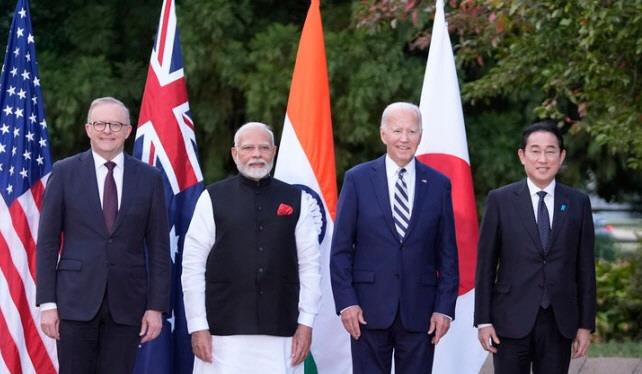
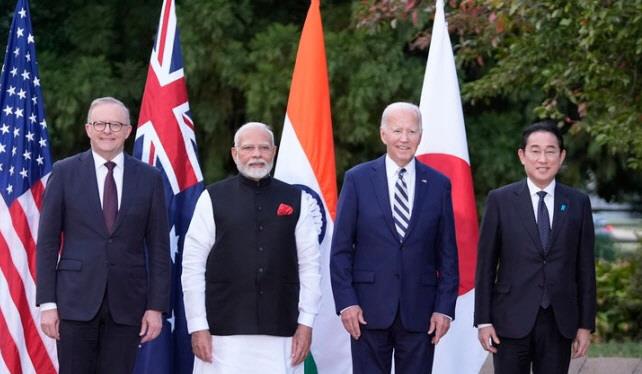
The leaders of the 'Quad,' a security alliance comprising the United States, Japan, Australia, and India, pose for a group
photo ahead of the summit in Wilmington, Delaware, U.S., on September 21 / Image circulated on Chinese social media
Quad 2.0 did not emerge abruptly under the Trump administration. Its revival was closely linked to Japan’s introduction of the ‘Indo-Pacific’ as a strategic concept, a response to China’s expanding influence.
After returning as Prime Minister in 2012, Abe proposed the ‘Asia’s Democratic Security Diamond,’ emphasizing collaboration among Quad countries. By 2016, he expanded it into the 'Free and Open Indo-Pacific' (FOIP) framework, encouraging U.S. support. This strategic shift was driven by rising threats from China, particularly the 2010 collision with a Chinese fishing vessel near the Senkaku Islands and Japan's 2012 decision to nationalize some of these islands.
If Quad 1.0 was a phase of trial and error, then Quad 2.0 (2013–2024) marks the institutionalization of a small multilateral body aimed at countering China. Revived by the Trump administration, which supported Japan's geopolitical vision, the Quad responded to rising strategic competition with China. Annual foreign ministers' meetings in 2019 and 2020 reflected growing concerns over China’s political interference, the COVID-19 pandemic, and increased tensions for Australia and India, particularly after their June 2020 border clash.
In 2021, the Biden administration held the third foreign ministers' meeting in February, followed by the first virtual leaders' summit in March. From September 2021 to September 2024, four in-person summits further solidified the Quad as a regional security consultative body.
During this period, the U.S. promoted the concept of ‘Quad Plus,’ inviting participation from regional countries, including South Korea. Although both the Trump and Biden administrations pursued this, the Moon administration’s cautious approach—considering China’s stance—resulted in a passive response. However, with Yoon’s administration pledging to join the Quad, the U.S. began advocating more concretely for South Korea’s involvement, as demonstrated by the Senate Committee on Foreign Relations’ proposal in February 2023.
How might the Quad evolve after 2025? Four major factors are expected to influence its trajectory. First, ongoing conflicts in Europe and the Middle East—like the protracted Russia-Ukraine war and the escalating Israel-Palestine situation—could push the Quad toward a more military-oriented alliance. Second, changes in China’s diplomacy and cross-strait relations will be significant, especially as Xi Jinping, facing economic pressure and nearing the end of his third term in 2027, might be forced to achieve a breakthrough with Taiwan’s pro-American President Lai Ching-te.
The third factor is the stance of Japan’s Prime Minister Ishiba Shigeru. With a firm approach to security, he aims to establish an ‘Asian NATO’ by linking and expanding existing alliances, potentially including South Korea. The final factor is the outcome of the U.S. presidential election in November. If Kamala Harris wins, continuity in the Quad’s approach is expected, while a Trump victory could bring shifts in U.S.-China relations and increase pressure for a more active South Korean role.
Two main scenarios emerge based on these four factors. The first is maintaining the status quo for Quad 2.0. If regional geopolitical tensions remain steady (even if Trump is elected) and no major incidents occur, the Quad will continue as a small multilateral consultative body. In this scenario, South Korea should recognize the importance of small multilateralism in the region. The U.S. is pursuing a broad deterrence strategy through various small frameworks, including the Quad, the Trilateral Strategic Dialogue (TSD) among the U.S., Japan, and Australia, AUKUS, U.S.-Japan-South Korea security cooperation, the D-10 (a democratic coalition), and Chip 4 Alliance between South Korea, U.S., Japan, and Taiwan. Rather than focusing on whether to join the Quad, South Korea should coordinate and expand its cooperation within these existing bodies as needed.
The second scenario involves military expansion. If regional tensions worsen and the risk of conflict rises, the U.S. may push to transform the Quad into a more military-focused alliance, actively engaging surrounding countries. This expansion could not only involve the Quad but also accelerate cooperation with NATO and the Indo-Pacific 4 (South Korea, Japan, Australia, and New Zealand). If this occurs, South Korea’s absence from the Quad could create distrust among regional and global partners. Therefore, swift political decisions would be required, with South Korea proactively participating in areas like defense industry cooperation and maritime capability development to share responsibilities.
The Quad is not a fixed institution but a response to regional geopolitical shifts. Its future will largely depend on these dynamics. As an influential middle power, South Korea must prepare for changes, especially as its own security situation intertwines with broader regional issues, such as the North Korea-Russia alliance and trilateral security cooperation with the U.S. and Japan. Understanding these shifts proactively and strategically aligning with neighboring countries is crucial for South Korea's diplomatic and security future.
-
PREV [Column]
-
NEXT [Defectors' Podium]