

North Korea’s Foreign Policy Outlook for 2025 Through WPK Plenary Meeting:
Strategies Toward Four Major Powers and South Korea’s Response

Lim Eun-jung
Professor, Division of International Studies, Kongju National University
Barry Eichengreen, an economist and professor at the University of California, Berkeley, marked the 40th anniversary of The Age of Uncertainty in 2017—a book by John Kenneth Galbraith, a Harvard professor and former U.S. ambassador to India—with an essay titled The Age of Hyper-Uncertainty. In it, Eichengreen explored the complexities of what he referred to as "The Post-Post-Cold War World."
While the post-Cold War era was defined by U.S.-led norms and global order following the ideological victory of the free world over communism—what Francis Fukuyama famously termed “The End of History”—The Post-Post-Cold War World is marked by the relative decline of U.S. dominance, China’s rapid rise as a G2 power, the emergence of a multipolar global order, and rising unpredictability as nations pursue self-reliance.
Eichengreen’s essay was published in December 2016, just before the start of Trump’s first term. Now, as Trump’s second term begins in January 2025, the international climate surpasses even his description of “hyper-uncertainty.” Lee Ha-won, foreign affairs editor at The Chosun Ilbo, borrowing Eichengreen’s terminology, has described the current era as one of “super-hyper-uncertainty.”
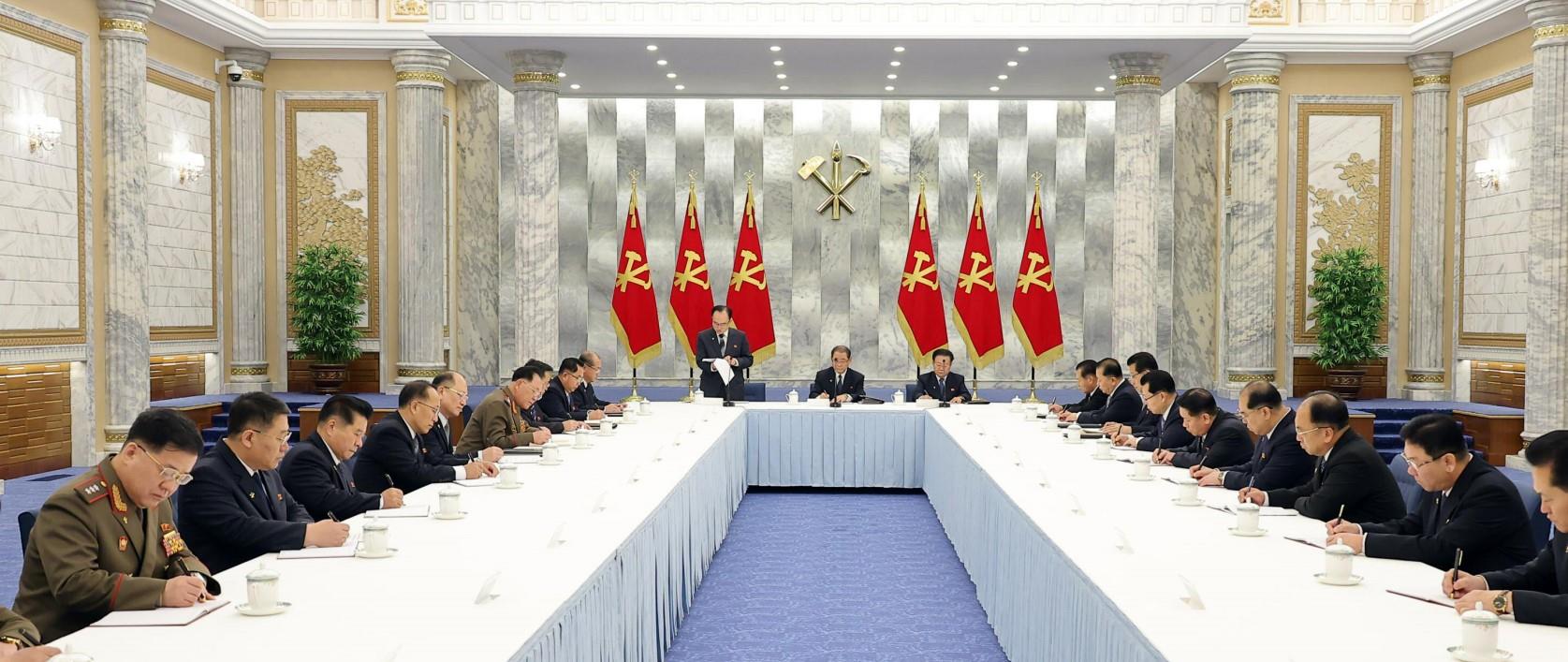
North Korea, too, confronts these uncertain times. Amid a turbulent 2024, the nation held an extended 11th Plenary Meeting of the 8th Central Committee of the Workers' Party of Korea from December 23 to 27. Kim Jong-un lauded recent accomplishments as “significant events ushering in a transformative phase” and stressed the importance of actionable plans for achieving party goals in 2025, the final year of the 8th Central Committee’s term.

11th Plenary Session of the 8th North Korean Workers' Party held in Pyongyang on the 29th of last month
As Kim Jong-un highlighted, 2025 is the final year of the 8th Central Committee and the 80th anniversary of the Workers’ Party of Korea. It also marks Trump’s second term, continued political turmoil in South Korea, the 80th anniversary of Korean liberation, and the 60th anniversary of normalized Korea-Japan relations. These events heighten uncertainty, as North Korea’s foreign policy could significantly impact East Asia’s regional dynamics and global security. This paper examines North Korea’s likely foreign policy in 2025, focusing on its dual approach of strengthening internal cohesion while increasing external pressure. By analyzing its strategies toward the four major powers, the study aims to provide implications and policy directions for South Korea.
Russia remains North Korea’s top strategic priority. Throughout 2024, the two nations deepened political, economic, military, and technological cooperation.
During the plenary meeting, North Korea showcased its “new strategic deterrence capabilities” and the “unlimited potential of defense science and technology,” though its rhetoric was measured. The promotion of figures like Kim Jong-kwan, a key figure in military collaboration with Russia, to positions such as Deputy Premier, highlights the ongoing importance of this partnership. Russia is expected to remain a top priority for North Korea in 2025.
North Korea may also promote tourism exempt from sanctions by attracting Russian visitors. Kim Jong-un is likely to attend Russia’s 80th Victory Day celebrations in May 2025, further strengthening ties.
While the outcome of the Russia-Ukraine war and Trump’s role in ending the conflict remain key factors, the existing “comprehensive strategic partnership treaty” suggests that Russia-North Korea relations will likely remain strong, even after the war concludes.
North Korea is likely to focus on improving relations with China. While ties with Russia have strengthened, its relationship with China has cooled in recent years. Although 2024 marked the 75th anniversary of diplomatic relations between the two countries, declared a “Year of Friendship,” significant follow-up events were lacking. Aside from an April visit by Zhao Leji, China’s third-ranking official, no major activities occurred, and even North Korean state media removed the dedicated anniversary section from its website.
However, with Trump’s second term and potential shifts in the Russia-Ukraine war, North Korea may seek to rebuild ties with China, its most significant economic benefactor and key ally. The plenary meeting’s emphasis on fostering relations with “friendly and amicable nations that respect sovereignty” signals North Korea’s intent to restore its partnership with China.
The most uncertain and concerning issue is the potential shift in U.S.-North Korea relations. During the plenary meeting, Rodong Sinmun reported a proclamation of the “strongest hardline response strategy against the U.S. to safeguard national interests and security.” However, no specific measures were disclosed, leading experts to interpret this as a reiteration of the existing “power-for-power” stance. Some also suggest this approach aims to temper domestic expectations for renewed negotiations with the U.S., as seen during the 2018-19 talks.
For now, North Korea is expected to closely monitor the uncertainties of Trump’s second term and adopt a flexible strategy toward the new U.S. administration’s policies. The elevation of Foreign Minister Choe Son-hui to a Politburo member is seen as preparation for potential negotiations with the U.S.
Changes may also stem from the U.S. In a December 29, 2024, New York Times op-ed titled “Trump-Kim, Part II, Could Shake Up the World,” Dmitri Alperovitch of the Silverado Policy Accelerator and Sergey Radchenko of Johns Hopkins SAIS argued that the growing anti-American bloc of authoritarian states—China, Russia, Iran, and North Korea (CRINKs)—poses the greatest threat to U.S. interests. They proposed weakening this alliance by improving ties with North Korea, viewed as its weakest link.
During his campaign, Trump highlighted his personal rapport with Kim Jong-un. If his administration prioritizes negotiations with North Korea over maintaining solidarity with South Korea, a decades-long ally, South Korea may face the challenge of redefining its national security framework.
North Korea is expected to maintain a hostile stance toward Japan, criticizing the U.S.-Japan alliance and Japan’s military expansion. This approach aligns with its strategy of emphasizing external threats to consolidate internal regime unity. During the plenary meeting, North Korea denounced the “expansion of the U.S.-Japan-South Korea alliance into an aggressive nuclear military bloc” and described South Korea as “a thorough anti-communist base of the U.S.” This rhetoric suggests that North Korea is unlikely to seek improved bilateral relations with Japan—or South Korea—in the near term.
As North Korea strengthens its military ties with Russia and expands its nuclear and missile capabilities, South Korea must prioritize its U.S.-ROK alliance to maintain a robust deterrence posture.
In addition, South Korea should enhance its technological defenses to counter North Korea’s cyber threats and asymmetric capabilities. Ensuring continuity and stability in military response systems amid political turbulence is critical. Addressing North Korea’s evolving foreign policy requires international cooperation rather than unilateral measures. Close collaboration with the U.S., Japan, the EU, and Global South nations will be essential for effectively containing North Korea.