

The March 1st Movement:
Different Perspectives and Identities in the South and North

Lee Seung-hyun
drharacearthur@gmail.com
Lee Seung-hyun
Ph.D in Public Administration (Research Fellow at the SAND Institute)
drharacearthur@gmail.com
March 1st commemorates Korea’s 1919 independence movement against Japan, a pivotal event in its history. While both Koreas observe it, their interpretations differ.
On March 1, 2025, South Korea marked the 107th anniversary of the independence uprising under Japanese rule. Civic groups held commemorative events, while political discussions drew comparisons to the December 3 martial law incident under the Yoon Suk-yeol administration.
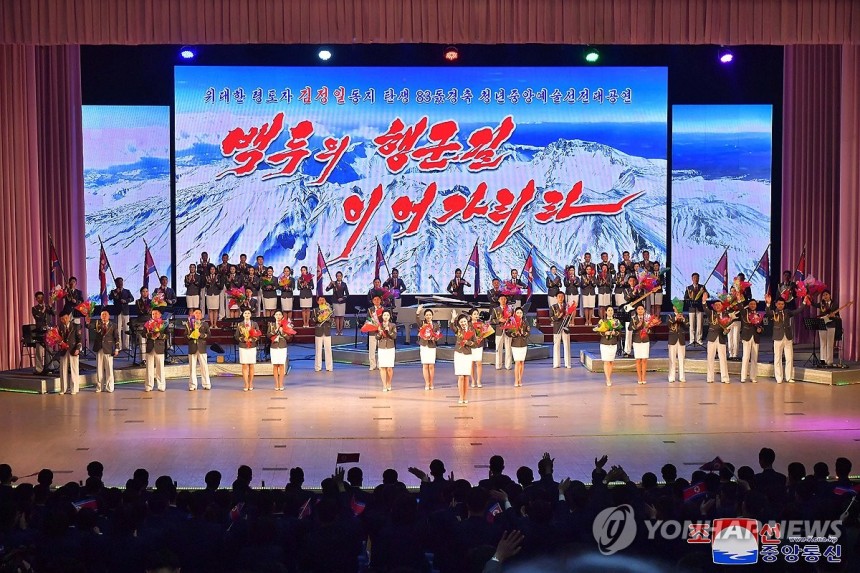
In contrast, North Korea did not issue any statements or official reports regarding the March 1st Movement. However, the absence of formal events does not imply that North Korea denies or considers the movement insignificant.
North Korea, especially the Kim dynasty, ties its origins to the anti-Japanese resistance. However, the lack of official statements or events on the March 1st Movement reflects the contrasting historical identities of the two Koreas.
Before examining the March 1st Movement’s identity in South and North Korea, it is essential to first understand their differing perceptions of it.
In South Korea, the March 1st Movement is viewed as the start of the independence struggle and a peaceful protest against Japanese rule. It led to the Provisional Government’s establishment on April 11, 1919, laying the foundation for national legitimacy. Today, it is a national holiday with annual commemorations.
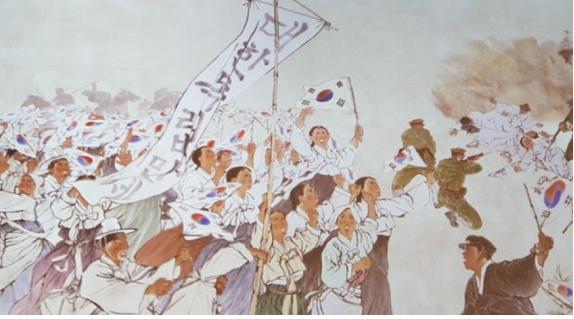
In contrast, North Korea views the March 1st Movement as a worker- and peasant-led anti-Japanese struggle, framed through socialist class struggle. It is closely linked to the 1930s armed resistance in Manchuria, which it claims was led by Kim Il-sung.
Thus, North Korea dismisses the Provisional Government as a "bourgeois movement" and instead emphasizes the communist-led anti-Japanese struggle, including the Korean Communist Party and Kim Il-sung’s partisan activities, using the March 1st Movement as a propaganda tool.
South Korea views the March 1st Movement as a peaceful fight for independence that led to the founding of the Republic of Korea, while North Korea sees it as an anti-Japanese struggle by workers and peasants linked to armed resistance. This highlights the different historical perspectives shaped by their political systems.
The differing views also reflect differences in their identities. In South Korea, it is celebrated as a symbol of democracy and independence, with a national holiday honoring the spirit of these values.
The March 1st Movement led to the establishment of the Provisional Government of the Republic of Korea, which is seen as the legal foundation of the current government. It promoted non-violent resistance, national unity, and democracy. As a result, the South Korean government made it an official national holiday in 1949.
Each year on March 1st, South Korea holds an official government ceremony, with the president giving a speech and honoring independence activists. In contrast, North Korea sees the March 1st Movement as the start of the anti-imperialist struggle for national liberation against Japan.
Unlike South Korea, North Korea views the movement as a failed struggle and associates it with Kim Il-sung’s anti-Japanese resistance, emphasizes his partisan struggle as the true independence movement. Therefore, March 1st is not an official holiday, and events are limited.
The March 1st Movement is used as propaganda to highlight the Kim family regimes. North Korea focuses more on the anti-Japanese partisan struggle and the founding of the Workers' Party of Korea, mentioning the March 1st Movement mainly to stir anti-Japanese sentiment within the South Korea-U.S.-Japan alliance. The table below summarizes the differing views between South and North Korea.
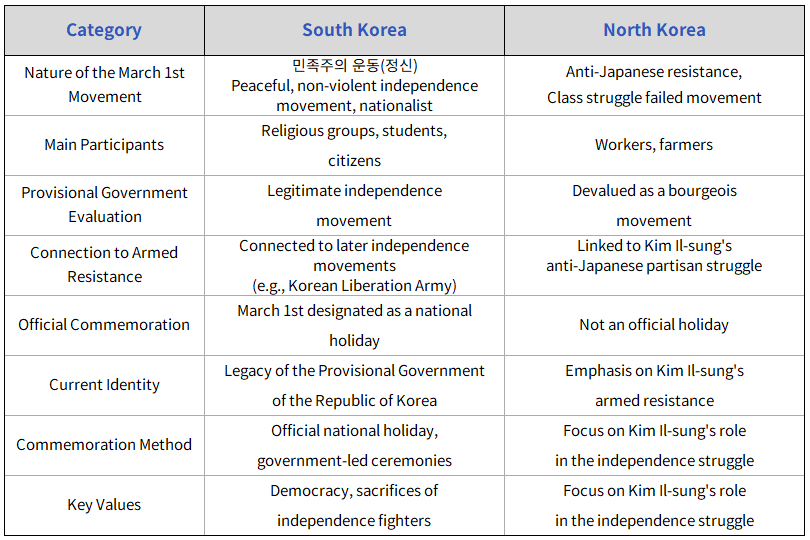
In conclusion, South Korea officially commemorates the March 1st Movement as the peak of the independence movement, recognizing it as a peaceful struggle that laid the foundation for the Republic of Korea and its democratic principles.
In contrast, North Korea views the March 1st Movement as part of the anti-imperialist struggle, linking it to Kim Il-sung’s armed resistance and portraying it as a worker- and farmer-led uprising against Japan.
Thus, South and North Korea have developed differing historical perspectives based on their democratic and socialist systems, leading to contrasting interpretations of historical events shaped by political ideologies.
-
PREV [Analysis and Prospects]
-
NEXT [Defectors' Podium]