

Rebuilding Dialogue: A Nuclear Freeze as a Pathway to Peace and Stability on the Korean Peninsula

Lee Ju Yeon
Northeast Asian History Foundation
Reframing the Approach: Strategic Empathy and Policy Orientation
At his 2026 New Year press conference, South Korean President Lee Jae-myung articulated a policy orientation toward North Korea grounded in what he described as “putting oneself in the other’s position.” By acknowledging the depth of Pyongyang’s distrust and the deterioration of inter-Korean relations, Lee signaled that any viable strategy must begin with an assessment of North Korea’s threat perceptions rather than rely solely on declaratory commitments to denuclearization.
This framing suggests that the Lee administration views sustainable peace on the Korean Peninsula not as the outcome of unilateral pressure, but as the product of a calibrated strategy that addresses the underlying drivers of North Korea’s security calculus. The same logic extends to the nuclear issue: without engaging the structural motivations behind Pyongyang’s nuclear posture, policy tools are likely to remain ineffective.
Regime Survival and the Logic of Nuclear Retention
A durable solution to the North Korean nuclear question requires moving beyond normative appeals for denuclearization toward a structural understanding of why Pyongyang regards nuclear weapons as indispensable. From the perspective of the North Korean leadership, nuclear weapons constitute the ultimate guarantor of regime survival.
Although the Cold War formally ended with the dissolution of the Soviet Union in 1991, its geopolitical legacy persists on the Korean Peninsula. The inter-Korean balance of power, however, has shifted decisively. South Korea’s economy is estimated to be roughly fifty times larger than that of North Korea.
Despite Pyongyang allocating a significant share of its gross domestic product—often estimated at approximately 15 percent—to defense spending, its overall defense budget remains substantially smaller than that of South Korea. In both qualitative and quantitative terms, the asymmetry is pronounced.
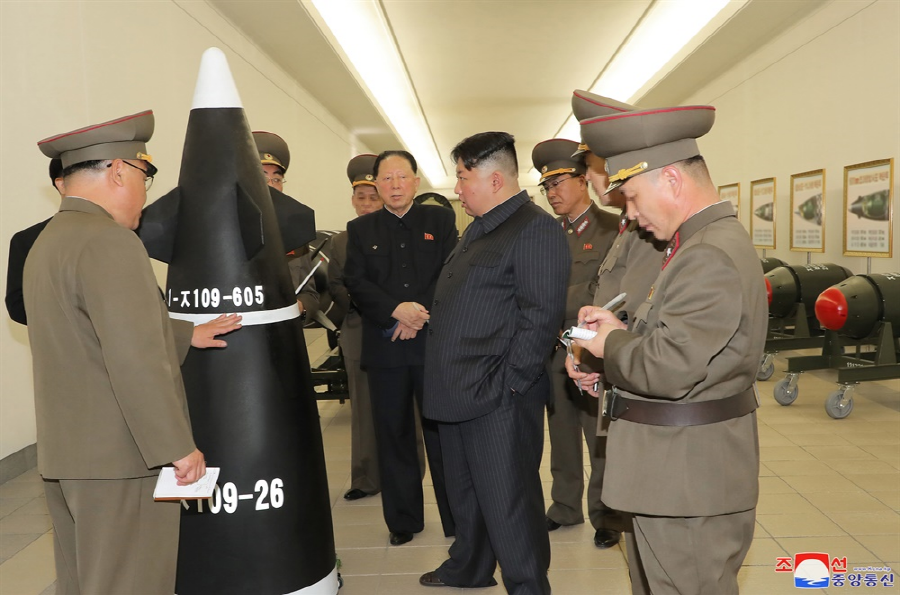
Under these conditions, North Korea is likely to perceive a persistent structural vulnerability vis-à-vis South Korea. The presence of the United States further compounds this perception. Historical cases—including U.S. interventions in Vietnam, Afghanistan, and Iraq—have reinforced, within North Korean strategic thinking, the notion that non-nuclear states remain susceptible to external coercion or regime change. From Pyongyang’s vantage point, the United States’ overwhelming military superiority represents a latent existential threat.
Accordingly, nuclear weapons are viewed not merely as instruments of prestige alone, but as equalizers in an otherwise unfavorable strategic environment. Unless North Korea’s threat perceptions are substantively mitigated, it is reasonable to assume that its nuclear capabilities will continue to expand both quantitatively and qualitatively.
Shifting Strategic Calculus and Lessons from the Russia–Ukraine War
The 2022 war between Russia and Ukraine appears to have reinforced Pyongyang’s conviction regarding the utility of nuclear weapons. The conflict underscored, in the eyes of many observers, the deterrent value of nuclear capability in preventing direct military intervention by major powers.
In a 1993 article in Foreign Affairs, John Mearsheimer argued that Ukraine’s decision to relinquish its inherited nuclear arsenal could leave it strategically exposed. When large-scale hostilities erupted in 2022, the argument was widely revisited as evidence that nuclear weapons may function as a powerful deterrent against external intervention. From North Korea’s perspective, this episode likely reinforced the belief that nuclear capability remains the most reliable hedge against regime-threatening contingencies.
The war has also illustrated a second dimension: the coercive leverage associated with nuclear possession. Following its invasion of Ukraine, Russia signaled the potential for nuclear escalation to deter more direct involvement by the United States and its European allies. In this sense, nuclear weapons served not only as defensive instruments, but also as tools of strategic compellence, shaping the decision-making calculus of third parties.
Pyongyang’s own legal codification reflects this broadened conception of nuclear utility. On September 8, 2022, the Supreme People's Assembly adopted a revised Nuclear Force Policy Law, expanding the conditions under which nuclear weapons could be employed. By institutionalizing a wider range of potential use scenarios, North Korea signaled that its nuclear arsenal is embedded within a comprehensive regime-survival doctrine applicable across diverse contingencies.
Implications for a “Nuclear Halt” Roadmap
Taken together, these dynamics suggest that immediate, comprehensive denuclearization is unlikely to be attainable under current structural conditions. A more pragmatic interim objective may lie in pursuing a verifiable “nuclear halt”—freezing further quantitative and qualitative advancements—in parallel with calibrated measures designed to reduce mutual threat perceptions.
Such an approach would not legitimize North Korea’s nuclear status; rather, it would acknowledge strategic realities while seeking to prevent further escalation. By coupling restraint mechanisms with incremental confidence-building measures, it may be possible to stabilize the security environment and reopen channels for sustained dialogue.
Ultimately, peace and stability on the Korean Peninsula will depend less on rhetorical commitments than on reshaping the underlying strategic equation. If North Korea’s nuclear program is rooted in regime-survival logic, then any credible roadmap must address the security dilemma at its core. A phased process—beginning with a nuclear freeze and progressing toward broader risk-reduction arrangements—may offer a more realistic pathway than maximalist demands unmoored from structural constraints.