

Paradigm Shift and Peace on the Korean Peninsula
as Reflected in President Lee’s March 1st Movement Commemorative Address

Seung-hyun Lee
Visiting Professor
Yonsei University
I. Introduction
This analysis examines the significance of President Lee Jae-myung’s March 1st Movement commemorative address through the lens of paradigm shifts in historical interpretation and national strategy. It evaluates how the speech reframes the meaning of the March 1, 1919 Movement and articulates a forward-looking vision for the Republic of Korea (ROK). Furthermore, it assesses the policy instruments proposed to implement that vision and considers their broader implications for peace and coexistence on the Korean Peninsula.
The address implicitly advances a reinterpretation of the March 1st Movement, which can be understood as a paradigmatic shift. Traditionally described as a “manse movement” centered on public demonstrations, the speech instead situates it as a foundational political revolution that established the normative and institutional origins of the modern Republic of Korea.
In doing so, it links the contemporary democratic state—free, prosperous, and internationally engaged—to the moral and political legacy of the independence movement. This reframing represents not merely rhetorical elevation but a shift in historical consciousness, positioning March 1 as the point of origin for South Korea’s constitutional democracy and civic sovereignty.
Against this interpretive backdrop, the speech articulates a strategic national vision that is grounded in historical continuity while oriented toward structural transformation.
II. Articulation of a National Future Vision
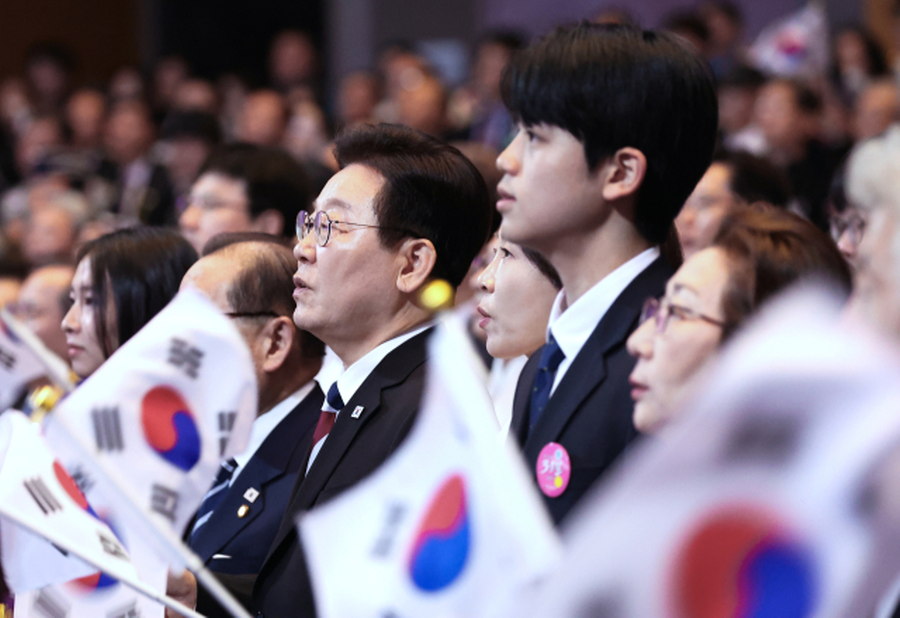
President Lee’s address presents an integrated national vision organized around three pillars: (1) the construction of a fair society, (2) the advancement of a culturally and technologically advanced nation, and (3) the realization of peace and shared prosperity on the Korean Peninsula. Each objective reflects an effort to translate the normative legacy of the March 1 Movement into contemporary governance priorities.
1. Building a Fair Nation
At the core of the fairness agenda is a moral recalibration of historical justice. The speech invokes a powerful social inversion: replacing the longstanding perception that participation in the independence movement resulted in generational disadvantage with the normative expectation that such sacrifice should yield generational honor and prosperity.
This reframing underscores a commitment to rectifying historical inequities, in which collaborators benefited socially and economically while independence activists and their descendants often faced hardship. Policies aimed at identifying previously unrecognized independence activists and expanding state honors serve both symbolic and redistributive purposes.
The proposed establishment of a national Independence Park in Yongsan—including the elevation of Hyochang Park as a central commemorative site associated with figures such as Kim Gu, Lee Bong-chang, and Yun Bong-gil—reinforces the state’s effort to embed historical legitimacy within contemporary civic identity.
In this respect, fairness is understood not solely in distributive economic terms but as a restructuring of historical memory and social recognition.
2. Advancing a Cultural and Scientific Nation
The second pillar of the vision emphasizes cultural vitality and scientific advancement. The speech recalls the aspiration expressed in the 1919 Declaration of Independence that Korea would contribute to global civilization through originality and innovation. By juxtaposing periods of national subjugation—when Korea was excluded from global scientific and technological developments—with its current participation in advanced industries such as artificial intelligence, the address constructs a narrative of historical recovery and accelerated modernization.
This framing situates contemporary achievements in science, technology, and cultural production—including the global expansion of Korean cultural influence—within a century-long arc of deferred potential now realized. The speech thus underscores the strategic importance of sustained investment in research, innovation ecosystems, and cultural industries as instruments of national competitiveness and soft power projection.
3. Peace, Coexistence, and Regional Stability
The third pillar emphasizes peace and coexistence on the Korean Peninsula. The speech advocates a shift from an adversarial security paradigm toward one grounded in mutual recognition, confidence-building, and practical cooperation. This perspective aligns conceptually with the historical advocacy of regional peace articulated by figures such as Ahn Jung-geun, whose vision of East Asian cooperation is invoked as a normative precedent.
The address rejects a zero-sum logic of hostility and instead calls for a paradigm transition from distrust to trust-based engagement. This language stands in contrast to North Korea’s increasingly explicit framing of inter-Korean relations as hostile and structurally divided.
III. Policy Instruments and Strategic Feasibility
A distinguishing feature of the commemorative address is its effort to link an aspirational vision with concrete and identifiable policy instruments.
1. Institutionalizing Historical Recognition
Concrete measures to honor independence activists—through expanded state recognition and the development of commemorative infrastructure—form the operational foundation of the fairness agenda. These initiatives aim to embed historical legitimacy within state institutions and public spaces, reinforcing civic cohesion and ensuring normative continuity.
2. Science, Technology, and Cultural Policy
In the domain of science and technology domain, the speech emphasizes the importance of positioning the ROK among the world’s leading innovation economies. By recalling historical exclusion during pivotal moments in global scientific advancement, the address underscores the urgency of sustained strategic investment. The broader objective is to ensure that South Korea not only participates in but helps shape emerging technological paradigms.
Similarly, the expansion of cultural influence is framed as both a national achievement and a policy priority. The address conveys confidence that South Korea’s cultural and technological capacities can serve as mutually reinforcing pillars of international standing.
3. Managing the Korean Peninsula Security Environment
With respect to inter-Korean relations, the address reiterates key principles: respect for the North Korean regime, avoidance of hostile acts, renunciation of absorption-based unification strategies, and sustained efforts to reopen dialogue. It also emphasizes the importance of preventing incidents that could escalate tensions, such as unauthorized cross-border activities.
The proposed long-term objective of transitioning from the armistice framework to a peace regime reflects continuity with prior diplomatic initiatives. However, given the deterioration of U.S.–DPRK dialogue following the Hanoi Summit and North Korea’s hardened strategic posture, the near-term feasibility of such a transition remains limited.
Within these constraints, the speech identifies a pragmatic maximum: strengthening trilateral cooperation among the ROK, China, and Japan; maintaining close coordination with the United States; and positioning South Korea as a facilitator in diplomatic engagement. The renewed emphasis on a “peacemaker” or “facilitator” role reflects a middle-power strategy designed to preserve agency within a constrained geopolitical environment.
IV. Conclusion
The March 1st Movement commemorative address situates contemporary policy within a century-long trajectory of national transformation. By reframing March 1 as the revolutionary origin of constitutional democracy, the speech advances a paradigm shift in historical interpretation that informs present governance strategy.
The resulting policy vision integrates historical justice, technological and cultural advancement, and a recalibrated approach to inter-Korean relations. While structural constraints—particularly in the security domain—limit immediate breakthroughs, the address articulates a coherent strategic orientation grounded in normative continuity and institutional reform.
In this sense, the speech does not merely commemorate the past; it seeks to operationalize historical memory as a driver of future statecraft.
-
PREV [Current Affairs Analysis]
-
NEXT [Feature Article]