

President Lee's State Visits to Singapore and the Philippines and the Internationalization of the Korean Peninsula Peace Initiative

Keeyoung Yoon
Adjunct Professor, Hankuk University of Foreign Studies
Director, Future Strategy Research Institute, FNS Consulting
History is often shaped by the timing gap between those who knock on the door and those who choose to lock it. In March 2026, President Lee Jae-myung visited Singapore and Manila in succession, repeatedly signaling to the international community his intention to resume inter-Korean dialogue.
Yet North Korea, the prospective dialogue partner, chose silence rather than issuing an official response. This silence is not merely the absence of a reply. Rather, it represents a strategic pause rooted in the logic of regime survival, and at the same time, serves as a precursor that may determine the direction in which the future of the Korean Peninsula ultimately diverges.
A. From the Inaugural Address to March 1: The Consistent Language of Peace and “Dialogue”
President Lee’s to North Korea has followed a single, consistent trajectory since his first day in office. From his June 2025 inaugural address calling to “restore communication and dialogue,” to his August Liberation Day speech outlining three principles—“respect for the regime, no pursuit of unification by absorption, and cessation of hostile acts”—and finally to his 2026 March 1st Movement Day address declaring the need to “lower tensions through actions, not words,” the overall direction has remained unwavering.
What merits attention is precisely this consistency. The more frequently a policy signal is repeated, the lower the other side’s cost of calculation becomes; over time, the threshold for entering negotiations correspondingly declines.
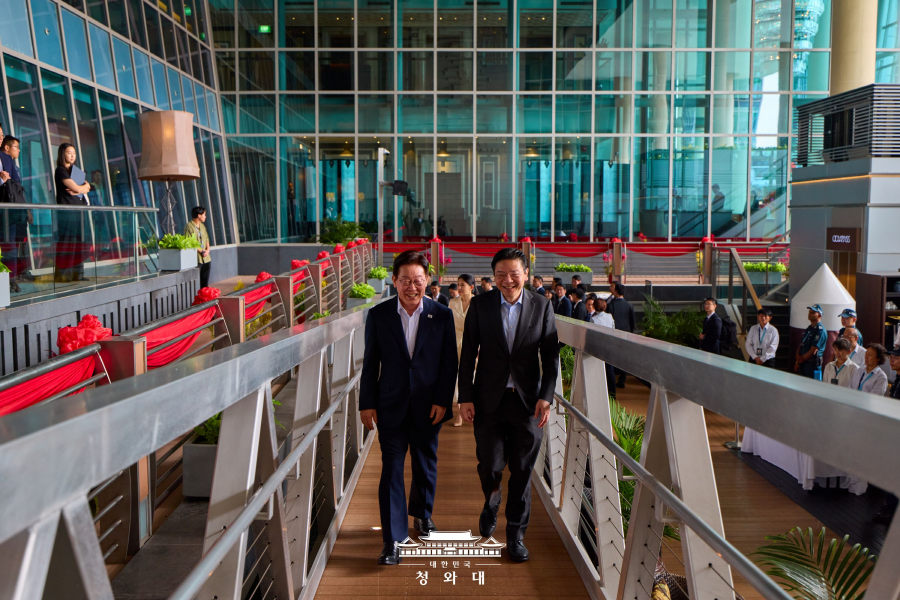
This overseas tour follows the same trajectory. In Singapore—at the very site of the 2018 North Korea–U.S. summit—President Lee called for support in advancing peace on the Korean Peninsula. In Manila, the joint press statement with the Philippines reaffirmed international solidarity for “efforts to resume dialogue.” This initiative should be understood not merely as a routine diplomatic itinerary, but rather as a medium- to long-term strategic effort to return the Korean Peninsula peace process to the international agenda.
B. North Korea’s Silence: “Strategic Pause” or “Permanent Rejection”?
North Korea’s response thus far has been silence. Neither state media nor senior officials have issued official commentary regarding the March 1st anniversary address or the remarks delivered during this overseas tour.
Earlier this January, however, Kim Yo-jong, vice department director of the Workers’ Party of Korea, dismissed expectations for improved inter-Korean relations as “delusions” and directly criticized Lee’s overseas trip as an attempt to solicit international support.
Yet this silence can also be interpreted in a different light. From an analytical perspective that characterizes the North Korean system as a “Confucian socialist monarchy,” the regime’s foremost priorities are regime security and the authority of the leader.
These are followed by the practical recognition of its status as a nuclear-armed state, sanctions relief, a reward structure designed to consolidate elite cohesion, and negotiations that do not place the regime within a surrender framework. In this sense, North Korea’s refusal may not represent a rejection of dialogue itself, but rather a rejection of unfavorable conditions and timing.
A degree of economic confidence may also underpin North Korea’s hardline posture and continued silence. Estimates suggest that the regime has secured annual economic benefits of approximately $10–20 billion through the deployment of troops and the provision of weapons and ammunition in connection with the Russia–Ukraine war.
Some analyses further indicate that, following three consecutive years of economic contraction from 2020 to 2022, the North Korean economy achieved growth of roughly 3 percent in 2023–2024. From Pyongyang’s perspective, there may be little immediate incentive to rely on South Korea.
However, a locked door and the absence of a door altogether signify entirely different futures.
C. The Korean Peninsula in a Multipolar World: The Slowing Clocks of Major Powers
One of the variables most frequently cited in analyses of the Korean Peninsula issue is the “allocation of attention” among major powers. As the international system moves deeper into a multipolar phase, the United States, China, and Russia are simultaneously committing strategic resources to the Middle East, Europe, India, and the Pacific.
Within this context, the Korean Peninsula can easily be pushed down the priority list of major powers at any given moment. The Trump administration’s emphasis on allied “burden-sharing” reflects one dimension of this broader trend. From South Korea’s perspective, an era has already begun in which it cannot predict when—or to what extent—the United States will intervene in Korean Peninsula affairs.
The Middle East variable further compounds this situation. U.S. military action against Iran delivered a powerful message to North Korea: “Countries that abandon their nuclear weapons are ultimately attacked.” This perception reinforces North Korea’s determination to retain its nuclear arsenal while simultaneously raising the threshold for entering negotiations. For both symbolic justification and practical benefits related to regime preservation, North Korea has little choice but to persist in its nuclear development and advancement.
The gap between Washington and Pyongyang remains substantial. The White House repeatedly reiterates its willingness for “unconditional dialogue” while maintaining the goal of denuclearization. North Korea, by contrast, has signaled a willingness to negotiate only on the premise of its “nuclear weapons state status.” While this gap slows the pace of negotiations, it simultaneously leaves open the possibility of an intermediate pathway: phased management focused on a verifiable freeze.
D. Four Potential Scenarios for the Korean Peninsula Peace Initiative
The future remains open and full of multiple possibilities. At certain moments, history reaches turning points where trajectories begin to diverge. The analytical method that anticipates such branching paths is known as scenario planning. From this perspective, four potential trajectories for future inter-Korean relations can be broadly outlined.
The first scenario is a “long-term freeze.” In this scenario, military conflict is narrowly avoided, yet relations repeatedly stall whenever friction points—such as loudspeakers, leaflet campaigns, or drone incidents—become flashpoints. If U.S. strategic attention continues to be dispersed and North Korea maintains its disregard for the South, inter-Korean relations may gradually drift along this path. This scenario is governed largely by the force of inertia.
The second scenario is “limited transactions.” This approach would involve expanding sanctions exemptions in areas such as humanitarian cooperation, disaster relief, and public health, while reducing the risk of accidental clashes through technical agreements—for example, the restoration of military communication lines. Although its political symbolism may be limited, it holds practical value by establishing repeatable and institutionalized procedures.
The third, and worst-case, scenario is an “escalating crisis.” If accidental clashes, rapid escalation in information and psychological warfare, and excessive domestic political reactions occur simultaneously, dialogue channels could close abruptly, returning the situation to a one-sided focus on arms competition and military deterrence.
Historically, inter-Korean relations have swung sharply between extremes whenever South Korea’s government has changed. There remains a meaningful possibility that hardliners in both South and North Korea could exploit crisis escalation for domestic political advantage.
The fourth, and most feasible, best-case scenario is the “stepwise expansion of common ground.” In this pathway, South Korea secures the minimum objective of reducing the risk of war and halting the acceleration of North Korea’s nuclear and missile programs. North Korea preserves its dignity while gaining a measure of economic breathing space.
The United States manages proliferation risks without incurring significant costs. When these three conditions converge, a sequence of small agreements—exchanging a “verifiable freeze” for “conditional sanctions exemptions and economic cooperation”—could begin to take shape. Third-party venues, such as ASEAN, could also serve as platforms for initial trust-building.
To design the most favorable future, the first priority must be the institutionalization of a functioning crisis management system. The starting point is to eliminate the structural vulnerability whereby a single incident could automatically escalate into war.
This requires establishing military communication channels, maritime and aerial protocols to prevent accidental clashes, and verification procedures to ensure that incidents such as drone incursions do not recur. Such measures may lack the dramatic appeal of high-profile summits, but they constitute far more essential infrastructure.
The next task is the design of “reversible support.” Within the existing sanctions framework, South Korea should prepare a package of humanitarian assistance, public health cooperation, agricultural support, and disaster response initiatives, while maintaining a strict separation between cash transfers and in-kind assistance.
At the same time, careful linguistic discipline is essential. Given North Korea’s acute sensitivity to the politics of face, rhetoric implying regime change or demands for public capitulation would undermine the very foundation of negotiations.
Perhaps the most critical variable is the resilience of South Korea’s domestic political system. Because even a single incident could collapse an agreement, any diplomatic initiative must be supported by sustainable explanatory capacity and at least a minimal degree of bipartisan consensus. As U.S. strategic attention becomes increasingly dispersed, Seoul must develop a more sophisticated diplomatic strategy of its own to minimize potential fractures in the ROK-U.S. approach toward North Korea.
President Lee’s repeated message during this trip of “resuming dialogue” represents an act of knocking on the door. North Korea’s silence suggests that the door will not open immediately. Yet the moment the knocking stops, the door inevitably becomes thicker. What matters is not optimism or pessimism, but the steady design and implementation of a sustainable vision for peace.