

Beijing’s Two Summits and the Realignment of Eurasia
— U.S.–China Rivalry, China–Russia Alignment, and South Korea’s Strategic Challenges —

Professor. Choi Jae duk
Seoul School of Integrated Science and Technology
In May 2026, Beijing emerged as a symbolic venue reflecting the evolving dynamics of the international order. Just four days after the conclusion of U.S. President Donald Trump’s visit to China, Russian President Vladimir Putin returned to Beijing. While the United States and China sought to manage their strategic competition, China and Russia reaffirmed their strategic partnership aimed at reshaping the international order. Although the two summits pursued different objectives, they ultimately underscored a common underlying trend.
On the surface, the U.S.–China summit was primarily characterized by efforts to manage tensions and stabilize bilateral relations. The two sides sought to prevent further deterioration in their relationship by signaling limited areas of economic cooperation, including potential purchases of Boeing aircraft and expanded imports of U.S. agricultural products.
However, no meaningful compromises were reached on core strategic issues such as Taiwan, semiconductor export controls, rare earth supply chains, and competition in advanced technologies. As a result, the structural differences between the two sides remain intact.
Indeed, the summit further reinforced the view that U.S.–China competition has entered a prolonged and structural phase. Particularly noteworthy was China’s restrained response to indications that the United States might ease certain semiconductor restrictions. This suggests that Beijing has firmly adopted technological self-reliance as a long-term national objective, seeking to reduce its dependence on U.S. technology while developing indigenous industrial ecosystems and supply chains.
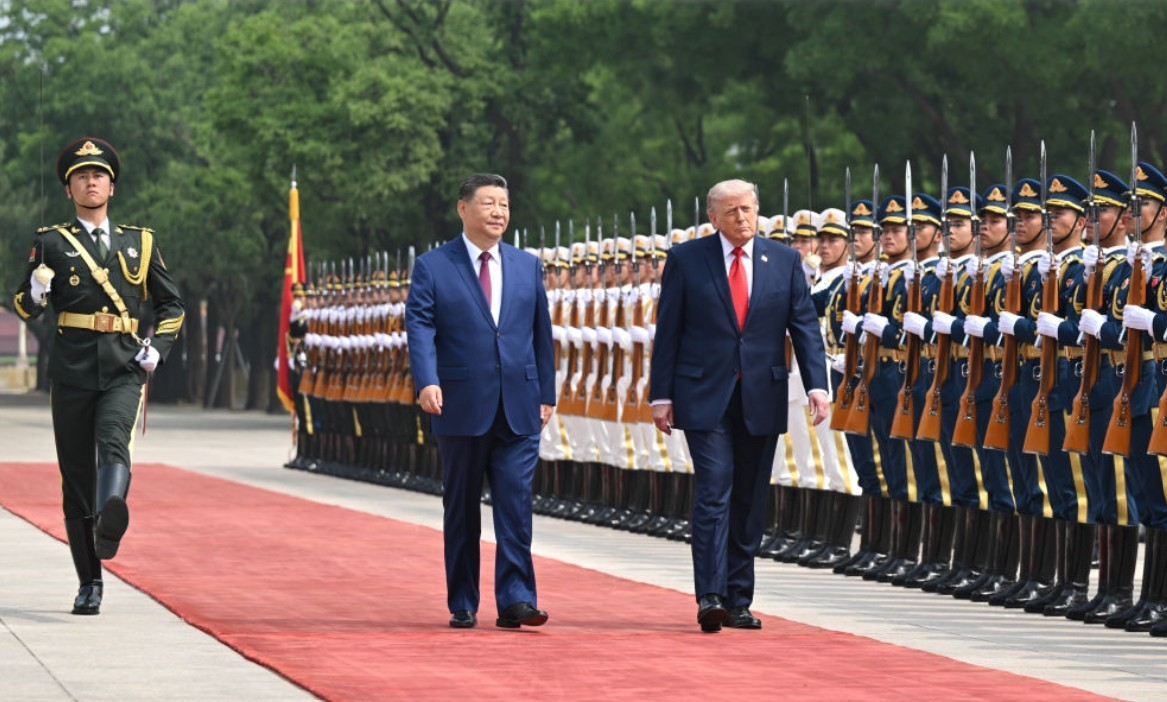
The United States currently faces a range of strategic challenges. The prolonged war in Ukraine and ongoing geopolitical tensions in the Middle East continue to place significant demands on U.S. diplomatic and military resources. Simultaneously, elevated interest rates, fiscal pressures, and rising supply chain costs are exerting considerable strain on the U.S. economy.
To be sure, inflationary pressures and rising Treasury yields could be partially alleviated through a reduction in Middle East tensions and greater stability in global energy markets. Nevertheless, Washington faces the complex task of managing commitments across Europe, the Middle East, and the Indo-Pacific simultaneously, fueling debates over the allocation of strategic assets and the prioritization of foreign policy engagements. Over time, this trend could weaken international confidence in both the predictability of U.S. foreign policy and the durability of American global leadership.
Nevertheless, the United States continues to possess the world’s most advanced technological innovation capacity, as well as unparalleled financial and military networks, while China faces structural challenges, including a prolonged real estate downturn, sluggish domestic demand, and increasing external scrutiny. Accordingly, it is more accurate to view the current international environment as a period in which major powers are competing to establish a new equilibrium of power and influence.
Against this backdrop, President Putin’s visit to China carries even greater symbolic significance. The visit coincided with the 25th anniversary of the Russia–China Treaty of Good-Neighborliness, Friendship, and Cooperation and the 30th anniversary of the establishment of their bilateral strategic partnership. During the visit, the two countries reaffirmed their “comprehensive strategic partnership.” Notably, through a joint statement, they reiterated their commitment to a multipolar world order and to the construction of a new international system.
The central theme of the joint statement was a challenge to the structural foundations of the U.S.-led international order. Criticizing unilateralism, hegemonism, the expansion of military alliances, and bloc-based confrontation, the two countries emphasized the principles of a “multipolar world order” and “indivisible security.” This represents more than diplomatic rhetoric; it reflects a long-term strategic vision aimed at reshaping the rules and distribution of power in the international system.
In particular, U.S. strategy toward Eurasia is viewed by both Russia and China as a critical security concern. Russia has long regarded NATO’s eastward expansion as a threat to its security interests, while China similarly interprets the U.S. Indo-Pacific Strategy and developments in the Taiwan Strait as elements of a broader, long-term containment strategy.
The war in Ukraine and tensions across the Taiwan Strait may therefore be understood as manifestations of great-power competition at opposite ends of Eurasia. Both Beijing and Moscow view these developments as extensions of efforts by the U.S.-centered order to preserve and expand its influence across the Eurasian region.
Against this backdrop, China–Russia relations are moving toward deeper structural integration. Sino–Russian cooperation is characterized less by a complete convergence of values and ideology than by a realist alignment driven by a shared strategic environment.
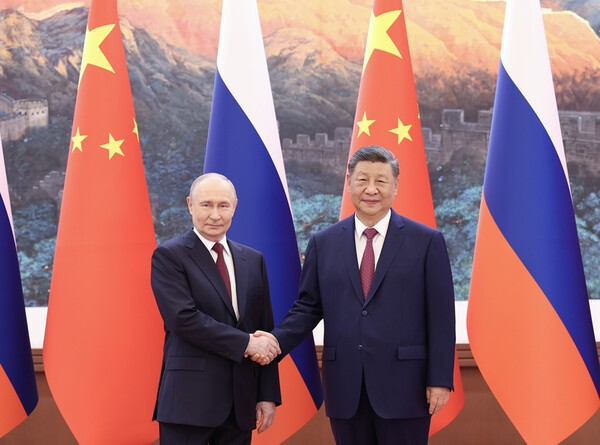
In particular, the two countries are strengthening a complementary framework of economic and strategic cooperation. Russia provides China with stable supplies of energy resources and raw materials, including crude oil, natural gas, and coal, while China supplies Russia with manufactured goods, electronics, and industrial equipment. In this arrangement, Russia serves as a supplier of energy and raw materials, while China contributes manufacturing capacity and industrial production.
This cooperation carries significance beyond the expansion of bilateral trade. Given the growing importance of stable energy supplies for the development of artificial intelligence industries and advanced manufacturing, Russia’s energy exports have become an increasingly important component of China’s industrial strategy. At the same time, the two countries are expanding ruble- and yuan-denominated transactions and exploring limited alternatives to the dollar-centered international financial system.
While U.S. strategic assets and diplomatic resources are increasingly absorbed by geopolitical crises such as the war in Ukraine and instability in the Middle East, China has focused on strengthening industrial competitiveness, securing supply chains, and accumulating technological capabilities. In effect, Beijing has gained a degree of strategic flexibility within an international environment shaped by multiple concurrent geopolitical conflicts.
A particularly noteworthy aspect of the joint statement concerns the Korean Peninsula. Both China and Russia oppose an approach toward North Korea centered primarily on sanctions and pressure, instead emphasizing the need for political and diplomatic solutions.
At the same time, China and Russia have adopted a critical stance toward the involvement of external powers in Eurasian security affairs, emphasizing the importance of a regionally centered security architecture.
The intensification of U.S.–China competition, the deepening of China–Russia ties, and the expansion of North Korea–Russia cooperation are all contributing to greater uncertainty in South Korea’s diplomatic and security environment. South Korea occupies a geopolitical position at the intersection of maritime and continental powers and faces simultaneous pressures arising from both U.S.–China competition and the broader realignment of Eurasia.
While the ROK–U.S. alliance remains the cornerstone of South Korea’s security, Seoul must also consider maintaining constructive relations with China, preserving diplomatic channels with Russia, and diversifying supply chains through deeper engagement with ASEAN and the Global South.
In particular, given the substantial differences among the United States, China, and Russia regarding the North Korean nuclear issue, diplomatic efforts aimed at narrowing these differences and promoting policy coordination are becoming increasingly important. While the United States continues to call for the complete denuclearization of North Korea, China consistently reiterates its principled position advocating a “political solution” to issues on the Korean Peninsula, including the nuclear question.
Russia, meanwhile, appears to be providing de facto diplomatic support on the North Korean nuclear issue, partly as compensation for North Korea’s troop deployments and military assistance related to the war in Ukraine. Given the wide divergence in the interests and policy approaches of these three countries, achieving a common framework for addressing the North Korean nuclear issue—similar to that established during the Six-Party Talks—appears increasingly difficult.
Under these circumstances, a so-called “freeze-first” approach—prioritizing the suspension of additional nuclear tests, the production of highly enriched uranium, and further advances in North Korea’s intercontinental ballistic missile (ICBM) capabilities in exchange for limited sanctions relief or measures to improve bilateral relations—may represent a realistic policy alternative at the present stage.
Although such an approach would not constitute a fundamental solution to the North Korean nuclear issue, it could help prevent further deterioration of the situation while preserving space for future negotiations. This perspective underscores the need for a phased and pragmatic strategy focused on constraining further nuclear expansion rather than expecting complete denuclearization in the near term.
Furthermore, in an era in which economic security and geopolitics are increasingly intertwined, strategies aimed at reducing dependence on specific countries and building diversified, multilayered networks are becoming ever more important. Such measures represent a pragmatic approach to preserving national strategic autonomy within a complex and evolving international environment.
The two summit meetings in Beijing illustrate that the international order is gradually moving away from a U.S.-centered unipolar framework toward a more competitive multipolar system characterized by overlapping strategic axes. They also demonstrate that the Eurasian space is increasingly becoming the principal arena of this transformation.
These shifts in the Eurasian order are having a direct impact on security dynamics on the Korean Peninsula. Looking ahead, South Korean diplomacy faces several critical challenges: how to achieve “connected peace” through “connected growth” amid the fragmentation of globalization and the rise of competing blocs; how to cultivate shared interests with as many countries as possible in order to become a nation of mutual strategic importance; and ultimately, how to foster a favorable strategic environment with like-minded partners in order to preserve peace and stability on the Korean Peninsula.
-
PREV [Analysis of issues]
-
NEXT [Issue Analysis]