

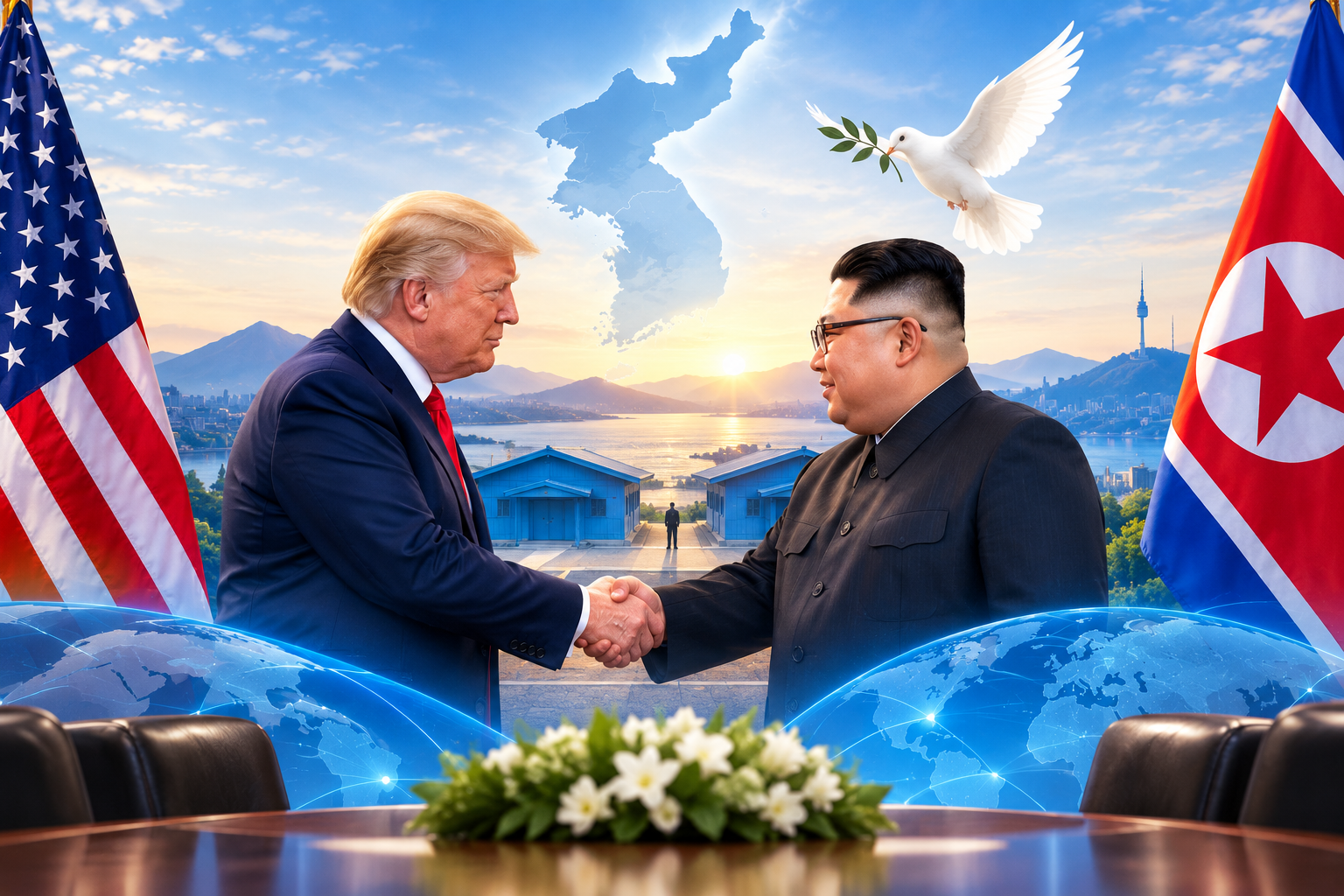
The Strategic Imperative of a U.S.–North Korea Summit for Peaceful Coexistence on the Korean Peninsula

Eui-haeng Cho
Seoul Theological University
The situation on the Korean Peninsula is once again approaching a critical diplomatic inflection point. North Korea’s nuclear and missile capabilities have progressed beyond the development stage and are increasingly moving toward operational deployment, while its growing military cooperation with Russia is directly linking security dynamics on the Korean Peninsula to the broader strategic confrontation unfolding across Eurasia. Even more concerning, North Korea’s adoption of a “two hostile states” policy has effectively severed inter-Korean channels, while substantive U.S.–North Korea negotiations have likewise remained stalled for an extended period.
With the two principal diplomatic channels—the inter-Korean relationship and U.S.–North Korea relations—effectively paralyzed, North Korea’s military capabilities continue to expand largely unchecked, exacerbating strategic instability on the Korean Peninsula. Paradoxically, it is precisely under these circumstances that the strategic imperative of a U.S.–North Korea summit becomes more apparent. As inter-Korean dialogue remains suspended, U.S.–North Korea dialogue constitutes the only high-level diplomatic channel with the potential to directly address the nuclear issue and manage military tensions on the Korean Peninsula.
The Structural Disruption of Inter-Korean Relations and Shifts in Strategic Diplomatic Space
Kim Jong-un’s declaration that the two Koreas constitute “two hostile states” is more than rhetorical posturing. It represents a fundamental shift in North Korea’s strategic framework for managing inter-Korean relations on the Korean Peninsula. As a result, even the basic military communication channels needed to prevent accidental clashes and unintended escalation have been effectively disrupted.
Even if the South Korean government continues to promote “peaceful coexistence” as a central policy objective, it will be difficult to break the current impasse through unilateral initiatives alone without a meaningful response from Pyongyang. Moreover, following the collapse of the 2019 Hanoi Summit, North Korea has increasingly shifted its diplomatic center of gravity toward China and Russia. In particular, the deepening of North Korea–Russia ties since Russia’s invasion of Ukraine has reinforced Pyongyang’s perception that it can secure greater diplomatic, security, and economic space without engaging directly with the United States.
However, this diplomatic stalemate cannot be sustained indefinitely. The history of the Korean Peninsula demonstrates that major shifts in the security environment can occur rapidly when changes in the international system converge with the strategic interests of the parties involved. What is needed, therefore, is not a passive wait-and-see approach, but a strategic framework capable of creating the conditions for renewed dialogue.
The Possibility of Resuming U.S.-North Korea Dialogue and Practical Challenges
Given the evolving trajectory of U.S. foreign policy and the volatility of the U.S. political environment, the possibility of renewed leader-level dialogue between the United States and North Korea remains open. With inter-Korean channels effectively blocked, the resumption of U.S.–North Korea summit diplomacy could provide a critical opening for restoring high-level political communication on the Korean Peninsula and restarting a negotiation process that has remained stalled for years.
Against this backdrop, a series of signals pointing toward a possible resumption of U.S.–North Korea summit diplomacy has emerged. U.S. President Donald Trump has recently drawn renewed attention to his previous summit diplomacy with Kim Jong-un by posting photographs on social media from their meetings in Singapore and at Panmunjom. North Korea, for its part, has continued to strongly criticize U.S.–South Korea and U.S.–South Korea–Japan military exercises, while describing the personal relationship between Trump and Kim as “good.” This suggests that Pyongyang has not entirely closed the door to renewed dialogue. Taken together, these signals from Washington and Pyongyang indicate that the prolonged diplomatic impasse could potentially begin to shift toward renewed engagement.
Experts in U.S. policy circles, including Victor Cha, the CSIS Korea Chair, are also closely watching the possibility that political momentum could create an opening for renewed U.S.–North Korea dialogue. One potentially viable scenario would involve the leaders first reaching a preliminary political understanding, followed by working-level negotiations to address the technical details of implementation.
Of course, the gap between North Korea’s insistence on its status as a nuclear-armed state and the U.S. commitment to “complete denuclearization (CVID)” remains extremely difficult to bridge in the short term. That is precisely why a summit is necessary. The objective should not be to secure either a temporary or comprehensive agreement in a single meeting, but rather to break the current deadlock—which has reached a dangerous level—and establish a durable negotiating framework for managing the risks.
Moving Beyond the “Big Deal” to “Phased Risk Management”
Any forthcoming U.S.–North Korea summit should move beyond the “big deal” framework of seeking a comprehensive, one-time settlement. The experiences of the Singapore and Hanoi summits have demonstrated that complex and highly technical nuclear issues cannot be resolved solely through a grand political agreement between national leaders.
A more realistic starting point is the “restoration of the negotiation process and risk management.” The immediate priority should be to establish a freeze that halts North Korea’s production of fissile material and constrains further expansion of its nuclear and missile capabilities. A credible roadmap should begin with the establishment of verification mechanisms and the implementation of a freeze, and then gradually expand to include the dismantlement of nuclear facilities and reductions in North Korea’s nuclear arsenal.
This approach does not constitute acceptance or legitimization of North Korea’s nuclear program. Rather, it represents a pragmatic effort to manage the risks posed by North Korea’s advanced nuclear capabilities, prevent further uncontrolled expansion, and preserve a viable pathway toward the ultimate objective of complete denuclearization.
From “Mediator” to “Pacesetter” Who Designs the Order
South Korea’s role in this broader strategic environment is becoming increasingly important. Seoul’s role should not be limited to that of a “mediator” seeking to bridge differences between Washington and Pyongyang. Instead, South Korea should act as a “pace-setter” that helps create the conditions for the United States and North Korea to return to the negotiating table and ensures that political understandings reached by their leaders are translated into substantive working-level negotiations and institutional safeguards.
To achieve this, South Korea must proactively create diplomatic space for dialogue while maintaining the robust deterrence provided by the ROK–U.S. alliance. Deterrence and dialogue are not mutually exclusive. Effective dialogue requires credible deterrence, while sustained dialogue can, in turn, create opportunities to reduce military tensions and establish a more stable security environment.
Building Institutional Peace with an Eye to the “Aftermath” of the Summit
The convening of a U.S.–North Korea summit should not itself be treated as the ultimate objective. The critical question is whether a leaders’ meeting can generate sustained working-level negotiations and, ultimately, restore military hotlines and institutionalized crisis-management mechanisms. These efforts should then lead to broader structural changes, including measures to prevent accidental clashes between the two Koreas and a gradual transition from the existing armistice framework toward a more durable peace regime.
Inter-Korean relations should likewise focus less on the premature restoration of trust and more on establishing “institutional mechanisms for managing mistrust.” Restoring military communication channels, reducing tensions in border areas, and expanding humanitarian cooperation should be among the immediate priorities.
Ultimately, peaceful coexistence on the Korean Peninsula cannot be achieved through a one-time agreement or unilateral concessions by either side. What is required is a sustained diplomatic process that restores strategic communication between the United States and North Korea while simultaneously reducing the risk of conflict between the two Koreas. A U.S.–North Korea summit could provide the critical diplomatic opening needed to initiate such a process. Rather than waiting passively for dialogue to resume, South Korea should proactively develop a sophisticated strategic roadmap to ensure that renewed U.S.–North Korea talks translate into sustained negotiations and ultimately support a stable transition toward a more durable peace on the Korean Peninsula.