


SAND Newsletter Editorial Team
The third newsletter of the South and North Development (SAND), which focuses on "North Korean human rights," provides brief insights into the world's leading think tanks and experts' diagnoses on various areas of North Korea, covering politics, economy, and society. It aims to shed light on how serious the current situation in North Korea is and how the international community perceives and evaluates it.
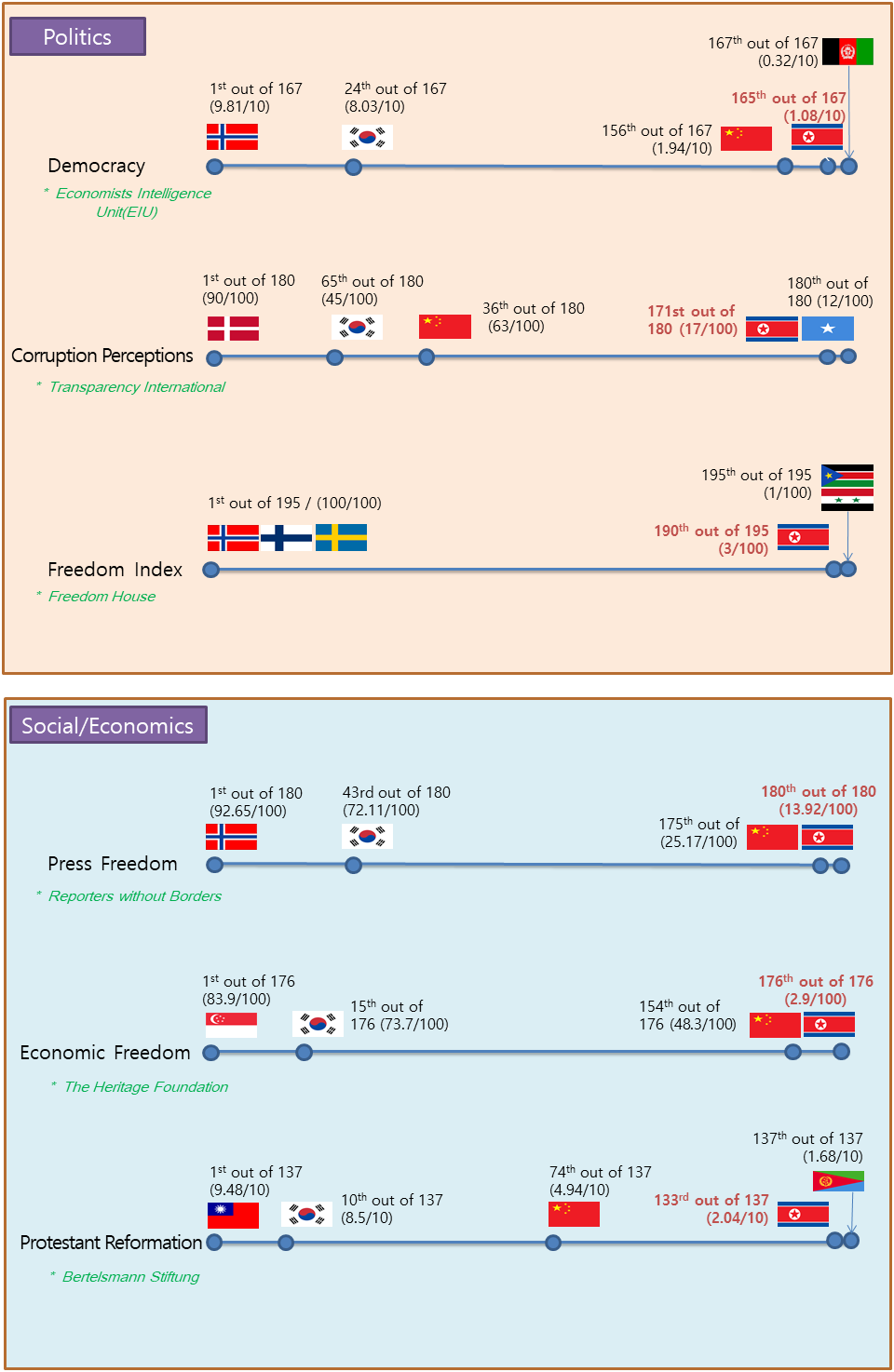
Politics: Global experts have identified the lack of a political system to curb Kim Jong-un's absolute power as the most significant challenge facing North Korea. The Economist Intelligence Unit (EIU), a subsidiary of the British weekly, The Economist, specializing in current affairs, has categorized North Korea as an authoritarian regime without an independent judiciary, ranking its democratic level 165th out of 167 countries. The EIU has pointed out that the North Korean government censors constructive criticism from its citizens and does not ensure free and fair elections. The situation is comparable to Afghanistan, which has undergone years of civil war. Transparency International, an NGO that releases the annual Corruption Perceptions Index (CPI), has ranked North Korea as the most corrupt country in the world. It has also stated that North Korea lacks the legal and administrative framework to combat corruption and suppresses individuals who voice their opposition to corruption. Additionally, Freedom House, an international human rights organization, has identified the North Korean authorities' violations of human rights against its residents as the primary issue in the Freedom in the World report. This report highlights a class society based on “Sungbun ,” which discriminates against individuals based on their background, isolation and expulsion of individuals with disabilities, and violence against women.
Society: North Korean society is highly controlled, and information is strictly prohibited. The country is known for its strict information control policies, including censorship of independent media. According to the Press Freedom Index by "Reporters Without Borders (RSF)," North Korea ranks the lowest among 180 countries. RSF pointed out that the North Korean regime forces its citizens to listen and watch only propaganda content to maintain the regime and thoroughly controls external information, indicating that there is no freedom of the press in North Korea. In addition, there is no freedom of religion in the country. Open Doors, an international Christian mission organization, has highlighted that North Korea is an "extremely hostile place for Christians to reside," despite not being reflected in the aforementioned indices. If discovered by the authorities, Christians face severe consequences such as forced labor under harsh conditions or immediate execution, and their families also share the same fate. Open Doors has ranked North Korea as the worst country for Christian. Under North Korea's new "Law on rejecting reactionary ideology and culture," being a Christian or possessing a Bible is considered a severe offense that results in cruel punishment. Reports have surfaced of several underground churches being discovered, and many North Korean believers being executed as a result.
Economy: North Korea is recognized for maintaining the most oppressive and isolated economic system in the world. The country's economic structure is identified by a centralized and planned economy, where the means of production are under socialist ownership. The Heritage Foundation, headquartered in Washington D.C., has published the "2023 Index of Economic Freedom," which evaluates a total of 12 areas across four categories, including the rule of law, regulatory efficiency, government intervention, and market openness. North Korea ranked last at 176th place with a score of 2.9 out of 100, and it has held the lowest position for 29 years. A report by the Bertelsmann Stiftung reveals that North Korea ranks 133rd out of 137 countries in terms of democratic market economy development, with only four countries - Somalia, Syria, Yemen, and one other - ranked lower. The report highlights that North Korea's class system, called "Sungbun," hinders economic activities and is the primary cause of poverty and social inequality among its citizens. Additionally, the report notes that corruption for the benefit of the privileged is rampant in the country.
Summary: Global think tanks have harshly criticized North Korea. Experts point out that there are no legal mechanisms to restrain internal power in North Korea, and the authoritarian regime inherent in the ruling class' efforts to maintain power actually suppresses freedom and democracy, controlling the citizens ideologically. Furthermore, it is evaluated that the political and economic activities of North Korean citizens are severely suppressed due to the class society called "Sungbun," ultimately perpetuating poverty and inequality in North Korea. There is also no media to point out these problems. The information circulated in North Korea is produced by the government for propaganda purposes and agitation, creating an environment where constructive criticism cannot be voiced. Ultimately, the internal situation in North Korea continues to be characterized by control, repression, and a vicious cycle of accepting these conditions as normal.