

North Korea's Worldview ②: How North Korea Views the US, Japan, China, and Russia?

Professor, Philo Kim
The Institute for Peace and Unification Studies Seoul National University
SAND’s Note: In the previous article of the "North Korea's Worldview" series, titled "How Does North Korea View South Korea?", we analyzed the perceptions of North Korea's leaders and residents towards South Korea, taking into account their active response to the current international situation characterized as the "New Cold War" and a "multipolar" trend. In this issue, we will explore how North Korea views the United States, China, Japan, and Russia based on their self-constructed ideological system, which has been shaped by an extreme closed-door policy for 70 years, cutting off exchange with the international community since the Korean War. |

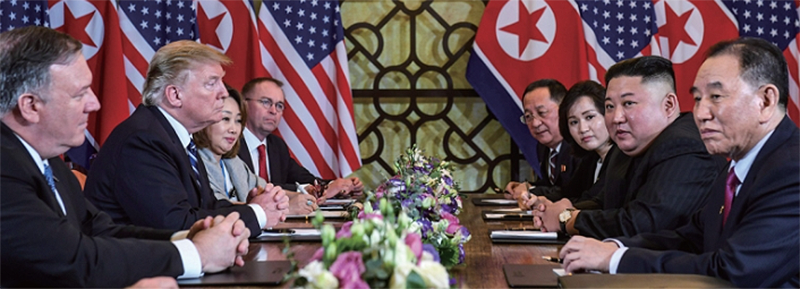
2019년 2월 28일 하노이에서 도널드 트럼프 미국 대통령과 김정은 북한 국무위원장이 회담 도중 심각한 표정을 하고 있다. / 사진:연합뉴스
North Korea's Siege Mentality and Obsessive Behaviors
Many studies have shown that socialist countries, including North Korea, have a strong "siege mentality" due to the constant military threats they face from capitalist nations. Post-Soviet states and many communist countries in Eastern Europe share a common historical experience of being involved in imperialist world wars. As a result, they have developed a fear that imperialist forces may invade and occupy socialist countries. Third-world countries that viewed colonization have a heightened awareness of the invasive and exploitative nature of imperialism. Consequently, they hold the view that engaging with imperialist powers is unlikely to foster national development. This has led to a belief in autarky and isolation as the only viable options for their country's development.
Kim Jong-il once said, "Our country is building socialism while constantly facing military threats from imperialist encirclement. Therefore, without a strong military, there can be no people, no socialist state, or no party." This statement suggests that North Korea perceives itself to be in a position where it faces military threats from imperialist powers. This is why North Korea pursued the "songun (military-first)” policy, deploying the military to defend the regime against imperialist aggression during the post-socialist transformation.
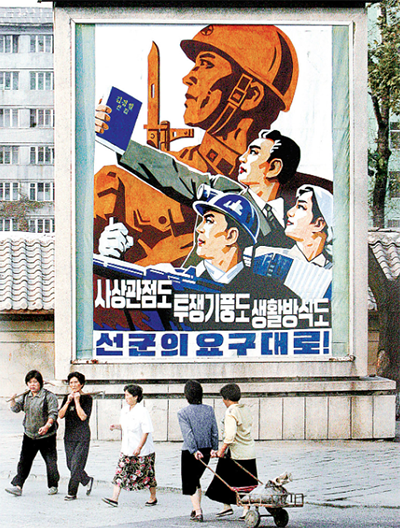
‘사상관점도 투쟁기풍도 생활방식도 선군의 요구대로!’ 북한 만수대 창장사에서 제작한 선전화 포스트, 북한사회의 곳곳에 선군정치 내용의 포스트가 붙어있다.
Nations that pursue an extreme closed-door policy driven by a siege mentality often have a distorted view of reality and may act in a self-centered manner, sometimes resorting to aggressive behavior. Their perception of the outside world is often heavily influenced by their siege mentality, leading to an obsessive and biased view. Just as individuals need to find a balance between instinctual impulses and objective environments, countries also need to demonstrate their ability to assess the realities of the outside world and regulate their actions accordingly. When a nation's regulatory abilities are lost, it can lead to obsessive behavior, hostility, and even violence. This can result in excessive aggressive realism, where the exclusive ethnic ideology functions as an amplifier that reinforces such behavior.
North Korea's behavior is often viewed by the outside world through a lens of "rogue states" and "axis of evil”. Kim Jong-un's brief experience studying in Europe, however, has not given him a full understanding of this perspective. He believes that these labels are part of a policy of hostility towards North Korea aimed at toppling the regime, and he argues for the reversal of such policies that view North Korea as an adversary. Kim has expressed a desire for North Korea to be treated on par with other nations. He conveyed this message directly to the South Korean delegation during the preparations for the April 2018 Inter-Korean Summit. Unfortunately, this aspiration has not materialized, and instead, there has been a rise in aggressive and hostile behavior from North Korea.
North Korea’s Attitude towards the US, Japan, China, and Russia
North Korean residents hold either pro-China or anti-America attitudes towards their neighboring countries. Around 70% of them regard China as the most friendly country to North Korea, while over 70% consider the United States to be the most threatening. This preference for China as a friendly country could serve as a significant indicator for reunification efforts. The German reunification serves as a prime example of how capturing the hearts and minds of residents was crucial to achieving unification. In a similar vein, for reunification on the Korean Peninsula to be possible, at least 50% of North Korean residents must view South Korea as a friendly nation. This underscores the significance of the preference of North Korean residents towards South Korea in the reunification discourse.
Following the breakdown of the 2019 DPRK-USA Hanoi Summit, North Korea has severed its ties with the United States and is now prioritizing International Socialist Solidarity. As a result, it has been strengthening its relationship with Russia and seeking economic, military, and political cooperation and support. In the wake of the Russia-Ukraine war, North Korea has shown a strong inclination towards Russia, seeking opportunities to contribute to post-war reconstruction projects and make special demands related to the conflict. While a survey by The Institute for Peace and Unification Studies at Seoul National University indicates that the majority of North Korean residents prefer China, those with a strong sense of ideology tend to favor Russia over China.
North Korea considers the United States to be the most dangerous country on Earth. According to a text analysis of the "Rodong Sinmun" newspaper, the term "enemy" was used to refer to the US over 44,000 times from 2016 to 2017, indicating a high level of antagonism. North Korea's hostility towards the US may vary over time, but it remains largely negative. According to a survey conducted by the Institute for Peace and Unification Studies at Seoul National University, the overwhelming majority of North Koreans perceive the US as the biggest threat to peace on the Korean Peninsula. Japan is considered the least favored neighboring country and is viewed as less threatening than the US and China but more threatening than South Korea and Russia. Although not as menacing as the US or China, North Korea perceives Japan as a more aggressive threat than its other neighboring countries.
The Organization and Guidance Department of the WPK holds a strategic perspective on neighboring countries that differs from the general public's perception. While the public generally prefers China and dislikes the US, the North Korean leadership has shown wariness towards China and has used the US as a tool for public diplomacy.
In essence, North Korea finds it challenging to deal with China, given its size and proximity. In contrast, although the US is perceived as a threat, it is geographically distant and unlikely to fully occupy North Korea. Therefore, North Korea strategically draws in the US to use it as a means to prevent China from occupying North Korea.
North Korea holds the expectation that the US military will continue to serve as a balancing force to control China even after reunification, as part of United Nations peacekeeping efforts. This perception is shared by the three successive Kims - Kim Il-sung, Kim Jong-il, and Kim Jong-un.
North Korean residents don't seem to view the sanctions against North Korea as seriously as South Korea and the Western world do. While the latter believe that US sanctions on North Korea will have a significant impact, it's not a major concern for North Korean residents. One interesting point to note is that a survey conducted by Seoul National University found that the average percentage of North Korean residents who believe that North Korea's economic difficulties are due to US sanctions is only 6.8% over the past decade. Despite North Korea's propaganda blaming US sanctions for their economic difficulties, the percentage of residents who believe this is not significant due to long-term government conditioning that their country can handle the sanctions.
However, it is important to note that this percentage has steadily increased from 4.8% in 2011 to 12.3% in 2020. This suggests that although the impact of US sanctions on North Korean residents' consciousness is still not significant, they are increasingly recognizing the importance of the influence of US and Western sanctions on North Korea's economy.
North Korea's Bridgehead for International Expansion: Europe and the United Nations
North Korea has viewed Europe as a more neutral target compared to the United States. In its efforts to overcome its diplomatic isolation and become part of the international community after the Cold War, North Korea has pursued diplomatic normalization with the European Union (EU). Following the 2000 Inter-Korean Summit, North Korea sought to establish diplomatic relations with EU member states, including the United Kingdom, the Netherlands, Belgium, and Germany. The EU and North Korea established diplomatic relations in 2001, and as part of their ongoing political dialogue since 1998, North Korea engaged in human rights discussions with the EU, using European countries as a gateway to enter the Western world.
Due to the nuclear issue, North Korea's dialogue with the EU and the West was interrupted, and it has since been focusing on enhancing cooperation with the United Nations (UN) to interact with the international community. Since requesting humanitarian assistance in 1995, North Korea has promoted international cooperation by adjusting goals in 2006, and working with the UN to achieve the Sustainable Development Goals (SDGs) and Millennium Development Goals. North Korea actively seeks to improve education and internationalize in its own way, as it requires advanced technology from the international community. However, the sanctions against North Korea are causing disruption, and North Korea is using the UN as a means to access the international community and overcome these challenges.
-
PREV [Policy Proposal]
-
NEXT [North Korea Glossary]