

The Korean Armistice Agreement and the Path to a Peace Regime

Hong Yong-pyo
Professor at Hanyang University,
Former Minister of the Ministry of Unification
This year marks the 70th anniversary of the Korean Armistice Agreement and the Mutual Defense Treaty Between the United States and the Republic of Korea. These agreements have played a crucial role in ending the Korean War and ensuring the security of South Korea. While minor military clashes have occurred along the Military Demarcation Line and in the Yellow Sea, a full-scale war has been avoided. Despite occasional concerns about war, most people focus on their daily lives. So, why do we stress the need for a "peace regime" and engage in discussions about it?
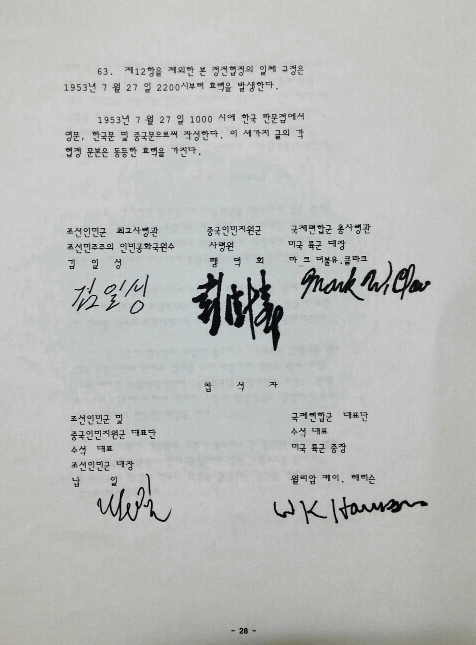
The Korean Armistice Agreement is the only internationally recognized legal document between the warring parties, aimed at ceasing hostilities and military actions on the Korean Peninsula. It has effectively managed the division since the war. The United Nations Command Military Armistice Commission, established to supervise the agreement, has served as a crisis management channel, preventing misunderstandings and de-escalating tensions. The 1992 Basic Agreements of North and South Korea also emphasize joint efforts to transform the current armistice into a state of peace until a formal peace is achieved.
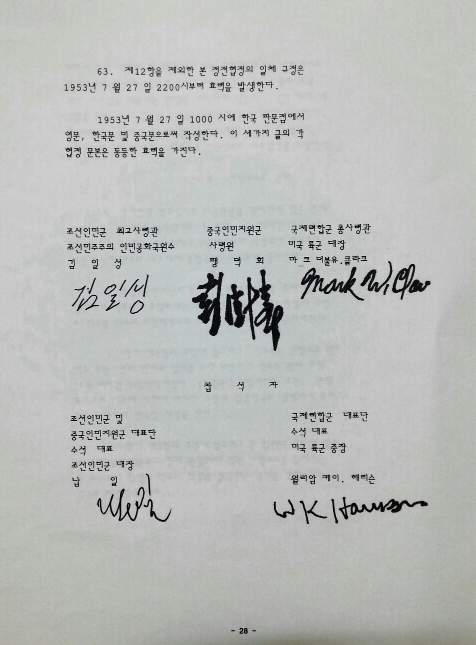
Korean Armistice Agreement signed by representatives of North Korea, China, and the United States on July 27, 1953, with a map / Yonhap News Agency
However, it is important to acknowledge the limitations of the Korean Armistice Agreement. The absence of a clear institutional framework to address violations has resulted in frequent non-compliance incidents. Additionally, while the Military Demarcation Line on land is well-defined, there is no clear demarcation line at sea, making it challenging to prevent disputes. North Korea's strategy to undermine the agreement as a useless framework in their pursuit of peace agreements has further weakened its implementation. The exclusion of South Korea as a signatory during the negotiations is another destabilizing factor, although South Korea plays a significant role in the peace issue on the Korean Peninsula.
Considering these challenges, there is consensus that transforming the armistice system into a peace regime is essential for lasting peace on the Korean Peninsula. However, it requires careful and thoughtful deliberation to determine the roadmap for establishing such a regime.
In 2018, through the Panmunjom Declaration, the leaders of North and South Korea agreed to "declare an end to the war and transform the Korean Armistice Agreement into a peace agreement," with the aim of building a permanent and solid peace regime. While this agreement between North and South Korea is a positive step towards peace, it is crucial not to perceive it as the only method for establishing a peace regime. Throughout history, peace has been achieved in various ways, sometimes without specific declarations or agreements, or with the involvement of only one party.
The argument for the need to declare an end to the Korean War is based on the perception that the 1953 Korean Armistice Agreement only brought a cessation of hostilities, leaving the war legally unresolved on the Korean Peninsula. However, as mentioned earlier, the war is effectively over. In the current situation, a declaration could potentially provide North Korea with an opportunity to demand the dismantling of the United Nations Command and the withdrawal of US forces from South Korea. Moreover, with little progress in North Korea's denuclearization efforts, a declaration alone could pose significant security concerns for South Korea. It is important to consider the broader implications, such as the prioritization of denuclearization, the impact on the Mutual Defense Treaty between the US and South Korea, the concerns of the parties involved, and the issue of war responsibility, rather than assuming that a peace agreement will solve everything.
Creating a lasting peace regime is a complex process that goes beyond signing agreements or treaties. It necessitates the establishment of genuine peace and a foundation of trust among the parties involved. History has demonstrated that a mere agreement is insufficient without true peace and trust. Additionally, it's essential to recognize that a peace regime doesn't automatically solve all issues on the Korean Peninsula. We must remain focused on our ultimate goal of unification and not lose sight of that objective.