

[North-South Korea Relations Series]
North Korean Nuclear Issue and Inter-Korean Basic Agreements in the 1990s

Jung Seung-hun, Professor extraordinary
Department of Politics and International Studies at Sunmoon University
Former head of office of the Inter-Korean Dialogue;
Former chief of North Korea Intelligence and Analysis Bureau;
Worked at the Ministry of Unification from 1990 to 2020
The principles for resolving the Korean Peninsula issue between North and South Korea encountered a new obstacle when the international community began expressing concerns about North Korea's nuclear program in the mid-1990s. The issue gained prominence during high-level talks between the two Koreas, resulting in the "Inter-Korean Basic Agreements" in December 1991 and the "Joint Declaration of the Denuclearization of the Korean Peninsula." These agreements established a link between addressing North Korea's nuclear problem and enhancing inter-Korean relations through dialogue.
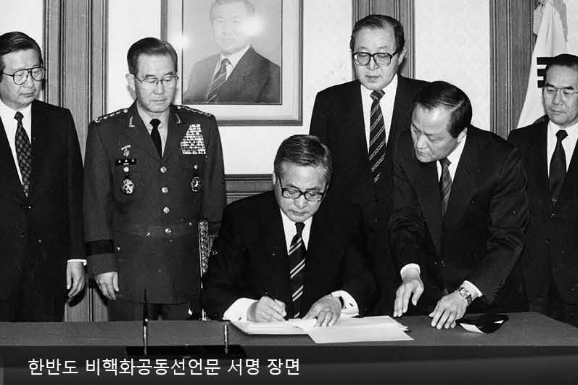
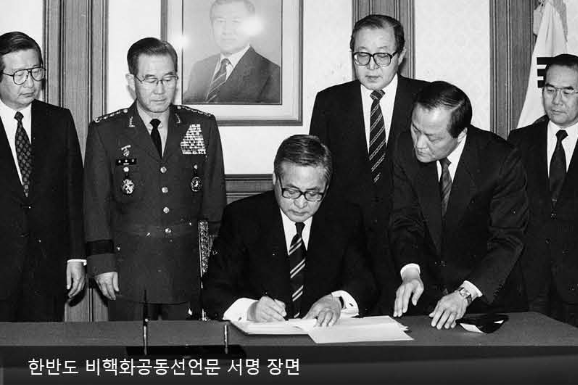
In 1991, during the third representative contact on nuclear issues at Panmunjom, North and South Korea adopted a joint declaration on denuclearization. The declaration took effect during the 6th high-level talks on February 19, 1992. / Photo by Joongang Ilbo
The "Joint Declaration of the Denuclearization of the Korean Peninsula" imposed eight prohibitions and obligations on North and South Korea, including "testing, manufacturing, production, acquisition, possession, storage, deployment, and use" of nuclear weapons. In an effort to implement the declaration, the two Koreas established the Nuclear Control Joint Committee from March to December 1992. However, the committee's progress was derailed due to issues surrounding mutual inspections and North Korea's lack of cooperation with the International Atomic Energy Agency (IAEA).
As the resolution of the nuclear issue through inter-Korean dialogue became challenging, it shifted towards bilateral negotiations between the United States and North Korea or multilateral negotiations involving neighboring countries. These discussions on denuclearization also encompassed the peace issue of the Korean Peninsula and economic incentives, leading to increased international involvement in matters that were previously considered bilateral issues between North and South Korea.
Inviting China to the Negotiating Table
In April 1996, President Bill Clinton of the United States and President Kim Young-sam proposed a four-party dialogue involving North and South Korea, the United States, and China to discuss the establishment of a peace regime on the Korean Peninsula and the issue of tension reduction. At the time, bilateral channels between North Korea and the United States were already operational based on the "Agreed Framework" reached in Geneva in October 1994, which aimed to address North Korea's nuclear program and provide light water reactor.
While there had been a single ministerial-level meeting between North and South Korea in Beijing in 1995 regarding rice aid, overall dialogue between the two Koreas remained at a standstill. China expressed principled support for direct talks between North Korea and the United States but refrained from direct involvement. The proposal for a four-party dialogue aimed to create a platform for inter-Korean discussions while also urging China to play a more active role.
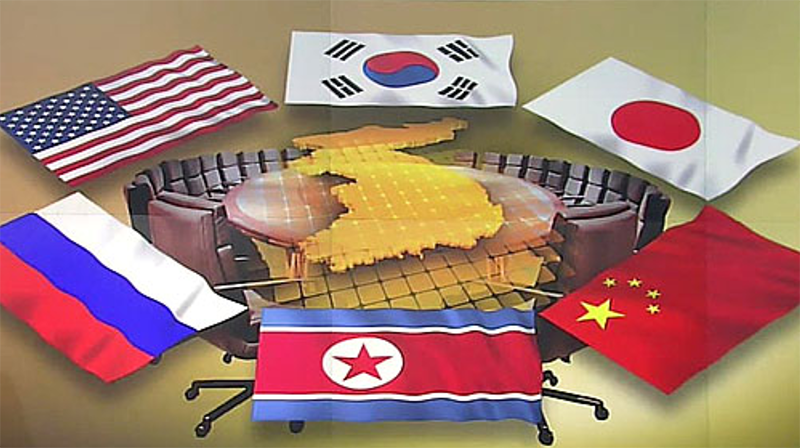
North and South Korea, as well as the four participating countries in the Six-Party Talks, the United States, China, Japan, and Russia, for the denuclearization of North Korea / Photo by SBS
The four-party dialogue took place from preliminary contacts and consultations in New York and Beijing to subsequent meetings in Geneva from December 1997 to August 1999. However, the talks concluded without significant progress as North Korea did not approach the negotiations with a sincere attitude, insisting on a peace agreement with the United States and the withdrawal of US forces from South Korea. Nevertheless, the four-party dialogue served as an opportunity for China to be recognized as a key player in resolving the Korean Peninsula peace issue and participating in the negotiation process. China has consistently demonstrated its willingness to engage in resolving the Korean Peninsula peace issue on various occasions since then.
-
PREV [Feature Article]
-
NEXT [Kim Il-sung Series]