

[Inter-Korean Relations Series 3]
Nuclear Negotiations with North Korea and Exploratory Talks between North and South

Jung Seung-hun, Professor extraordinary
Department of Politics and International Studies at Sunmoon University
Former head of office of the Inter-Korean Dialogue;
Former chief of North Korea Intelligence and Analysis Bureau;
Worked at the Ministry of Unification from 1990 to 2020
(Continued from the previous issue)
- The June 15th North-South Joint Declaration and Inter-Korean Cooperation Projects
- The Breakdown of the 2003 U.S.-North Korea Agreed Framework & the Pursuit of the Six-Party Talks through China's Mediation Role
1. The June 15th North-South Joint Declaration and Inter-Korean Cooperation Projects
The summit meeting between President Kim Dae-jung and Chairman Kim Jong-il in Pyongyang from June 13th to 15th, 2000, marked a historic dialogue between the leaders of the divided governments. At this pivotal event, they unveiled the "June 15th North-South Joint Declaration," encompassing resolutions for reunification, family reunions, economic cooperation, and various collaborative endeavors. The first clause of the statement emphasizes the principle of "our nation's people, the true owners of the reunification issue, solving it together independently," echoing North Korea's perspective while reaffirming the "independence" principle from the July 4 South-North Joint Statement.
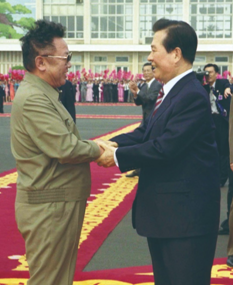
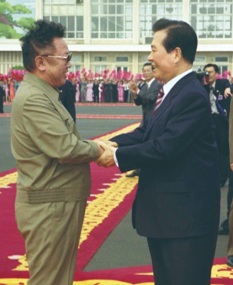
On June 13, 2000, President Kim Dae-jung arrived in Pyongyang for the inter-Korean summit, warmly exchanging greetings with Chairman Kim Jong-il – Photo by Ehistory
About ten days before the inter-Korean summit, on May 29th, 2000, North Korean Chairman Kim Jong-il made an unofficial visit to China, engaging in communication and coordination with Chinese President Jiang Zemin ahead of the summit. This customary practice of North Korean leaders preceding talks with South Korea or the United States continued in subsequent processes.
The period between the June 2000 inter-Korean summit and North Korea's first nuclear test in 2006 witnessed the addressing of the North Korean nuclear issue through bilateral negotiations with the US and the Six-Party Talks. As the focus shifted, there arose a window of opportunity for advancing inter-Korean cooperation projects and initiatives.

During the Six-Party Talks in China on September 19, 2005, a Joint Statement was adopted, encompassing six principles, including the denuclearization of the Korean Peninsula. This image symbolizes cooperation as they shook hands, marking a positive outcome. – Photo by Yonhap News Agency
Starting in 1998, the Mount Kumgang tourism project began to expand significantly through land routes. After the 2000 inter-Korean summit, efforts were made to connect the North and South by rail and road, as well as to establish the Kaesong Industrial Complex. The South Korean government facilitated North Korea's response by providing rice and fertilizer assistance, leading to increased reunions of separated families and enhanced inter-Korean exchanges. This period can be considered "unprecedented" in terms of the implementation of specific cooperation projects based on the agreements reached between North and South Korea.
2. The Breakdown of the 2003 U.S.-North Korea Agreed Framework & the Pursuit of the Six-Party Talks through China's Mediation Role
The resolution of the North Korean nuclear issue, centered around North Korea-U.S. bilateral talks, faced a crisis in 2002 when the Bush administration raised concerns about North Korea's highly enriched uranium (HEU) program. This led to a second nuclear crisis, involving North Korea's withdrawal from the NPT, the freezing of its nuclear facilities, and suspension of heavy fuel oil supplies.
As a result, the North Korea-U.S. dialogue reached a deadlock, and as an alternative, multilateral talks were initiated in 2003 with active mediation by China. The backdrop for this was the Bush administration's reluctance to engage in bilateral talks with North Korea, which they had classified as part of the "Axis of Evil." China sought to leverage its influence over North Korea as a way to facilitate negotiations.
In April 2003, China hosted a three-party talk involving North Korea and the U.S., in Beijing, which later evolved into the Six-Party Talks from August 2003 to September 2007, involving South Korea, Japan, and Russia. China played an actively involved role, persuading North Korea to come to the negotiation table and providing a venue for the talks, acting as a mediator and facilitator throughout the process.
The process of the Six-Party Talks demonstrated a distribution of roles, with North Korea and the United States facing each other while South Korea and China acted as mediators. Through a process of negotiation and mediation, they reached the September 19, 2005 Joint Statement. The core elements of the agreement were that North Korea would abandon all nuclear weapons and existing programs, while the U.S. and other participating countries would provide North Korea with non-aggression assurances, promote normalization of relations, discuss the provision of energy (including discussing the provision of a light-water reactor at an appropriate time), and pursue a peace regime.
However, shortly after reaching the September 19 Joint Statement, the U.S. Department of Treasury announced financial sanctions on the Macao-based Banco Delta Asia (BDA) bank, accusing it of handling North Korea's illegal funds. This created significant obstacles in implementing the agreement. As the unfreezing of North Korean funds became a precondition for agreement implementation, it took a year to resolve this issue. Eventually, it led to North Korea's long-range missile test (Taep'odong-2) and UN Security Council sanctions, culminating in North Korea's first nuclear test in October 2006.
Subsequently, although there were initial measures agreed upon for implementing the September 19 Joint Statement within the framework of the Six-Party Talks, the verification of North Korea's submitted nuclear activity records became a contentious issue, resulting in the suspension of both the Joint Statement implementation and the Six-Party Talks.
In July 2011 and February 2012, North Korea and the U.S. resumed bilateral talks, leading to agreements on the North Korean nuclear and missile test moratorium, the freezing of Yongbyon nuclear facilities, and other North Korean assistance. However, they were unable to prevent North Korea from conducting additional missile tests and a third nuclear test in 2013. Following these events, the Obama administration adopted a policy of so-called "strategic patience."
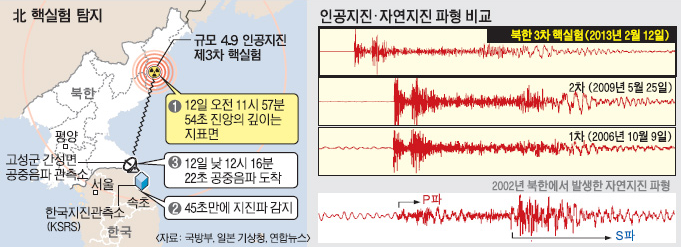
On March 12, 2013, the power and characteristics of an artificial earthquake resulting from North Korea's forced third underground nuclear test were analyzed by officials from the Korean Meteorological Administration. The data was compiled from the Ministry of National Defense, Korea Meteorological Administration, Japan Meteorological Agency, and various media sources. (Source: Seoul Shinmun)
In the absence of bilateral or multilateral nuclear negotiations, Kim Jong-un, who emerged as North Korea's new leader in 2012, focused on the development of nuclear and missile capabilities under the slogan of "parallel development of nuclear weapons and the economy." The international community responded to North Korea's provocations, including nuclear and missile tests, through UN Security Council sanctions resolutions and diplomatic pressures, leading to a vicious cycle of such actions that persisted until the end of 2017.