

North Korea's Potato Revolution
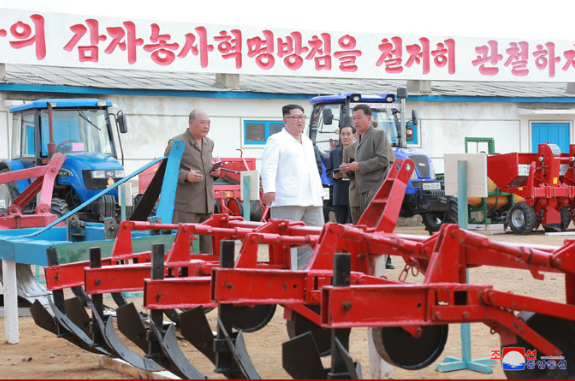
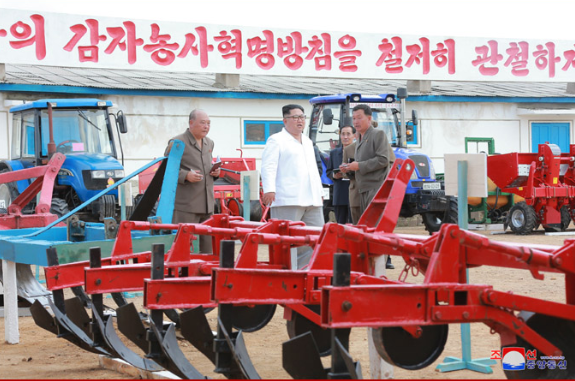
Chairman Kim Jong-un is seen giving directives to increase the level of mechanization in potato farming at the Jungheung Farm in Samjiyon City. (Photo by Rodong Sinmun)
In the face of persistent food shortages, North Korea has embarked on a mission to address the hunger issue of its people by prioritizing potatoes as a staple crop. The regime is actively promoting potato cultivation and an increase in production, with a particular focus on the Ryanggang Province, centered around Taehongdan County. North Korea aims to instigate a significant boost in potato production, akin to a potato farming revolution.
During the mid-1990s, a period known as the "Arduous March," North Korea witnessed a surge in malnutrition cases, underscoring the pressing need for increased agricultural production. In response, in October 1998, Kim Jong-il, during his visit to Taehongdan County, directed the replacement of corn, previously regarded as the king of crops, with potatoes. This decision marked the beginning of the "Potato Farming Revolution," highlighting a transformative shift towards potato cultivation.
In January 1999, Ryanggang Province was designated as the "Potato Province," and in July 2000, North Korea established the "Potato-Producing Nation" for its agricultural sector. The regime also forcibly relocated thousands of soldiers to Samjiyon City and Taehongdan County in Ryanggang Province to intensify potato cultivation. North Korean authorities have pursued policies aimed at making potatoes a staple food source to address food shortages.
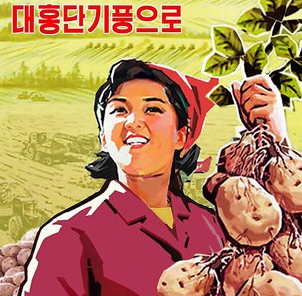
A propaganda poster released in celebration of the 65th anniversary of the founding of the WPK, featuring the slogan "Let's bring unprecedented prosperity to our potato fields!"
North Korea explains, "There are two methods to increase agricultural production: raising the yield per unit of land and expanding cultivation areas." The Potato Farming Revolution aims to achieve a dramatic increase in potato production through these two approaches. The goal is to produce an average of 60-70 tons per hectare in designated regions. Potatoes thrive in cooler conditions, making them suitable for North Korea's average temperatures and elevations. They also have the advantage of being cultivable in areas where rice and corn struggle to grow, making expanded cultivation a promising avenue for increased potato production.
Taehongdan County in Ryanggang Province stands out as a prime potato-producing region and is renowned for its modernized and scientific agricultural practices referred to as the "Taehongdan-style Scientific Farming Methods." It has achieved comprehensive mechanization in potato farming, a key feature of its success.
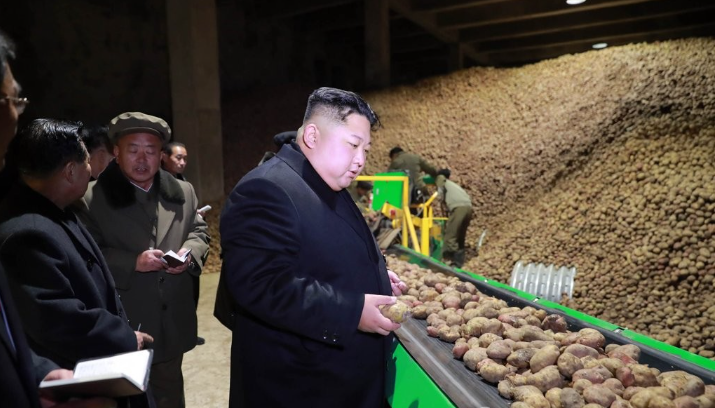
Kim Jong-un is personally overseeing Taehongdan County in Ryanggang Province, North Korea's most prominent potato production area. (Photo by Rodong Sinmun)
As of October 2020, the major potato-producing region of Ryanggang Province had completed its potato harvest. In particular, Samjiyon City, a large-scale production area, reported exceeding this year's potato production plan, boasting the involvement of 18 multiple harvest teams and hundreds of workers. These harvested potatoes undergo secondary processing for enhanced shelf life at Samjiyon Potato Flour Production Factory and Taehongdan Potato Processing Factory. Despite being a crucial component of North Korea's agricultural policy alongside rice and corn, potato farming still faces challenges. To achieve substantial expansion in potato production, securing adequate supplies of fertilizers, energy, plastic, and agricultural machinery remains the most critical factor, and this is where North Korean authorities face their biggest hurdles in achieving the promised revolutionary transformation.