

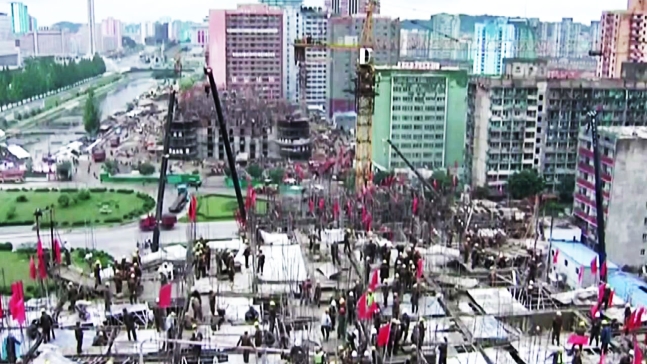
Pyongyang's Manhattan: Built at the Cost of Young North Korean Soldiers' Lives
“In the Ryomyong Street project, we were forced to work in perilous conditions, without any proper safety gear, enduring excruciatingly long hours – 13 to 18 hours a day. This grueling labor resulted in the heartbreaking loss of 2 to 5 soldiers each day.” said Mr. Lee.
Back in 2017, Lee Eun-san, a defector who had worked on the construction site of "Ryomyong Street," often referred to as Pyongyang's Manhattan, shared his harrowing experiences with a trembling voice. Ryomyong Street was a city project in North Korea, personally planned by Kim Jong-un between 2016 and 2017, as an attempt to bypass international sanctions. It includes North Korea's tallest skyscraper, towering over 70 floors, situated between the Kumsusan Palace of the Sun, where Kim Il-sung and Kim Jong-il are laid to rest, and Yonghung Street. The project boasts 44 condominium buildings (4,804 units) for Kim Il-sung University educators and scientists, along with 28 public facilities like schools and nurseries. The stark difference between the grandeur of Ryomyong Street and the everyday lives of ordinary North Koreans led to the creation of a new term, "Pyonghattan," merging Pyongyang and Manhattan.
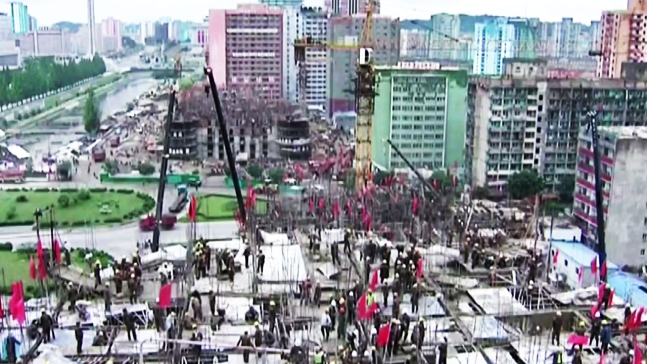
North Korean soldiers working on the construction of Ryomyong Steet in May 2016 / Photo by Rodong Sinmun
Mr. Lee had been sent to work on a construction site in Moscow, Russia, as part of his duties to earn foreign currency as a soldier. However, he couldn't endure the hardships and abuse any longer. In 2021, he made a brave decision to defect to South Korea. During a meeting with the SAND editorial board in Seoul on November 18th, Mr. Lee criticized the construction of Pyongyang's buildings, stating, "These structures were built at the cost of the blood and lives of young North Korean soldiers."
Mr. Lee joined the North Korean military in 2010 and was assigned to the engineer elements after completing his basic training. These military engineer elements receive military training in January and February and are then put to work on construction projects from March to December.
The military engineer element Mr. Lee was a part of was tasked with building Ryomyong New Street in 2016 under the orders of North Korean authorities. North Korea employs soldiers for major construction projects because they provide high-quality construction labor without getting paid. Mr. Lee described the harsh labor conditions and inhumane treatment he endured.

Ryomyong Street: Construction began in April 2016 and concluded in April 2017; many soldiers lost their lives due to the relentless pace to meet deadlines / Photo by Rodong Sinmun.
North Korean military leaders set an ambitious goal to complete one floor of a building each day. Remarkably, they achieved heights of over 10 floors just two months after starting construction in early April 2016.
According to Mr. Lee, the soldiers had to work from 4 a.m. until midnight, with only short 20-minute breaks for lunch and dinner. To meet the tight construction deadlines, soldiers had to engage in life-threatening labor, working an average of 13 to 18 hours each day.
The soldiers slept in makeshift tents at the construction site, without access to showers or laundry facilities. Water was scarce, making it impossible to wash properly. Mr. Lee mentioned, "Even when we had a little water, I was afraid to wash my face because the freezing cold water had made my nose bleed before." It was a tough environment where no one could even request a break or time off when they fell ill.
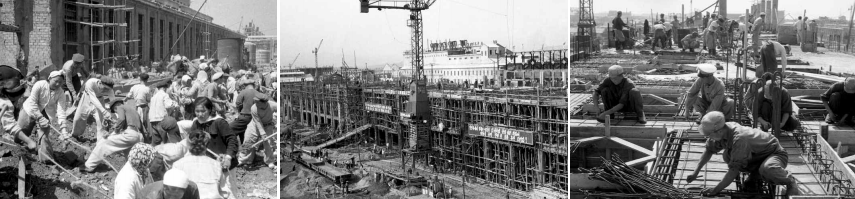
Published by Rodong Sinmun on March 21, 2020, here is a glimpse of civilians working at a construction site without safety equipment. (Photo: Rodong Sinmun)
He also recounted the most painful aspect - witnessing the tragic deaths of his fellow soldiers. Due to the long hours, lack of sleep, and extreme fatigue, their minds would become foggy. Working on the exteriors of high-rise buildings without safety equipment meant that if someone slipped or lost their footing, they would fall to their deaths. He recalled, "Some of my fellow soldiers fell from great heights, and I remember their bodies bursting like bombs upon impact and bouncing off other soldiers below. The image still haunts me, and it sometimes overwhelms me."
He revealed that nearly every day, 2 to 5 soldiers lost their lives in accidents. However, the authorities dismissed these deaths as common occurrences in the construction industry, hastily closing accident cases. The funerals for the deceased soldiers were rushed, lasting only an hour, and their grieving parents received no financial compensation, only a "patriotic martyr's certificate."
He added, "The grand buildings of Pyongyang City were built with the blood, sweat, and lives of young soldiers in their twenties. Every time I walked the street, memories of the comrades I had worked alongside came rushing back.
It's a well-known fact that frequent accidents resulting in many injuries and deaths occurred during the construction process. In early February 2017, Radio Free Asia reported a structural collapse at the construction site that left over 30 people injured. Furthermore, it was reported that upon learning about the incident, Kim Jong-un sent Choe Ryong-hae, a member of the Workers' Party of Korea, to oversee the situation.
Mr. Lee emphasized that various accidents happened due to the rushed construction efforts to meet Kim Jong-un's set deadlines and stressed that these projects were primarily intended for the privileged class, not the general population.
The conditions for soldiers in other units were no different. North Korean soldiers often suffered from malnutrition due to poor-quality meals during their 10-year military service. They might also lose their lives due to inadequate medical care and treatment in case of accidents during their work. Brutal physical beatings within the units were also common. Mr. Lee was also beaten by his unit leader for not promptly washing his shoes during winter. Most defector soldiers had experienced or witnessed beatings as well. Moreover, there were various forms of cruelty within the North Korean military, including exposing soldiers to extreme cold, forcing them to undress and stand in freezing temperatures for extended periods, or tying parts of their bodies to cold objects, resulting in frostbite.
Mr. Lee concluded saying "Since coming to this free country South Korea, I can't help but feel sorry for North Korean soldiers. I am determined to learn more and work towards the reunification of the Korean Peninsula."
-
PREV [SAND Research Report]
-
NEXT [Science Column]