

South Korea's 30cm Resolution vs. North Korea's 3m Resolution: The Significance and Prospects of North Korea's First Reconnaissance Satellite Launch

Lee Chun-geun
Honorary Research Fellow at the Science and Technology Policy Institute
North Korea launched its first reconnaissance satellite after facing previous setbacks in rocket and satellite launches. This achievement was hard-won, with persistent challenges stemming from instability and reliability issues in the second-stage high-altitude engine, identified as the root causes of past failures. Recent assistance from Russia seems to have played a pivotal role in addressing these challenges.
Of course, there is global curiosity about the assistance Russia provided. This support likely included technical advice, test evaluations, component supply, and the provision of high-altitude engines. Russia received North Korean launch-related data that pinpointed issues, helping to identify problems and propose solutions. The primary focus was on providing technical advice. Resolving the instability and reliability issues in the second-stage high-altitude engine could potentially enhance the range and accuracy of liquid-propelled Intercontinental Ballistic Missiles (ICBMs) using similar engines.
The launch timing raised controversy as it occurred over an hour earlier than North Korea had initially announced, sparking speculation about a surprise launch intended to deceive. However, this skepticism seems unfounded. Launch timings are typically chosen based on factors like optimal sunlight exposure for the satellite in orbit, ideal imaging conditions for the target area, and prevailing weather conditions. North Korea reportedly captured images as the satellite passed over the Korean Peninsula around 10 AM, suggesting they chose a favorable time for its reconnaissance duties.
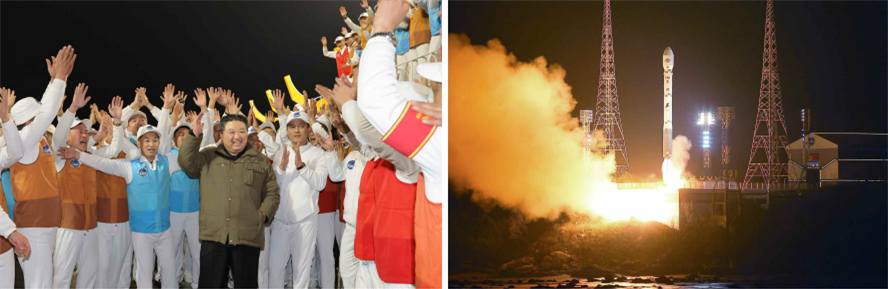
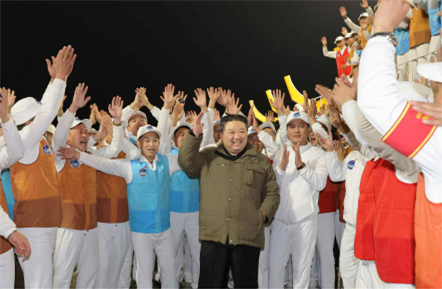
On November 21, at 22:42, Kim Jong-un was present at the ‘Malligyong-1’ launch site. (Photo: Rodong Sinmun)
Malligyong-1 recently entered a Sun-synchronous orbit at about 500km altitude, moving at 7.6km/s, with a 94-minute orbit cycle, similar to typical reconnaissance satellites. The minimal altitude difference indicates an effective Chollima-1 launch. North Korean reports confirm initial communication, ground control, and power supply. They're now likely concentrating on camera imaging and optimization.
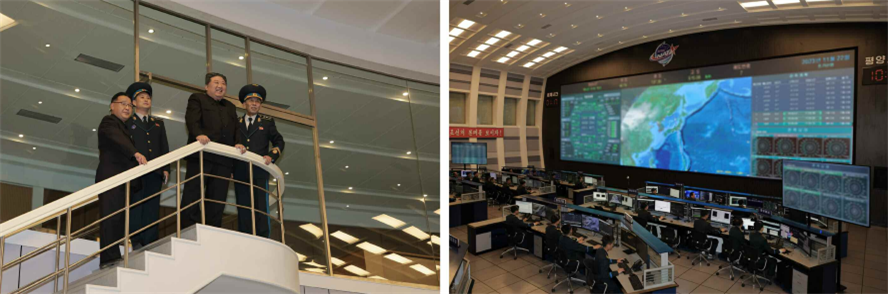
On November 22, at 10:00, Kim Jong-un conducted an inspection of the Pyongyang's integrated control center. (Photo: Rodong Sinmun)
Kim Jong-un has visited Pyongyang's integrated control center, reviewing images of global targets and commending officials. This is unusual as Malligyong-1 isn't fully stable yet. North Korea seems focused on domestic propaganda to compensate for past failures. Scientists at the control center likely face intense pressure to stabilize the system quickly and shift to routine operations.
Russia can offer significant support in stabilizing and optimizing the system. The limited time for communication and control due to the narrow Korean Peninsula can be improved with Russia's extensive global ground control networks, reducing the normalization period. This also applies to the analysis and interpretation of image data. North Korea can leverage its existing opportunities from Russia's support in the Ukraine conflict and the North Korea-Russia summit.
However, a significant challenge persists with Malligyong-1 as a Reconnaissance satellite. Information indicates its camera resolution is less than 3 meters, and it relies solely on electro-optical (EO) sensors, sensitive to weather conditions. This limited capability falls short of effectively monitoring crucial strategic assets and movements. Nevertheless, it remains valuable for observing large vessels at ports, aircraft carriers, buildings, facilities, and various applications such as agricultural assessments, forestry surveys, and construction monitoring.
Overall, North Korea has established the foundation for its initial Reconnaissance satellite system through this launch, acquiring valuable experience, knowledge, and expertise. It seems they intend to enhance and expand the system step by step, progressing from "Reconnaissance satellite series 1.0" to 2.0 and 3.0. Potential measures may involve further launches in the Malligyong-1 series, launching optical satellites with better resolution, and developing and launching SAR and IR satellites.
North Korea's acquisition of a Reconnaissance satellite brings it into competition and comparison with South Korea. While North Korea has just begun, and its capabilities are not on par with ours, South Korea is advancing its capabilities with optical cameras at 30cm resolution and SAR and IR satellites at 50cm resolution, and increasing their numbers. Thus, it's vital to track North Korea's Reconnaissance satellite development and improve our response accordingly. Collaboration between South Korea and the United States to share top surveillance and reconnaissance assets is also part of this effort.