

Analysis of North Korea's Military Policy and Expected Provocations In 2024

Kim Ho-hong
Korea Research Institute for national Strategy
Director of North Korea Strategy Center
Kim Jong-un's 10 Years in Power:
Concentrating National Resources and Capabilities on Enhancing Nuclear Forces
“To let the dignity of Joseon shine through the ages and to successfully realize the construction of a strong and prosperous nation, prioritizing the People's Army is essential. Strengthening it in every way must be our first, second, and third priorities.”
This was emphasized by the North Korean leader Kim Jong-un during his first public speech after assuming power at the centenary military parade of his grandfather, Kim Il-sung, on April 15, 2012. Ten years have passed since Kim Jong-un rose to power. During this period, despite economic challenges and the hardships faced by its people, Kim Jong-un has directed all national resources and capabilities towards strengthening national defense. Pursuing a policy of 'parallel development for economic construction and nuclear force', with a 'military-first, economy-later' approach, he concentrated all efforts on advancing nuclear forces. The constitution was amended to affirm 'nuclear possession', and through four nuclear tests, along with the launching of intercontinental ballistic missiles (ICBMs), among other forms of provocations, North Korea declared the 'completion of nuclear forces' in November 2017.
Subsequently, at the 8th Party Congress in January 2021, Kim unveiled a 'Five-Year Plan for the Development of National Defense Science and Weapons System (2021-2025)'. This plan serves as a mid- to long-term roadmap for advancing nuclear weapons to a level where they can be operationalized as attack weapons. Key projects under this plan, including the development of tactical nuclear weapons, hypersonic missiles, reconnaissance satellites, submarine-launched ballistic missiles (SLBMs), unmanned vehicles, and solid-fuel ICBMs, are being implemented at a rapid pace, with many of them being physically revealed.
North Korea's 2023:
Boosting Nuclear Capabilities and Legal Framework Side by Side
In 2023, North Korea launched 28 missiles, including 5 ICBM tests, which marks the highest annual number of ICBM launches since the regime's inception. The year saw an acceleration in their nuclear capability enhancement, showcasing diverse weaponry. On the 75th anniversary of the Korean People's Army Foundation Day (Feb 2nd), a solid-fuel ICBM and tactical nuclear units targeting South Korea were revealed for the first time. In late March, under Kim's supervision, an underwater explosion test of the nuclear-powered unmanned submersible 'Haeil' was conducted, and the actual photo of the tactical nuclear warhead 'Hwasan-31' was also disclosed.

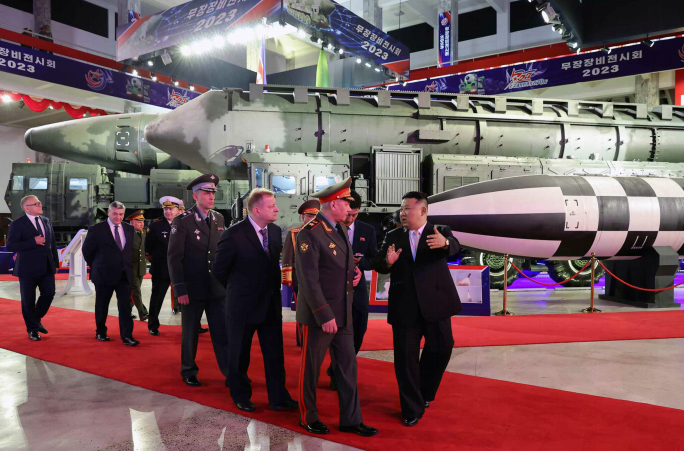
Kim Jong-un guiding Russian Defense Minister Sergei Kuzhugetovich Shoigu at the 2023 Armed Equipment Exhibition. (Photo by Rodong Sinmun)
In July, on the 70th anniversary of the Day of Victory in the Great Fatherland Liberation War, the ' 2023 Armed Equipment Exhibition' was held to showcase new weapons. Kim Jong-un, along with Sergei Kuzhugetovich Shoigu, the Russian Minister of Defense, attended the exhibition, where strategic unmanned reconnaissance aircraft 'Saetbyol-4' and attack-type drones 'Saetbyol-9' were unveiled. Despite violations of United Nations Security Council resolutions, North Korea concentrated efforts on launching military reconnaissance satellites. After two failed attempts in May and August, the launch of the carrier rocket 'Chollima-1', carrying 'Malligyong-1', was successful on November 21st. In September, the launching ceremony of the tactical nuclear attack submarine 'DPRKS Hero Kim Kun-ok' was held with Kim's attendance. North Korea touted it as 'a new type of attack submarine the world has never seen', but its performance has received predominantly negative evaluations.
Alongside its nuclear advancements, North Korea swiftly incorporated these developments into its legal framework. At the 9th meeting of the 14th Supreme People's Assembly, conducted on September 26-27, a significant constitutional amendment to bolster nuclear forces was ratified. This change elevated the 'Nuclear Forces Policy Law' from September 2022, which includes 'five conditions for a preemptive nuclear strike', to a constitutional level. Originally, Article 58 of Chapter 4 of the Socialist Constitution of the Democratic People's Republic of Korea was broadly framed, stating that 'The Democratic People's Republic of Korea relies on an all-people, all-nation defense system'. This was subsequently revised to specifically endorse 'enhancing nuclear weapon development as a responsible nuclear power'. This aims to ensure the country's survival and development rights, deter war, and maintain peace and stability in the region and globally. This amendment establishes a clear legal basis for improving nuclear capabilities and permits the execution of nuclear attacks in emergencies.
2024 Outlook:
Projected Increase in North Korean Provocations Against the Backdrop of Global Events, Including U.S. Elections
Kim Jong-un is increasingly showing a willingness to use nuclear and missile capabilities for provocation. In December 2023, North Korean media reported that after observing the Hwasong-18 solid-fuel ICBM launch, Kim Jong-un outlined ‘major tasks’ to boost nuclear strategic forces. He strongly advocated for ‘decisive nuclear strikes’, even threatening the capability to target the U.S. mainland. At the 9th Plenary Meeting of the 8th Central Committee of the Workers' Party of Korea, directives were given to speed up war readiness across military, military industry, nuclear weapons, and civil defense sectors, demonstrating a firm stance against the U.S.
For 2024, Kim Jong-un is anticipated to heighten provocations, seeing the global political landscape, especially the 'South Korea-U.S.-Japan vs North Korea-China-Russia' dynamic, as an opportunity to reinforce his strategic position. He is likely to enhance nuclear capabilities, leveraging alliances with China and Russia, while keeping an eye on the U.S. presidential election to be held in November this year, and the Ukraine war, instead of pursuing major changes in the status quo.
In the realm of nuclear technology, North Korea might test the operational readiness of the Hwasong-18 ICBM by demonstrating atmospheric re-entry capabilities. Plans for constructing a nuclear-powered submarine are also on the agenda. The upcoming tests of reconnaissance satellites and the public demonstration of the 'Hwasan-31' tactical nuclear weapon, are significant. Moreover, the possibility of a seventh nuclear test looms, with the International Atomic Energy Agency (IAEA) noting increased activities at the Nyongbyon Light Water Reactor, and the National Intelligence Service acknowledging the likelihood of such a test.
North Korea's push for advanced nuclear and missile capabilities depends heavily on cooperation with China and Russia. It is expected to engage in diplomatic maneuvers to invalidate United Nations Security Council resolutions, using the backing of these allies. The potential visit of Vladimir Putin to North Korea could lead to more concrete military collaboration. The prospect of joint military exercises by North Korea, China, and Russia in the East Coast, in response to the South Korea-U.S.-Japan alliance, is something to monitor closely.
Next is the provocation towards South Korea. North Korea openly displays hostility towards the Yoon Suk-yeol administration, and the recent nullification of the 2018 '9.19 South-North Korea’s Military Agreement' raises the chances of military confrontations. The likelihood of North Korea attempting to disrupt South Korea's April legislative elections through significant military conflicts along the West Sea Northern Limit Line (NLL) or the Military Demarcation Line (MDL) is a concerning possibility.
In 2024, heightened tensions are expected in the Korean Peninsula and Northeast Asia, due to the escalating threat of North Korean provocations. This is a crucial time for collaboration and strategic thinking to counter these provocations and foster peace, relying on a strong South Korea-U.S. alliance, robust security measures, and coordinated policies.
-
PREV [Analysis]
-
NEXT [Feature Article]