

Assessment of the 9.19 South-North Korea’s Military Agreement and Its Outlook

Jin Eui-lim
Researcher, Korean Institute for Defense Analyses
(Former) 2nd Secretary, R.O.K. Ministry of Foreign Affairs
1. Introduction
On January 8, 2024, the South Korean military declared that, "due to North Korea's three consecutive days of artillery firing, the buffer zone set by the 9.19 South-North Korea’s Military Agreement, specifically the cessation of hostilities area, no longer exists." This marked the complete withdrawal of the 2018 military agreement, finalized five years after our military's declaration. While criticisms existed regarding our unilateral compliance with the 9.19 Agreement amid North Korean violations, no official termination had been declared. However, in the past two years, inter-Korean relations deteriorated with strong counteractions, leading to the official withdrawal of the 9.19 South-North Korea’s Military Agreement. In this article, we will assess how this agreement shaped the past five years and examine future prospects for inter-Korean relations.
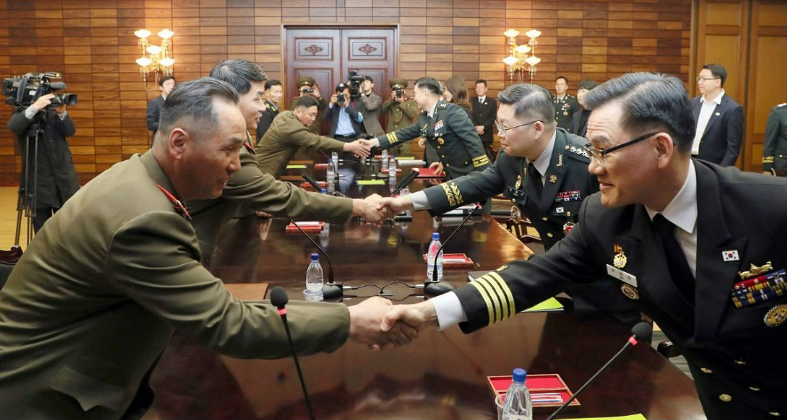
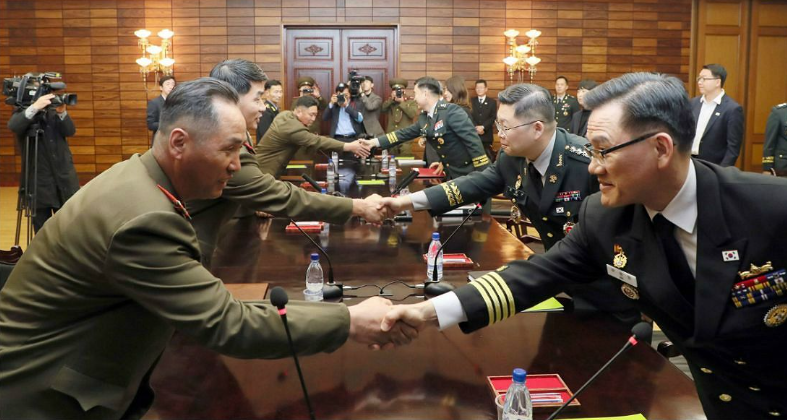
Military delegations from North and South Korea exchanging handshakes at the conclusion of the 10th Inter-Korean Defense Minister Talks on October 26, 2018 / Photo by Joint Press Corps, Nocut News
2. From Conclusion to the Collapse of the 9.19 South-North Korea’s Military Agreement
In September 2018, during the inter-Korean summit, South and North Korea adopted a military agreement as an annex. Its primary objective was to prevent armed conflicts in all domains, including land, sea, and air, by halting all hostile activities. Immediately after its adoption, there was progress in various areas, including the demilitarization of the Panmunjom Joint Security Area (JSA), collaborative excavation projects in the demilitarized zone (DMZ), and the withdrawal of Guard Posts (GP) from the DMZ. However, North Korea started violating the 9.19 South-North Korea’s Military Agreement in November 2019 with coastal artillery firing in the Inter-Korean Maritime Buffer Zone near Changrin Island in the West Sea. In June 2020, they targeted a South Korean GP in the DMZ along the central front, and in 2022, simultaneous firing occurred in the Inter-Korean Maritime Buffer Zone in the East and West Seas. By December of the same year, North Korea completely disregarded the agreement's ban on aerial hostilities by deploying small unmanned aerial vehicles over northern Seoul and the Ganghwa area of Gyeonggi Province. According to the Republic of Korea Joint Chiefs of Staff, these violations had accumulated to approximately 3,600 by January 2024.
In November 2023, the South Korean government issued an ultimatum: if North Korea proceeded with its third Reconnaissance satellite test launch, parts of the 9.19 South-North Korea’s Military Agreement would be suspended. After North Korea's test launch, some aspects of the agreement were indeed suspended. Then, in early 2024, as North Korea conducted coastal artillery firing over three consecutive days, the South Korean military declared on January 8th that 'the cessation of hostilities area no longer exists,' resulting in the complete withdrawal of the 9.19 South-North Korea’s Military Agreement.
3. Assessing the 9.19 South-North Korea’s Military Agreement and Future of Inter-Korean Relations
Opinions on the effectiveness of the 9.19 South-North Korea’s Military Agreement vary. Some argue it reduced military tensions, while others feel it lost impact as North Korea neglected it while South Korea adhered. These perspectives gain significance considering political regime changes in the South. Initially, from its adoption until 2020, conventional provocations significantly decreased, with strong South Korean commitment. However, after the 2022 regime change, a tougher policy emerged in response to ongoing provocations, accompanied by increased conventional provocations and enhanced missile capabilities.
When assessing the implementation of the 9.19 South-North Korea’s Military Agreement, it's evident that North Korea violated it more than 3,600 times, except for a few instances right after its adoption. With the recent abrogation of the agreement, it appears that North Korea used it as a smokescreen to reduce conventional provocations while bolstering its nuclear and missile capabilities. North Korea's complete withdrawal from the agreement in November 2023 might be linked to its belief that it had already achieved its military enhancement goals to a certain extent, rendering mere verbal compliance meaningless.
What does the future hold for inter-Korean relations? At the end of 2023, North Korea, as a result of 9th Plenary Meeting of the 8th Central Committee of the WPK, redefined the relationship as no longer fraternal but hostile, between two belligerent states. They emphasized the subjugation of the entire territory of South Korea through all means, including nuclear forces, hinting at the possibility of strong military actions, including missile tests and intense conventional provocations. Furthermore, it's probable that North Korea is formulating a strategy for provocations aimed at influencing this year's South Korean general elections and the US presidential election, attempting to change the situation and gain a negotiating advantage. Therefore, considering these developments and South Korea's firm response, a strategy to deter further North Korean provocations seems necessary.
-
PREV [NK Focus]
-
NEXT [SAND Feature Article]