

A Glimpse into North Korea-Russia Arms Dealings through a UN Report
- Potential for New Sanctions on North Korea and North Korea’s Strategic Intentions -

Lee Seung-hyun
Ph.D. in Public Administration,
Research Associate at SAND Institute
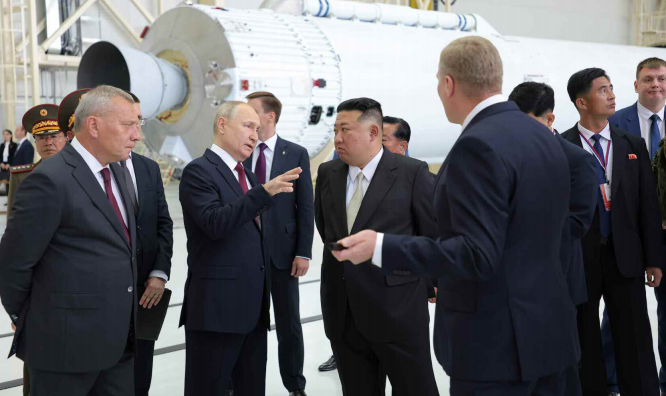
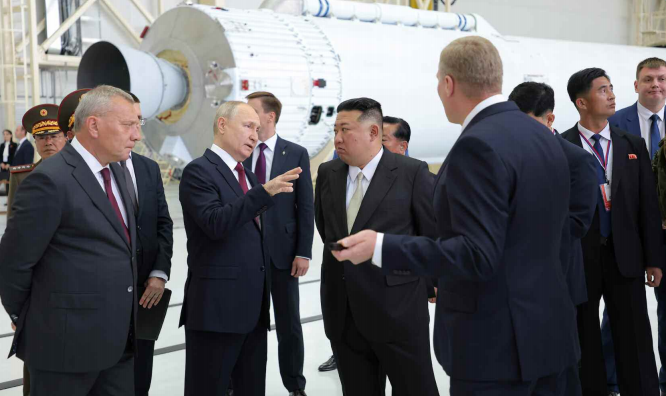
North Korean leader Kim Jong-un, during his visit to Russia on September 13, 2023, observing the Vostochny Cosmodrome alongside Russian President Vladimir Putin / Photo by Rodong Sinmun
On January 22nd (local time), the Guardian Media Group disclosed that the British government had submitted a detailed account of arms trade between North Korea and Russia to the United Nations last year. This dossier, forwarded by the UK's Ministry of Defence to a UN expert panel, aimed to kickstart a formal inquiry into the dealings, featuring undisclosed satellite imagery of Russian vessels transporting cargo at North Korea's Rajin Port, as per the Guardian Media Group's report.
The continuous revelations of arms supply from North Korea to Russia, although not entirely surprising—considering Kim Jong-un's visit to Russia reportedly involved discussions on conventional weapons and space technology—carry significant consequences. Particularly, the finding of debris, believed to be North Korean, in missiles launched by Russia during the Ukraine-Russia conflict this January, underscores the compelling evidence of the North Korea-Russia arms trade. However, the importance of the UK's submission to the UN goes beyond simple documentation.
The UK's submission of the report, as a significant player both as a permanent member of the United Nations Security Council and a NATO member, carries considerable international weight. With the UK actively opposing Russia in the Ukraine conflict and Russia engaging in strategic yet cautious cooperation with China, another communist ally, this action places significant political pressure on Russia.
The report's underlying intent is crucial. The UK's goal in presenting this document to the UN is to trigger an investigation into the arms trade dynamics between North Korea and Russia. While satellite snapshots alone don't conclusively prove the cargo's nature, coupled with evidence of North Korean missiles used by Russia in Ukraine, it sets the stage for a UN probe that could highlight Russia's contravention of UN mandates.
This action is poised to amplify global criticism of the North Korea-Russia arms trade, particularly among other permanent UN Security Council members like the US and France, potentially placing Russia in violation of resolutions it once endorsed. Thus, the UK anticipates that highlighting military collaboration between North Korea and Russia could prompt new sanctions and global pressure, possibly accelerating the end of the Ukraine-Russia war and mitigating North Korea's threat internationally. This report could serve as a catalyst for heightened global scrutiny and a unified stance against both Russia and North Korea.
What implications does this UN report hold for us? We can anticipate two main consequences: firstly, the increased isolation of North Korea. Despite the regime's endurance through challenges like the Arduous March, UN sanctions, the COVID-19 pandemic, and domestic difficulties, North Korea's economic woes continue to be a pressing issue, as reflected in the discussions of the 10th Session of the 14th Supreme People's Assembly of the DPRK on January 15th.
North Korea understands that addressing its economic challenges is difficult when isolated from the international community due to sanctions and pandemic lockdown measures. As a result, North Korea is focusing on bolstering its alliances with Russia and China to secure economic support and engage in trade post-pandemic, including arms dealings with Russia. Consequently, the international community's scrutiny and reactions to the arms trade between North Korea and Russia, sparked by the UK's report to the UN, are likely to place significant constraints on the relationship between the two nations.
Moreover, it places China under scrutiny, potentially facing restrictions for sanction violations and illicit dealings with North Korea. Consequently, North Korea risks facing accelerated international isolation and stricter UN sanctions.
The report's second impact on the Korean Peninsula lies in highlighting North Korea's potential for provocation. Some argue that UN sanctions and isolation might inevitably push North Korea towards aggressive actions, a theory gaining traction due to its recent hardline stance against South Korea.
Particularly from the perspective emphasized by the US, a detailed examination of the 8th Central Committee's 9th plenary meeting held at the end of last year and subsequent speeches by Kim Jong-un indicates that North Korea is cautious about engaging in a full-scale war or conflict. This analysis suggests that North Korea's military maneuvers require a pretext for justification, leaning on the significant military deterrence posed by the US-ROK alliance. Essentially, even North Korea, equipped with nuclear capabilities, recognizes that it cannot directly challenge the world's leading military power, the US, along with South Korea, ranked fifth, at the same time. As a result, North Korea is more likely to resort to provocations on a smaller scale, such as localized skirmishes or cyber warfare, which pose a challenge for the US-ROK alliance to address promptly.
North Korea's extensive arms trade with Russia hints it's not preparing for full-scale war. Typically, a country gearing up for major conflict or aggressive provocations would accumulate, rather than export a large arsenal. North Korea's choice to supply Russia with weapons suggests a strategic stance that prioritizes international trade over immediate military escalation.
So, what's North Korea's calculus? The nation is testing the effectiveness of its weapons in the Ukraine-Russia conflict and simultaneously escalating tensions on the Korean Peninsula with threats. By proving its weapons' capabilities in actual combat, North Korea aims to enhance their marketability for future exports, creating a vital source of income. This approach is about more than just flexing military muscle; it's a calculated move to assert regional influence and bolster arms sales as a means to mitigate its economic challenges.
The ongoing conflicts in Ukraine-Russia and Israel-Hamas represent substantial threats to global economy and stability, with the potential to escalate into broader wars. The international community, therefore, is keen on mitigating these situations promptly for collective benefit. We too must counter North Korea's provocations and threats, seeking new alliances and leveraging South Korea to sustain its regime. Consequently, the UK's UN report could emerge as a pivotal tool in tightening the noose around the North Korean regime, marking a potential turning point in inter-Korean relations. Although it seems unlikely that North Korea is planning for war, the saying "A trapped rat will bite the cat" reminds us of the potential for desperate actions. Therefore, strengthening our security stance and coordinating with international responses to this UN report is crucial, ensuring we meet our obligations to the global community.