

Delving into the Shifts in National Discourse and Identity on the Korean Peninsula: A Tale of “Open” Nationalism and “Closed” Nationalism
Jeon Gyeong-ju
Former Employee of the North Korean Trade Office
The division between South and North Korea has spanned over seven decades but the shared ethnic heritage of the Korean people is an undeniable link between the two nations. At the 9th Plenary Meeting of the 8th Central Committee of the WPK in late December 2023, Kim Jong-un stated, "Discussing unification with South Korea, which I would call a puppet of the United States, simply because of our shared ethnicity and peninsula, is inappropriate," and he further clarified, "The relationship between North and South Korea is not based on ethnicity but is a hostile one between two warring nations."
This bold stance redefines North Korea's view of South Korea not merely as an estranged sibling but as an entirely distinct entity. The concept of shared ethnicity, which has undergone various interpretations over the years, now faces a stark denial from the North, challenging the long-held notion of a singular Korean identity.
Historically, both Koreas promoted ethnocentric narratives, each emphasizing a unified ethnicity to garner absolute loyalty. South Korea, under its authoritarian regime, focused on nationalist ideologies and research to boost national security and ethnic unity.
Since the 1990s, South Korea has shifted towards democratization and multiculturalism, integrating immigrants, foreign workers, and multicultural families into its national narrative with respect and harmony. This shift highlights diversity, human rights, peace, and fairness, marking a significant evolution in South Korea's approach to nationality, blending democracy, economic growth, and cultural inclusivity.
Since its inception in 1948, North Korea has fostered a narrative of nationality focused on independence and nationalism, with the Workers' Party of Korea (WPK) at its core. This narrative, rooted in the WPK's ideologies and theories, has highlighted national unity and self-reliance, increasingly centering on the cult of Kim Il-sung. Over time, North Korea's national discourse has evolved to incorporate principles like “Kim Il-sung-Kim Jong-ilism” and the Juche idea, crafting a distinctive socialist framework. This framework underscores the nation's autonomy and sovereignty, reinforcing the supreme leadership's legitimacy within its ideological and social fabric.
North Korea, which previously emphasized strategies for unification aiming at the withdrawal of the United States Forces Korea, highlighted the "Kim Jong-il patriotism" after Kim Jong-il's death in 2011. A new discourse, "Our State First," emerged in 2018.
North Korea's strategy appears to be introducing a new theory to tackle internal challenges and lessen global criticism, aiming to strengthen unity and ease international scrutiny.
The symbolism of North Korean nationality has evolved over time, shaped by various influences. Starting in 1948 with the adoption of its national name, flag, and capital, North Korea has added more symbols across the leaderships of Kim Il-sung, Kim Jong-il, and Kim Jong-un.
In the late 1980s, North Korea intensified its focus on national symbols amid global isolation following Eastern European socialism's collapse. This period saw a surge in nationalism and patriotism to rally both South Koreans and expatriates, aiming to garner economic support.
Under Kim Jong-un's leadership, North Korea significantly amplified its use of national symbols to bolster unity and patriotism. Notably, the pine tree was declared the national tree in 2015 for its symbolism of strength, the Pungsan dog as the national dog in 2014 for courage, and the Goshawk was selected as the national bird, replacing the magpie chosen in 2008. These symbols are part of a broader effort to strengthen national identity, patriotic sentiment, and support for the regime.
Beyond these national symbols, the reverence for supreme leadership takes precedence in North Korea, marked by the creation of national commemorative days. For instance, Kim Jong-il inaugurated the "Day of the Sun" in honor of Kim Il-sung's birthday and adopted the "Juche" calendar starting from Kim Il-sung's birth year, 1912. Following his father, Kim Jong-un introduced the “Day of the Shining Star” to commemorate Kim Jong-il.
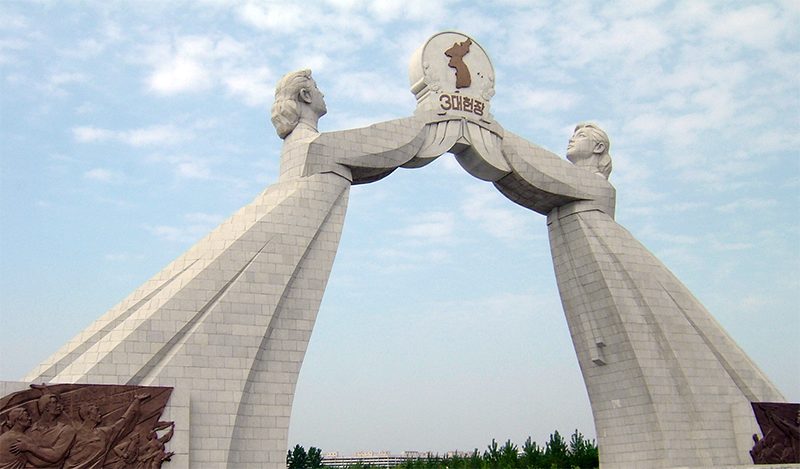
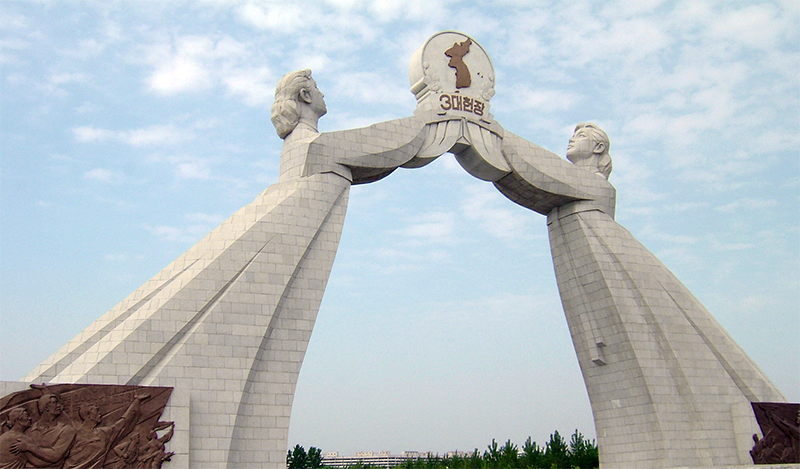
This is evident in the titles as well, with North Korea using titles for their supreme leader such as 'Suryong', 'General', and 'Our Great Leader', enforcing loyalty and worship. Symbols of monumental art like the Mansu Hill Grand Monument, badges, the Juche Tower, the Arch of Triumph, as well as movies, photographs, portraits, stamps, architectural symbols, institutional symbols (such as Kim Il-sung University), and national flowers (Kim Il-sung flower, Kim Jong-il flower) also function as mediums to foster loyalty towards the Kim family.
State pledges, monuments, military parades, festivals, and various official meetings strengthen the sense of nationality and deepen loyalty to the supreme leadership, embedding these feelings deeply within the populace. Such practices, regularly integrated into daily life, foster a natural acceptance among citizens. Devotion to the supreme leadership is further highlighted by visits to the Kumsusan Palace of the Sun. The 'Kim Il-sung Kim Jong-il Fund Committee,' established in 2012 to fund the Kumsusan Palace, effectively requires contributions from both domestic and international supporters. Failing to contribute result in being marked as disloyal, compelling individuals to participate.
Recently, in line with Kim Jong-un's reclassification of North and South Korea as two distinct countries, North Korea's Korean Central Television updated its map graphics on January 17, 2024. The new graphics highlight only the North in red, moving away from the previous practice of marking the entire Korean Peninsula in blue to signify a shared ethnicity. This change underscores a shift in the symbolic representation of North Korea's national identity, reflecting changes in policy and perspective as dictated by the current leadership and circumstances.
National discourse and symbolism embody a country's identity, promoting unity and pride internally while representing the nation externally. The narratives and symbols of Korean nationality, shaped by culture and tradition, have evolved significantly due to the division. South Korea embraces "open nationalism," reflecting its achievements in democracy and economic development. In contrast, North Korea's "closed nationalism" fosters loyalty to the Kim family, stemming from its economic struggles and authoritarian regime.
With North-South relations at a low point, North Korea now views South Korea as an enemy, ramping up its citizens' hostility towards the South. This strategy aims to prevent North Koreans' growing admiration for the South, exacerbated by the Korean Wave, by limiting exposure and interaction. Despite these measures, it's unlikely that the deep-seated admiration for South Korea among North Koreans will diminish.
-
PREV [SAND Feature Article]
-
NEXT [SAND Feature Article]