

Is Kim Jong-un Really Planning a War?
Directives for North Korea's Chief of the General Staff
North Korea's Leader, Kim Jong-un, recently labeled South Korea as the 'primary enemy,' escalating aggressive rhetoric with mentions of 'territorial occupation' and 'pacification.' Openly disputing the Northern Limit Line (NLL) on the Korean Peninsula, North Korea has conducted test launches of advanced weaponry like hypersonic and long-range cruise missiles, increasing tensions. Internally, North Korea prioritizes its ‘20×10 regional development policy’, heavily mobilizing the Korean People's Army (KPA). Speculation about potential conflict on the Korean Peninsula is widespread, drawing attention to North Korea's probable provocative actions.
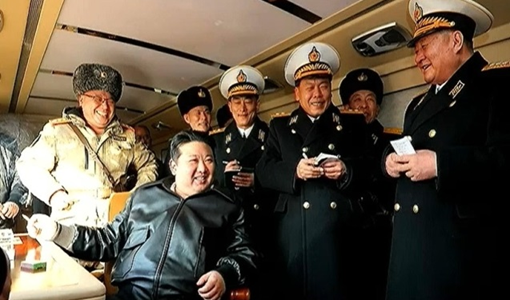
Kim Jong-un overseeing the inspection firing test of the new naval surface-to-surface missile 'Padasuri-6' on the 14th, reiterating his determination to challenge the NLL as a fictitious demarcation line / Photo by Korean Central Television
During his congratulatory visit to the Ministry of National Defense on the occasion of the Korean People's Army Foundation Day on the 8th, Kim Jong-un emphasized designating South Korea as the ‘hostile country' and the ‘primary enemy,' with plans to occupy and pacify their territory in similar situations.
Previously, Kim Jong-un removed the Three-Point Charter for National Reunification –Independence, peaceful reunification and great national unity – from the constitution. He initiated the formation of organizations responsible for civilian exchanges between North and South Korea, while labeling South Korea as the 'number one hostile country' and a 'belligerent state at war.' Additionally, he instructed preparations for major territorial pacification, including the potential use of nuclear weapons.
Furthermore, North Korea has raised the issue of the Northern Limit Line (NLL), a contentious point in the Korean Peninsula. Kim Jong-un, speaking at the Supreme People's Assembly on the 15th of last month, declared the NLL as illegal and unacceptable. He reiterated his resolve to address the NLL militarily while overseeing the inspection firing test of the new naval surface-to-surface missile 'Padasuri-6' on the 14th of this month. Kim emphasized the need to safeguard maritime sovereignty through action, not just words.
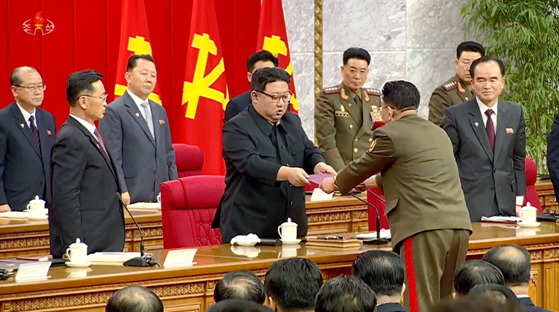
At the 19th Enlarged Meeting of the Political Bureau of the 8th Central Committee of the WPK, held from January 23 to 24, Kim Jong-un provided directives to Ri Yong-gil, Chief of the General Staff, regarding the deployment of the KPA for local construction / Photo by Korean Central Television
With North Korea's recent shift towards threats of a nature different from the armistice and continued missile test provocations, discussions of war on the Korean Peninsula have emerged both domestically and internationally. Consequently, there is growing interest in the actual possibility of North Korea's war provocations. To examine the possibility of North Korea's war provocations, it is important to first understand its domestic policies. A nation's foreign policy is inherently linked to its domestic politics and economy, especially in autocratic states like North Korea. Considering that changes in a country's foreign policy are influenced by the development of its domestic politics and economy, it is necessary to examine the political situation within North Korea.
Recent North Korean domestic policy notably includes the public promotion of Kim Jong-un's daughter, Kim Ju-ae, as part of a push for fourth-generation succession. However, discontent among citizens regarding Kim Jong-un's intentions for succession is spreading. Amid economic hardships, there is a growing wealth gap favoring the regime and elites. Dissatisfaction has also been voiced regarding the inclusion of a 10-year-old daughter in the succession plans.
According to the Ministry of Unification, North Korean authorities have recently enacted laws like the Reactionary Ideology and Culture Rejection Law and the Youth Education Guarantee Law to bolster ideological control and maintain internal cohesion. However, these efforts have not halted changes in the perceptions of young people, posing a threat to the security of the Kim Jong-un regime. Observations suggest that North Korea may have adopted a hardline foreign policy to address internal crises and deflect domestic discontent.
While North Korea, armed with enhanced nuclear missile capabilities, may continue provocations, doubts persist about its readiness for full-scale confrontation. Similar to detecting Russian military movements before the Ukraine invasion, reconnaissance assets from the United States, South Korea, and Japan could spot signs of North Korean military preparations. Reports suggest no unusual signs detected by US and South Korean intelligence agencies, crucial for troop mobilization and stockpiling, indicating a low likelihood of imminent large-scale conflict.
In preparation for a full-scale confrontation, stockpiling ammunition and shells is essential, yet North Korea's recent actions suggest otherwise. Reports indicate North Korea has exported over 5,000 containers, including more than 2.3 million rounds of 152mm artillery shells and new missiles like the KN-23, to Russia. Kim Jong-un's consecutive visits to major military factories to encourage weapon production raise questions. Critics argue that if North Korea were gearing up for a full-scale confrontation on the Korean Peninsula, it wouldn't be exporting large quantities of shells.
A notable aspect of North Korea's domestic agenda is the prioritization of policies other than war preparation. This year's main focus is on implementing the ‘20×10 regional development policy’. Kim issued directives to mobilize Korean People's Army (KPA) units for local industry development at the 19th Enlarged Meeting of the Political Bureau of the 8th Central Committee of the WPK held from the 23rd to the 24th of last month. Kim Jong-un handed directives to Ri Yong-gil, Chief of the General Staff of the North Korean Army.
According to Daily NK, the General Staff Department of the KPA has issued orders to deploy engineering units from the army, navy, and air force to construction sites for local factories.
While external rhetoric heightens war tensions, internally, the country is dedicated to implementing the 20×10 regional development policy. This strategy aims to construct modern local industrial facilities in 20 cities and counties nationwide each year, with the goal of enhancing living standards within 10 years. It's perceived as a move to secure a stable succession position for Kim Ju-ae, who will be in her twenties in a decade, by modernizing approximately 200 North Korean localities.
It seems that North Korea prioritizes the 20×10 regional development policy over inter-Korean exchanges and external openness, fostering local development within a closed system by antagonizing relations with South Korea. This approach aims to cultivate a 'pure' younger generation resistant to external influences, consolidating Kim Ju-ae's succession plan, while analysts suggest that Kim Jong-un's warlike atmosphere serves internal ideological control.
However, even if North Korea avoids a full-scale war, the likelihood of localized provocations, such as shelling of Yeonpyeong Island, missile test launches (including Intercontinental Ballistic Missiles and Submarine-Launched Ballistic Missiles), and a 7th nuclear test, remains high. Concerns arise from Kim Jong-un's repeated mention this year of nullifying the NLL, which could lead to low to medium intensity provocations, like shelling near the NLL or unmanned aerial vehicle infiltration into South Korean territory.