

Serious Radiation Contamination and Harm from Nuclear
Tests at Punggye-ri: Chromosomal Abnormalities Detected
in 17 North Korean Defectors
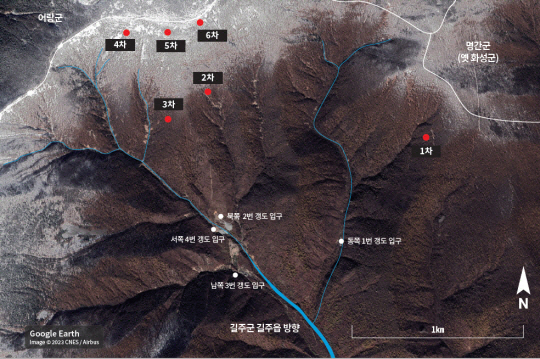
A study conducted on 80 North Korean defectors originating from the area surrounding the Punggye-ri Nuclear Test Site, located in Kilju County, North Hamgyong Province, has revealed alarming signs of chromosomal abnormalities in 17 individuals. Despite challenges in directly linking these abnormalities to the nuclear tests, the Korea Atomic Energy Research Institute (KAERI), which carried out the examinations, suggests the findings are significant. This represents 21.25% of the participants, indicating a substantial prevalence of abnormalities and highlights the potential for radiation exposure, as evidenced by abnormalities in more than 7 out of 1000 cells tested. The Punggye-ri region, known for six underground nuclear tests conducted by North Korea from 2006 to 2017, has experienced numerous tremors, raising concerns about radioactive contamination of groundwater.
<Confluence point of surface water near the North Korean Punggye-ri Nuclear Test Site / Photo by the Transitional Justice Working Group (TJWG)>
The Korea Institute of Radiological & Medical Sciences reported the results of radiation exposure and radioactive contamination tests conducted from May to November of the previous year on 80 North Korean defectors who had lived in eight municipalities near the Punggye-ri site. These tests were commissioned by the Ministry of Unification.
The examination revealed that 17 of the 80 participants showed signs of radiation exposure. Notably, the "stable chromosome abnormality (translocation analysis)" test, which measures cumulative radiation doses, identified abnormalities exceeding the minimum detectable limit of 0.25 Gy. Among those with confirmed abnormalities, five hailed from Kilju County, with one individual having defected after the sixth nuclear test.
Individuals who agreed to share their radiation exposure data revealed doses between 0.279 Gy and 0.684 Gy, indicating significant exposure. This level corresponds to detecting over seven chromosomal abnormalities per 1000 cells tested. Such figures starkly contrast with the Korean and international annual exposure standard of 1mSv (equivalent to 1mGy). The exposure of 0.25 Gy, roughly 250 times higher than the usual rate of 1 Gy per person, is notably high. In response to the Fukushima disaster, Japan adjusted its radiation standards upwards, highlighting the severity of exposures above 0.25 Gy, or 250mSv, marking them as critically important health risks that demand serious consideration.
A Korea Institute of Radiological & Medical Sciences representative noted that attributing chromosomal abnormalities solely to nuclear tests is challenging. Other influences like alcohol, smoking, heavy metals, and medical radiation could also affect test outcomes.
In the group of 17 people with confirmed results from the translocation analysis, two had shown normal levels in a similar test back in 2016. This suggests that factors encountered after their defection could have influenced the latest test results. Additionally, tests designed to detect residual radioactive substances in the body did not yield any significant findings.
Some critics point out that the enhancements in testing methods and outcomes for North Korean defectors in this study, when compared to those under the previous administration, are slight. Although the Ministry of Unification recognized the past issue of lacking a control group in radiation exposure studies, it appears no significant steps were taken to rectify this in the current investigation.
In February 2016, the Ministry of Unification stated that the purpose behind launching this study was to achieve more insightful outcomes than prior efforts, which were hindered by the absence of control groups, small sample sizes, and a lack of comprehensive data to pinpoint confounding factors. This research specifically aimed at examining North Korean defectors from Kilju County and surrounding regions, following North Korea's initial nuclear test.
Previous tests conducted by the Ministry of Unification on 40 North Korean defectors from Kilju County and nearby areas in 2017 and 2018 found high levels of radiation exposure in nine individuals but failed to establish a direct link to nuclear tests. The possibility was also considered that other factors, such as medical radiation, exposure to toxic substances, or aging, could explain the chromosomal abnormalities in the other 15 individuals.
Assessing the link between chromosomal abnormalities and the nuclear site's environment, particularly through water source comparisons, failed to establish causality with exposure levels.
The institute also mentioned that despite successfully treating lung and cervical cancer in two of the 17 individuals, directly linking their cancers to nuclear test exposure is uncertain, given their prior radiation tests and exposure to toxins, making such connections speculative.
The institute highlighted the challenge of not being able to obtain environmental samples, like drinking water, as a hindrance to linking radiation exposure causally. It emphasized the need for more extensive research, including gathering more subjects and promptly conducting tests upon their arrival to reduce medical radiation's impact. By expanding the scope of testing and increasing participant numbers, it's possible to gather sufficient data to establish a causal relationship statistically, despite confounding factors.
The total number of North Korean defectors from Kilju County and surrounding areas stands at 796, with only 150 having undergone radiation exposure tests to date. The Korea Institute of Radiological & Medical Sciences, the sole credible institution for such testing in South Korea, has a maximum annual capacity of 80 tests. With approximately 650 individuals still awaiting testing, completing the full examination could take over eight years. Suggestions have been made to also seek assistance from international bodies such as the International Atomic Energy Agency (IAEA) and reputable foreign institutions.
Responding to criticisms about the lack of detailed data weakening the study's goals, the Ministry of Unification emphasized the importance of considering variables such as medical radiation and age. These factors make it challenging to attribute radiation exposure solely to nuclear tests, though the ministry recognized their notable contribution to radiation exposure.
Additionally, the limited disclosure of information, such as the participants' residential areas and occupations during the nuclear tests, contrasts with the transparency of previous disclosures under the Moon Jae-in administration, leading to criticism that the full-scale examination's significance is diminished.
The government's thorough investigation into radiation exposure and groundwater contamination near Punggye-ri aimed to assess its impact on locals. However, significant information withholding has undermined the probe's value.