

The 'Dangerous Bromance' between Russia and North Korea:
Dynamics and Possibilities for Change Amidst the Ukraine Conflict
Cho Han-bum
Senior Research Fellow at the Korea Institute for National Unification (KINU)
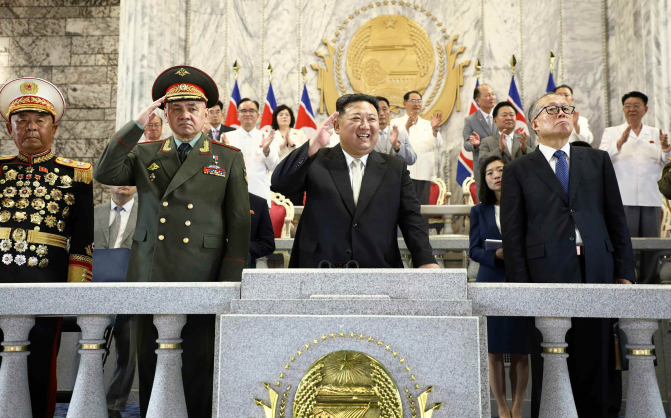
In February 2022, North Korea unequivocally supported Russia's invasion of Ukraine, leading to a rapid deepening of ties between the two nations. By July 2023, the visit of Russian Defense Minister Sergei Kuzhugetovich Shoigu to Pyongyang during North Korea's 'Day of Victory in the Great Fatherland Liberation War' significantly bolstered military cooperation.
By late March 2024, the Center for Strategic and International Studies (CSIS) estimated that North Korea had supplied Russia with military provisions equivalent to 10,000 containers and over three million rounds of ammunition during the conflict.
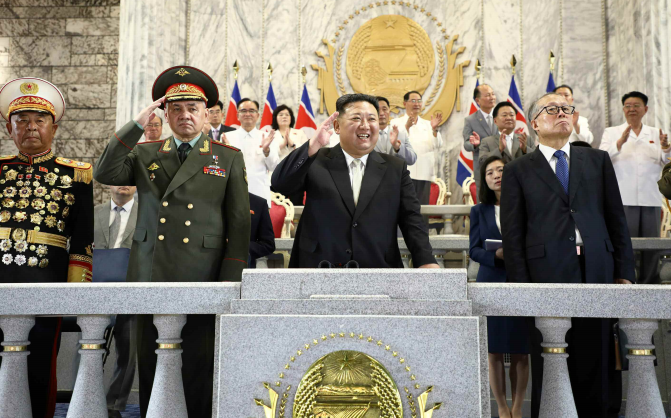
On July 27, 2023, North Korean leader Kim Jong-un hosted a banquet for Russian Defense Minister Sergei Kuzhugetovich Shoigu and his delegation, who were visiting to celebrate the 70th anniversary of the so-called 'Day of Victory in the Great Fatherland Liberation War,' commemorating the Armistice Agreement of the Korean War. (Image: Rodong Sinmun)
Despite a robust offensive from Ukraine in the latter half of 2023, bolstered by Western support, Russia sustained minimal damage and made notable advancements on several fronts. Widespread international sanctions notwithstanding, North Korea's logistical support has been crucial for Russia's sustained military capabilities.
Following the North Korea-Russia Summit at Russia's Vostochny Cosmodrome in September 2023, the bilateral relations have rapidly expanded across various dimensions. Post-COVID-19 border reopening, North Korea has been enhancing its foreign relations and international exchanges; however, the scope and quality of interactions between North Korea and Russia are unparalleled compared to other nations. Recent trends show an uptick in North Korea-Russia activities over those with China, North Korea's traditional ally, with vigorous exchanges and cooperation ongoing in both governmental and civilian sectors.
On March 21, 2024, a ballet performance by an art troupe from the Mariinsky Theater of Primorsky Krai took place in Pyongyang, followed by a Russian art group participating in the April Spring Friendship Art Festival on the 'Day of the Sun,' celebrating Kim Il-sung's birthday.
On April 22, 2024, the Moscow Zoo delegation arrived in Pyongyang. Russia has a history of donating numerous animals, including lions, leopards, and Himalayan blue sheep, to the Korea Central Zoo in Pyongyang.
Since reopening its borders, which were previously closed due to COVID-19, North Korea has specifically expanded tourism cooperation with Russia, permitting only group tourists from Russia to enter.
At the end of last year, officials from Primorsky Krai finalized talks with North Korea, promising broad tourism cooperation. Russian tourist groups visited North Korea in February and March 2023, and starting in June, private Russian agencies will begin offering North Korean tour packages. However, despite the friendly nature of cultural and artistic exchanges, North Korea's appeal as a tourist destination for Russians remains limited.
Officials from North Korea’s Ministry of External Economic Relations, Ministry of Education, Ministry of Public Health, and the Agricultural Committee have sequentially visited Russia. Although over 90% of North Korea's foreign trade is with China, making its economic ties with Russia relatively minimal, these visits aim to enhance economic collaboration. This effort leverages existing military cooperation. Additionally, the trip by the Chairman of the North Korean Agricultural Committee to Russia focused on addressing critical food shortages.
Particularly noteworthy is the visit of the North Korean Ministry of Education delegation, led by Kim Sung-du, which focused on discussing various areas of cooperation, especially on increasing the quota of North Korean students at Russian educational institutions.
Given the acute foreign exchange shortage, it is improbable that North Korea will increase the number of its students in Russia. Additionally, with sanctions prohibiting North Korean labor abroad, there are legitimate concerns about the misuse of student visas as a workaround.
So far, the expanded cooperation between North Korea and Russia has had minimal impact on the North Korean economy. On February 27, 2024, Defense Minister Shin Won-sik revealed that since around July to August 2023, over 9,000 containers have been shipped from Russia to North Korea.
Minister Shin noted that while the exact contents of the containers are unknown, food makes up the largest share. With Russian food aid, food prices in North Korea seem to have stabilized somewhat. However, the costs of staples like rice and corn remain high, with little change from the previous year. Despite cooperation between North Korea and Russia, prices in the local markets, known as Jangmadang, continue to rise.
Despite the swift advancement in North Korea-Russia relations, this progress remains largely confined to military sectors and has not spurred broader economic development in North Korea. Russia, a key supplier of energy, food, and fertilizers needed by North Korea and holder of advanced military technology, still faces significant limitations in its industrial capacity.
Most of Russia's exports rely on natural resources, while it primarily imports consumer goods and essentials. Russia's inadequate manufacturing capabilities present structural limitations, making it a less sustainable partner for the long-term economic development of North Korea.
The strategic significance of North Korea to Russia could shift depending on the course of the Ukraine war. If the war stabilizes or if Russia develops its own military logistics capabilities, North Korea's strategic value might diminish. North Korea has little to offer Russia beyond ammunition and labor, and lacks the financial capacity for substantial payments, making it a less attractive long-term cooperation partner.
Despite rapid progression in North Korea-Russia relations, their long-term sustainability remains uncertain, possibly reflecting one-sided affection from North Korea. In an April 27 interview on KBS 1TV's 'North-South Windows,' National Security Director Chang Ho-jin highlighted ongoing military cooperation talks and suggested that if the Ukraine-Russia war ends and conditions revert to their pre-war state, South Korea-Russia relations might also improve.